A conversation on inequality, authorship, and the instinct behind the clothes
By Kenneth Richard
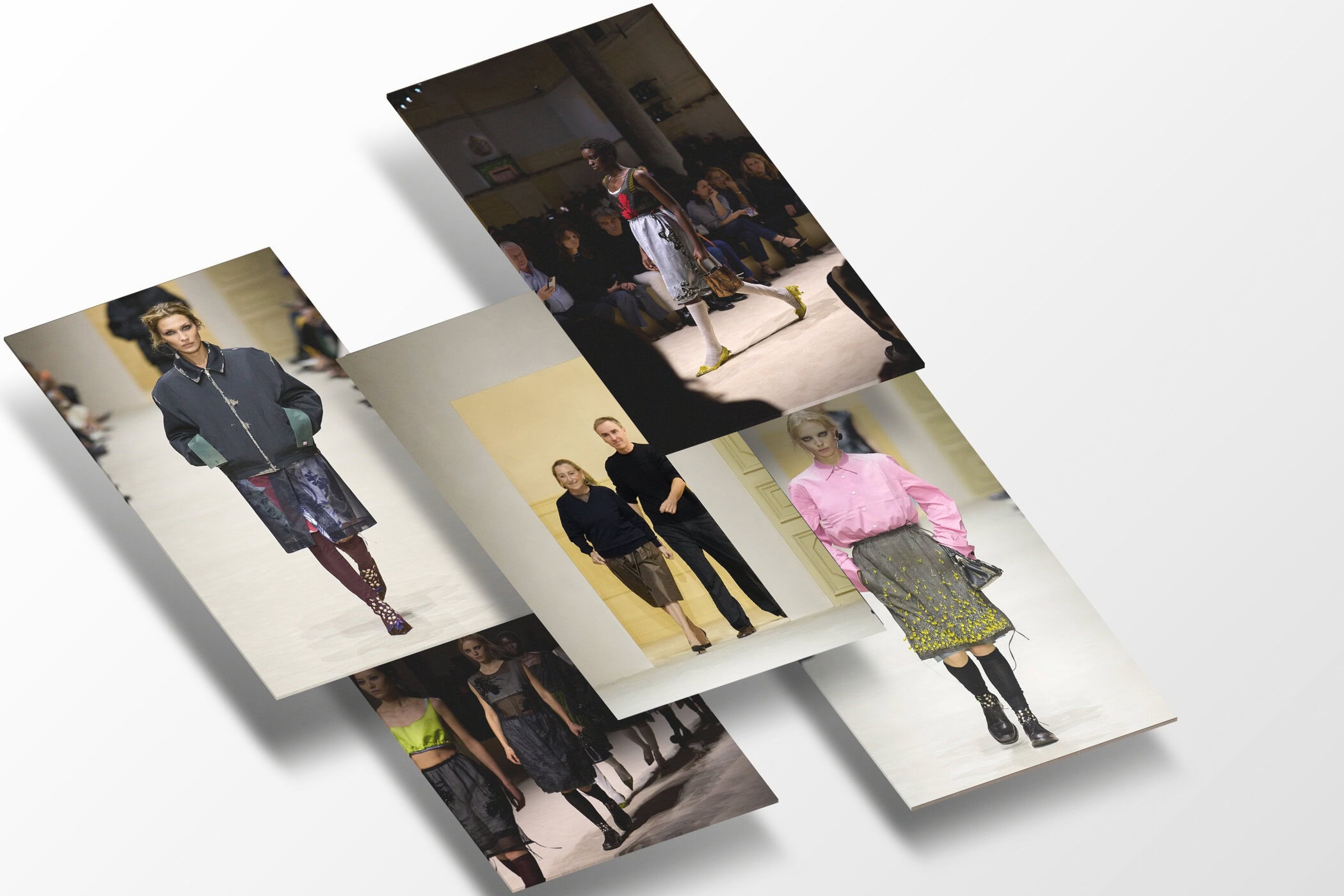
There was no spectacle of scale at Prada this season. No parade of 60 exits marching toward a declaration. Instead, there were 15 women — seen, reconsidered, recomposed. A small cast, as Raf Simons put it, allowing you “to relate in a different way… because you see them more times, and you see different ways of dressing.”
It was less about reduction than concentration.
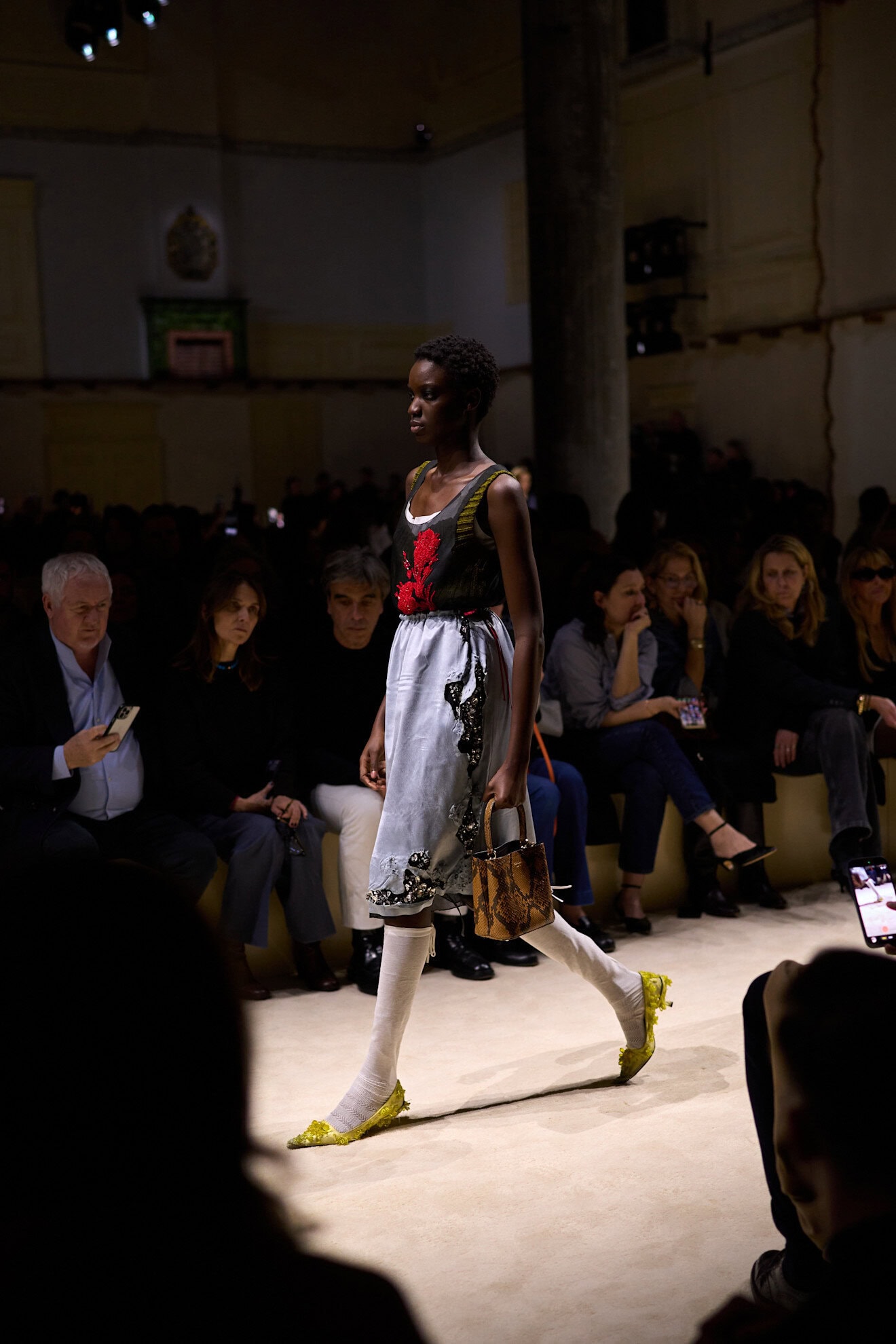
The collection unfolded as an exercise in composition. “About personalities, moments, sentiments, sexuality,” Miuccia Prada began. “And this woman lives them together in a day or in a life.” The proposition was not a character study but a layering of states — historical fragments, emotional registers, and aesthetic tensions worn simultaneously. A Grecian drape might meet a 1950s volume beneath a minimal shift. Damaged embroidery coexisted with austerity. Opulence brushed against restraint.
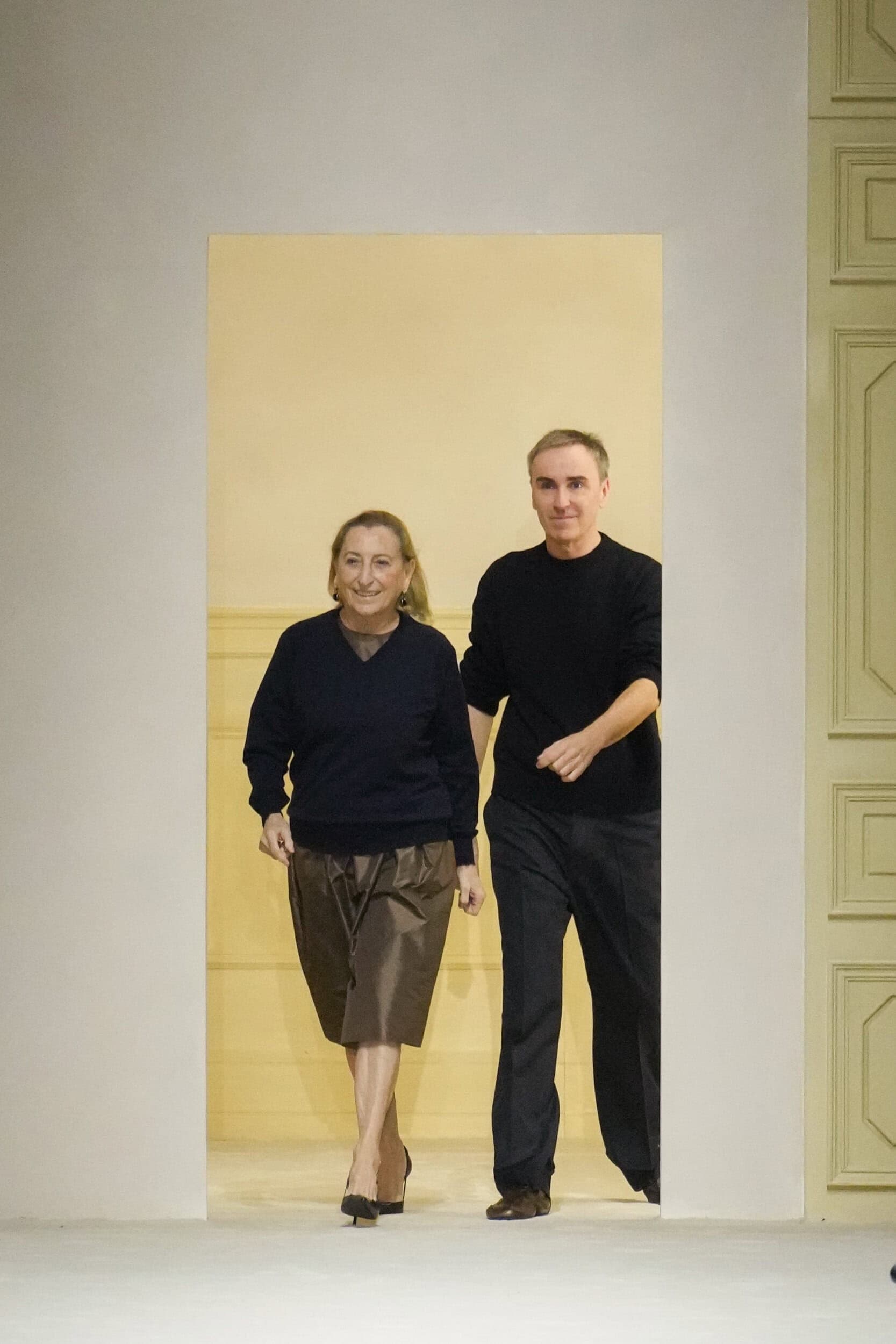
“There are fragments of history,” Prada said. “Because I am obsessed with history of the moment.” The phrasing was deliberate. History not as nostalgia, but as equipment. “If you don’t know that, you’re really lost. It’s so complex.” Knowledge, she suggested, is not decorative; it is navigational. To dress now requires awareness — of what has been, of what is being lived.
Simons echoed the refusal of hierarchy. “We don’t want to make a hierarchy between high and low,” he said, whether in fabrication or in feeling. Clothes were to appear “lived in and worn over a long time.” Even when the references stretched across centuries — Egypt, the Delta, mid-century couture — they resisted costume. A minimal dress might conceal a historical silhouette underneath; a classic man’s eyewear frame might be enlarged to improbable width. The past was captured in form language, then unsettled.
The decision to work with 15 women was both structural and emotional. Prada recalled her early shows, when Kate Moss might take five exits, “changing completely.” Back then, she noted, the runway was shorter; transformation was theatrical. Now, there was “no changing of the look,” Simons clarified. Garments were not swapped so much as rebalanced. Pieces were removed, recomposed. The continuity of the body remained.
You saw the same shoe behave differently. The same coat acquire another charge. It was styling as philosophy — how do you dress every day? “Every day, you decide,” Simons said. “How do I dress? What is possible? And then you do it in another way, and in another way.”
The dialogue between men’s and women’s codes was present but not declarative. “When you think about women again, you think about men,” Prada offered. The silhouettes shared an underlying grammar. Jackets competed on equal footing. The separation felt increasingly procedural rather than ideological. A co-ed show, she suggested half-seriously, would change the emphasis — but perhaps also diminish the specific weight of women’s lives. The thought lingered.
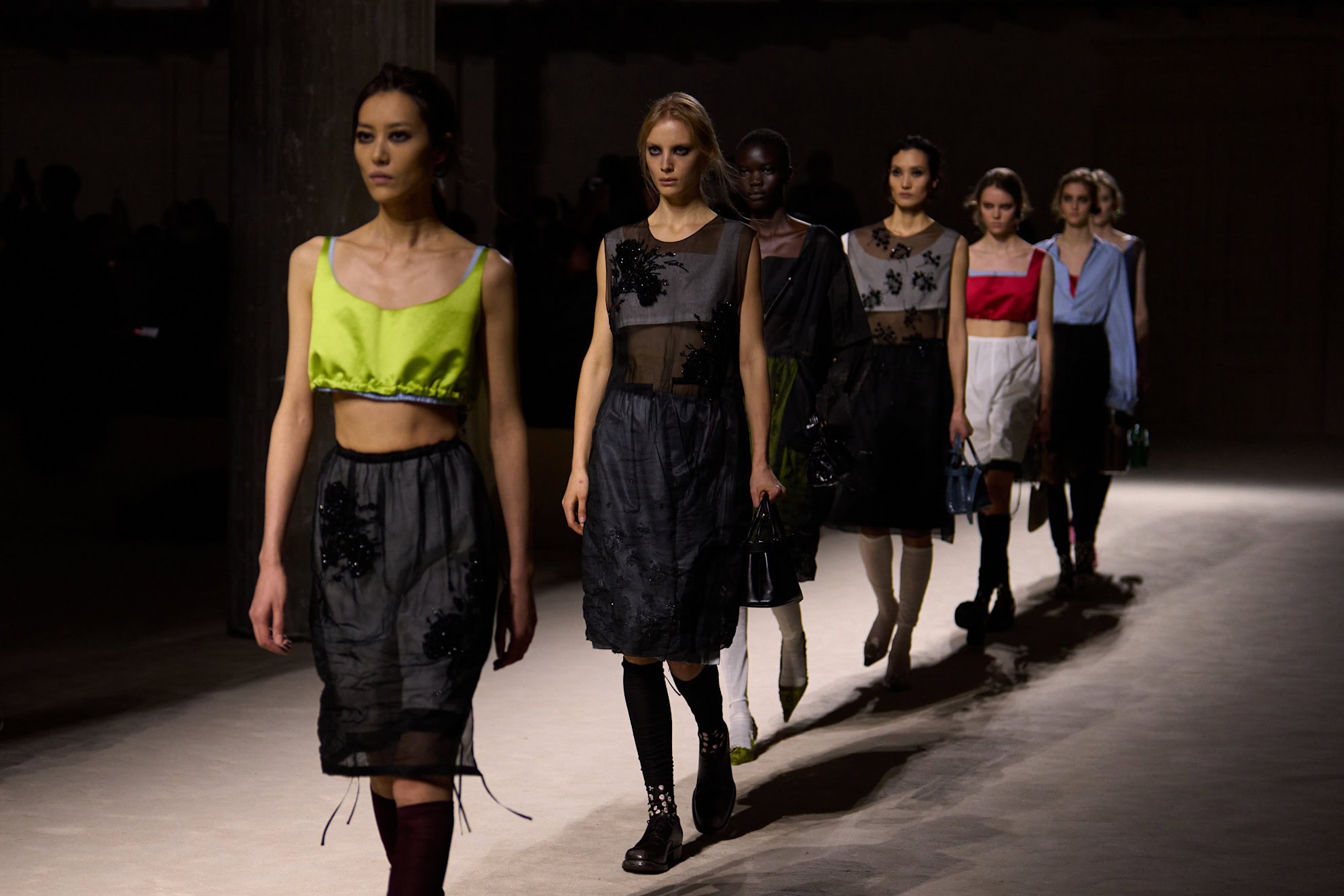
If the show felt hectic, it was by design. Simons described an interest in bringing together elements that “do not necessarily give you what you expect.” The music might contradict the space; the clothes might defy the soundtrack. Prada has long resisted the tidy narrative. “It’s not how we really work,” he said. The story is not announced; it is assembled by the viewer.
Politics, inevitably, hovered. Prada addressed it directly — and sidestepped it. “I did politics in my clothes in a different way I always did,” she said. “I never did a suit that was offending to women.” For her, the political gesture is embedded in respect: proportion, movement, agency. Yet she acknowledged the paradox of her position. “We are designing for rich people… dressing rich people.” In that context, overt political signaling risks dissonance. “I try to do everything to be political, except obvious political.”
It was a pragmatic stance, not an indifferent one. When the conversation turned to inequality — called “the biggest danger to the luxury business” — and to sustainability, Simons was blunt. The industry’s claims often veer toward hypocrisy. “To be really sustainable, you have to buy nothing,” he said. “No car, no airplane, nothing at all.” The path forward, then, is incremental: “steps towards a better way of doing everything.”
On artificial intelligence, the resistance was instinctual rather than reactionary. Designers, Simons argued, must work “from the heart, from the mind, from the feeling, from our knowledge, from our respect for history and our interest in the future.” If AI were to produce a show that truly astonished him, he would reconsider. “I’m happy to be taken by surprise.” But authorship — the intrinsic work of people — remains the point.
What lingers from Prada Fall 2026 is not a single look but a method: fewer bodies, more attention; fragments without nostalgia; instinct sharpened by history. When the show was dismantled, the clothes remained wearable. That, for Simons, was the ultimate test. There are louder ways to animate a runway. But when stripped back, “you can wear it.”
In a season tempted by amplification, Prada chose concentration — 15 women carrying centuries lightly, and dressing for the complexity of now.