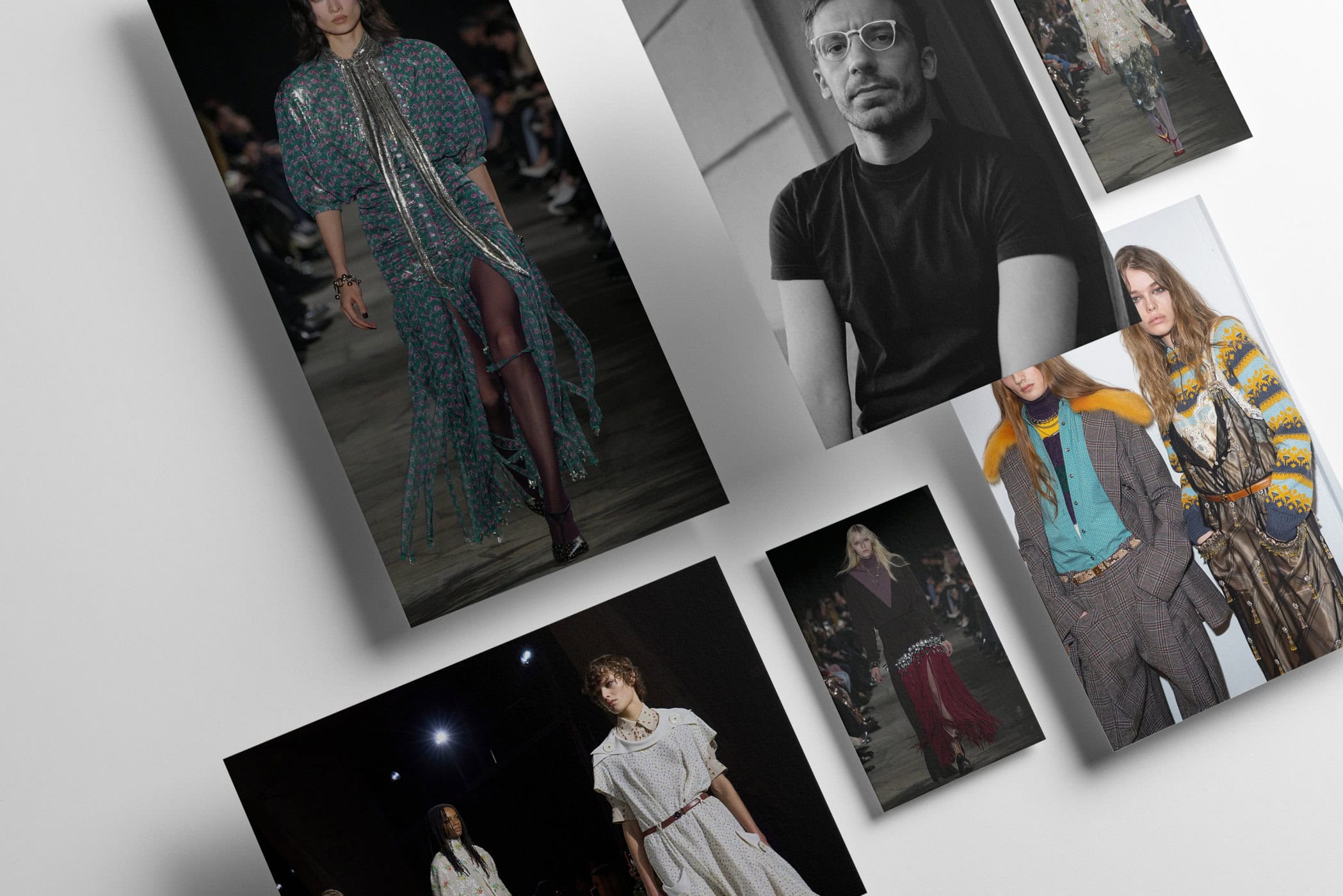
Tea dresses, post-punk spirit, and a wardrobe shaped by identity
By Kenneth Richard
Fashion often promises fantasy. Julien Dossena prefers reality—though not the polished, aspirational kind. The Rabanne creative director is more interested in the poetry that emerges from everyday lives: the quiet codes people wear to signal who they are, where they belong, and sometimes, what they resist.
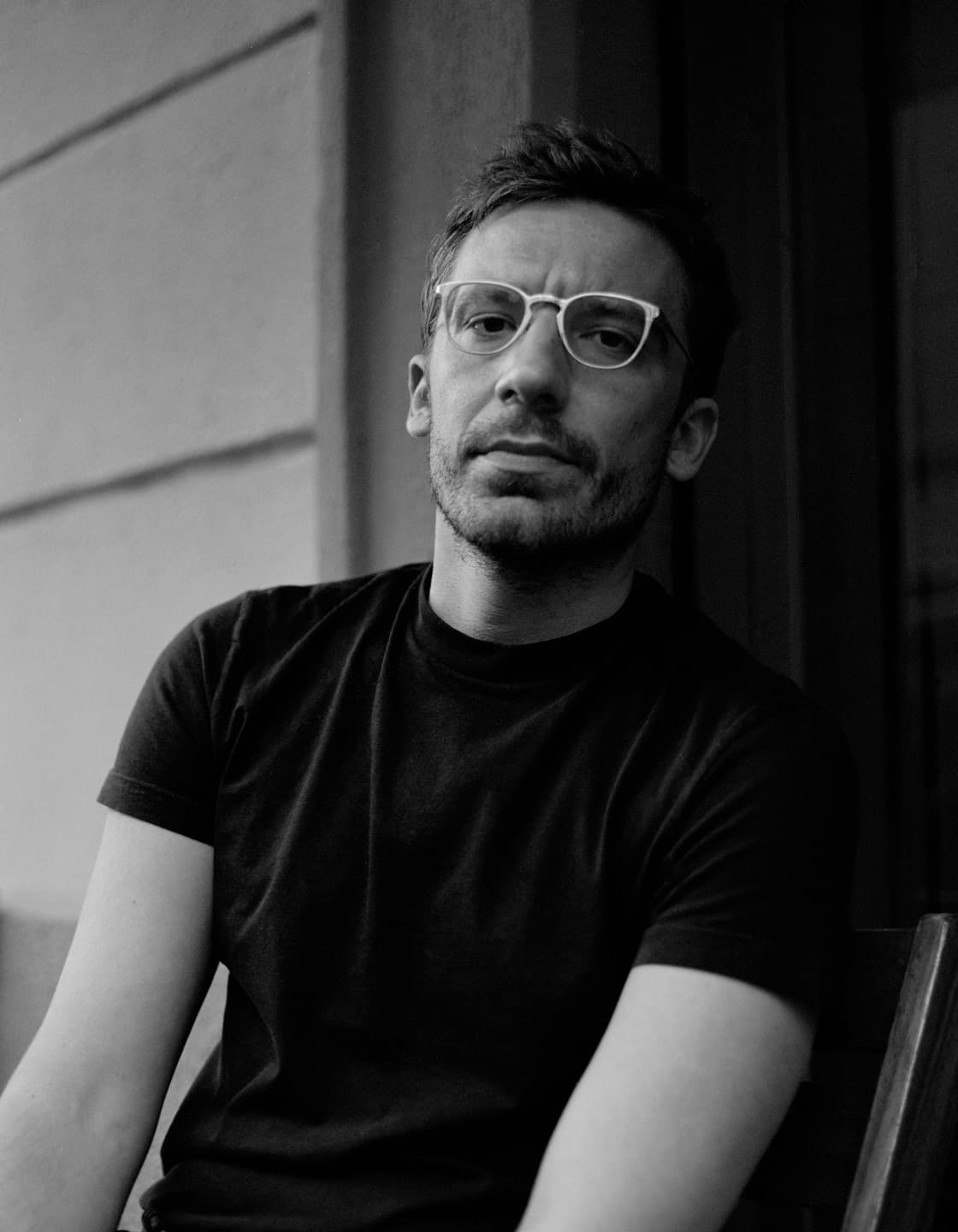
Following the Rabanne show, Dossena spoke with The Impression about the thinking behind a collection that felt less like a singular vision than a gathering of characters. “I had really much fun,” he said with a smile. “It was like playing around with incarnations.”
That sense of multiplicity defined the collection. Instead of a rigid silhouette or a tightly controlled aesthetic thesis, Dossena approached the season as a kind of wardrobe for a loose community. Each look hinted at a personality, a lifestyle, or a cultural reference point, layered together in a way that felt deliberately raw.
“I live in the 10th of Paris,” he explained, referring to the neighborhood whose mix of cultures, artists, and nightlife has long shaped the city’s contemporary energy. “I wanted to have that loose thing and that intimate thing, and actually to work on reality. Of course there is fantasy in reality—but those layers felt like they were giving identity, giving clues about the lifestyle of those characters.”
Polish was not the goal. “I didn’t want something too polished or searching for elegance,” he continued.
I wanted something super sophisticated but more raw in that sense. Accessible in a way.”
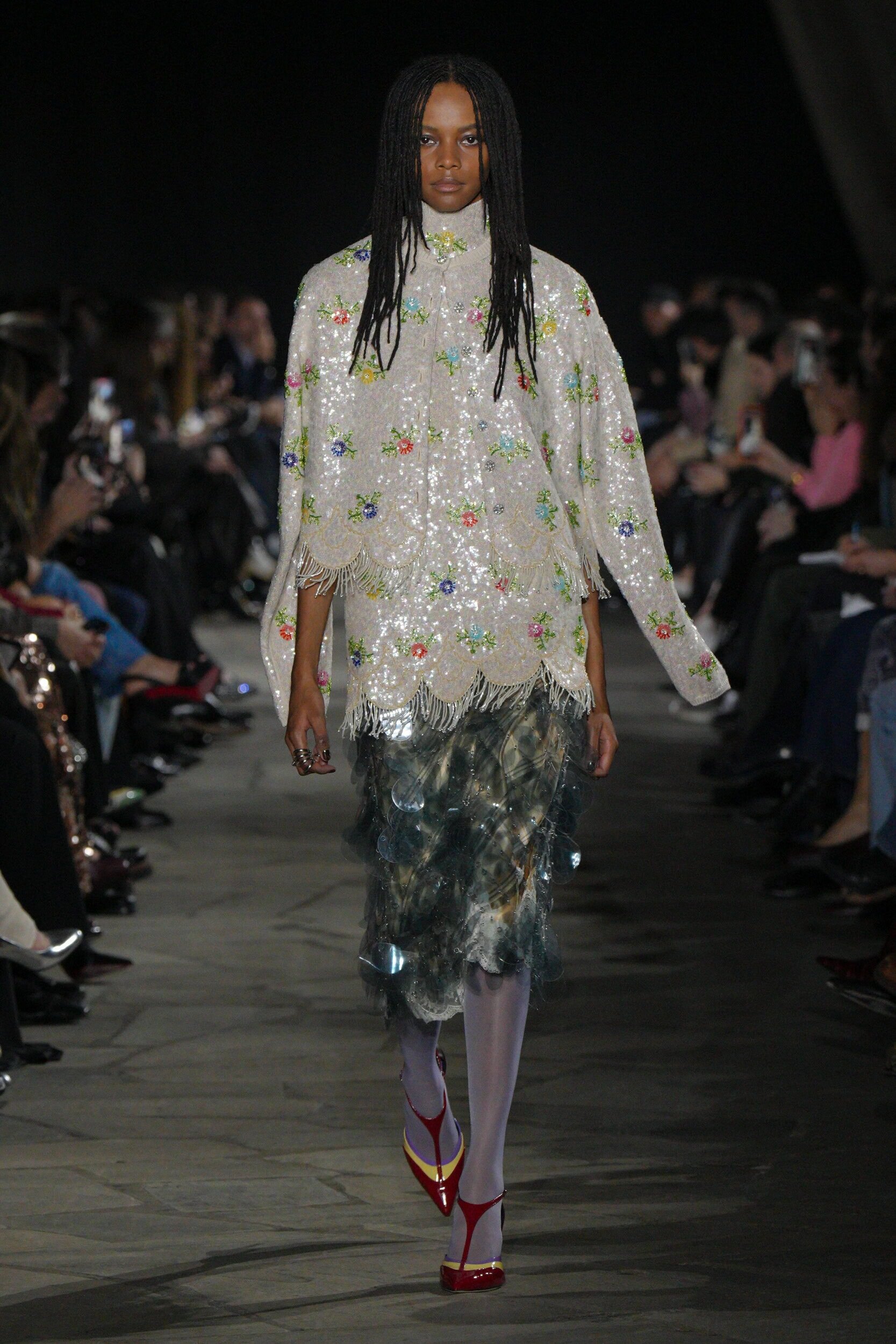
The collection’s starting point arrived unexpectedly in the form of 1940s English tea dresses—a garment both delicate and pragmatic, worn during a time defined by uncertainty. Dossena became fascinated by the way women dressed during that period, pairing the soft femininity of the tea dress with utilitarian or masculine layers.
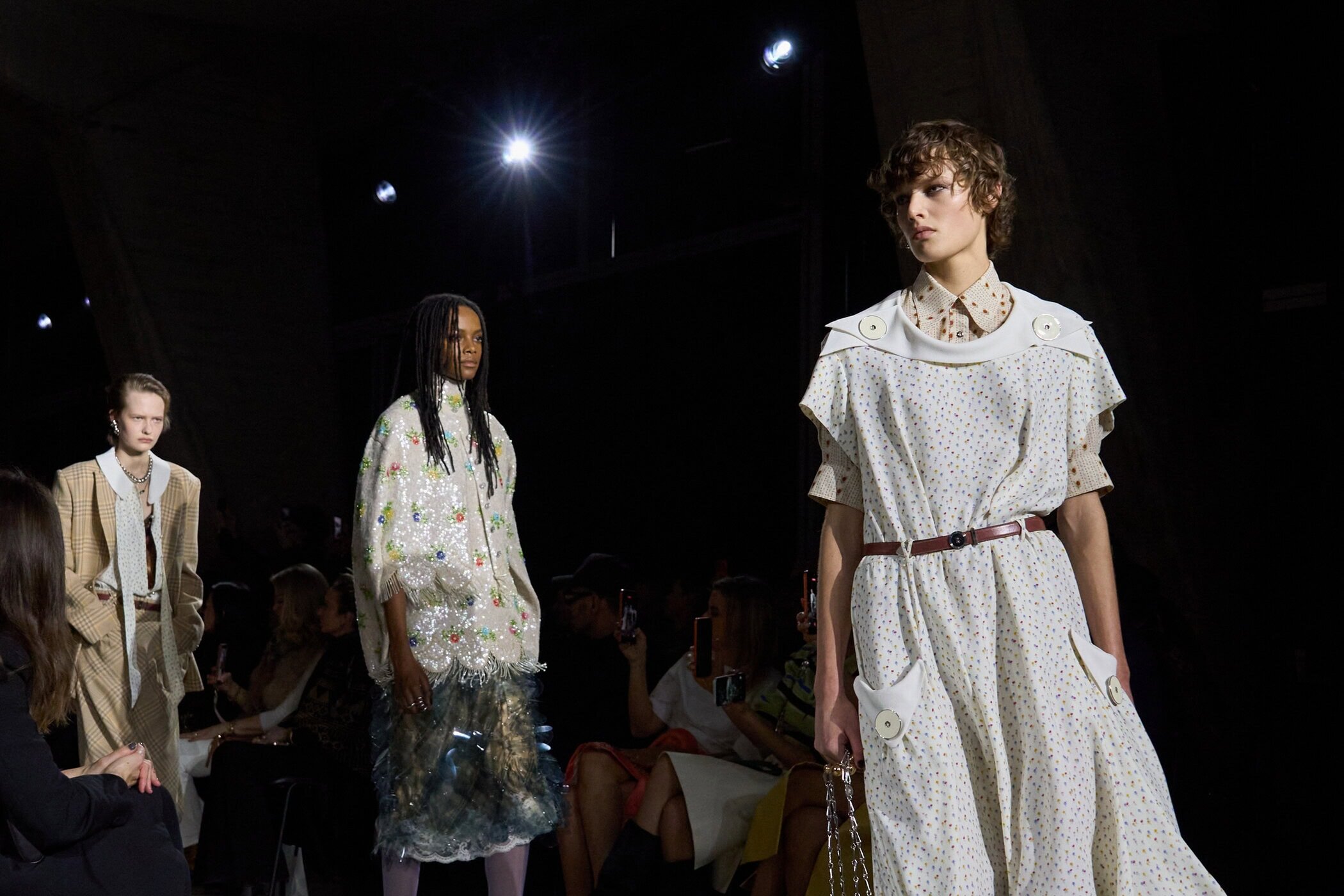
“I fell in love with a lot of tea dresses from the ’40s,” he said. “It was a terrible, tough moment in history, but women were pairing them with cardigans, jumpers, aviator jackets—masculine things. There is something proletarian about it too, because it was almost like a uniform.”
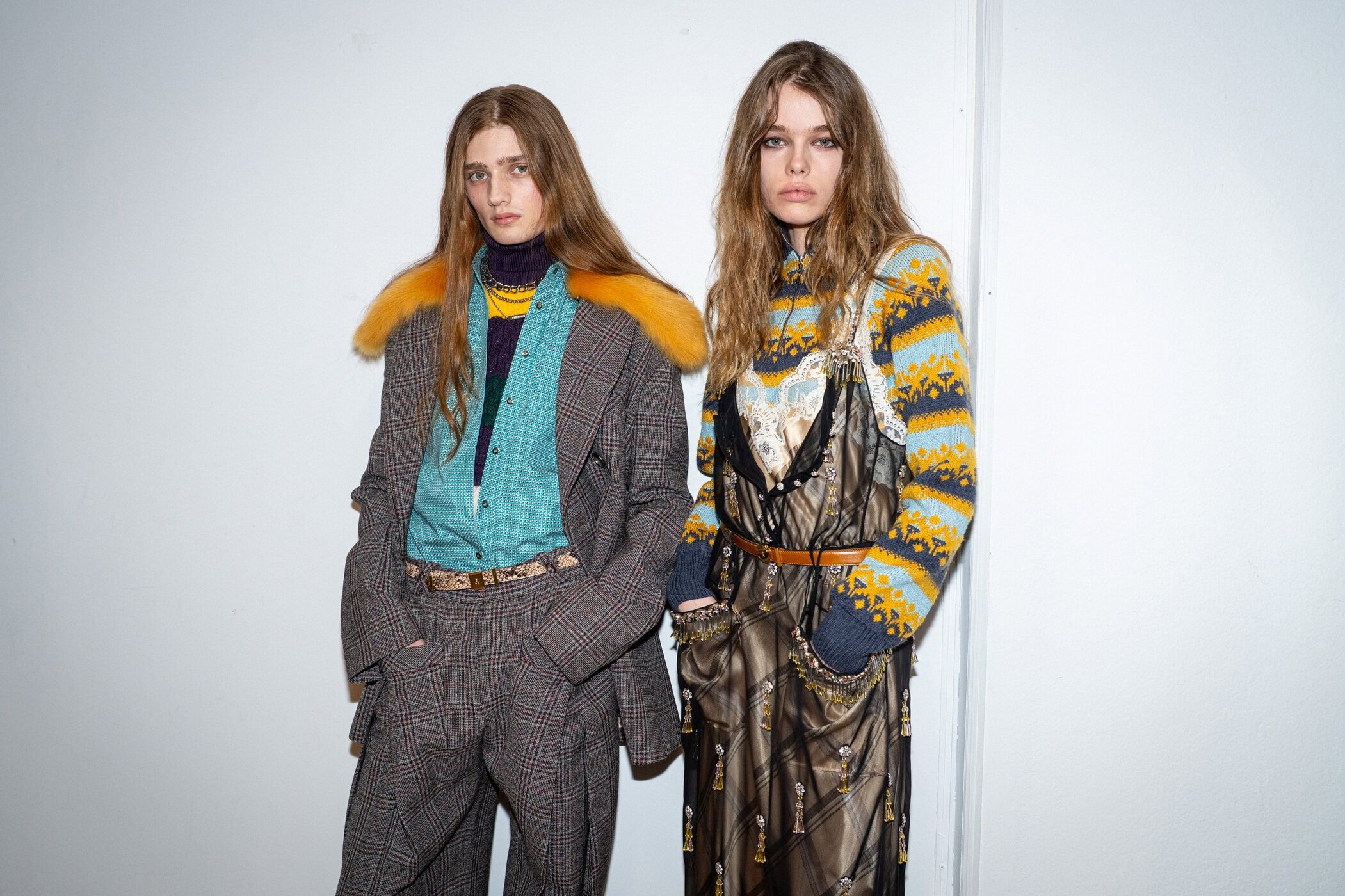
From that foundation, the collection expanded outward through contrast. Tea dresses appeared beneath industrial outerwear. Cardigans layered over sheer fabrics. Eyelet dresses clashed with blue fur. The effect was intentionally eclectic—less about a finished image than the feeling of a life in motion.
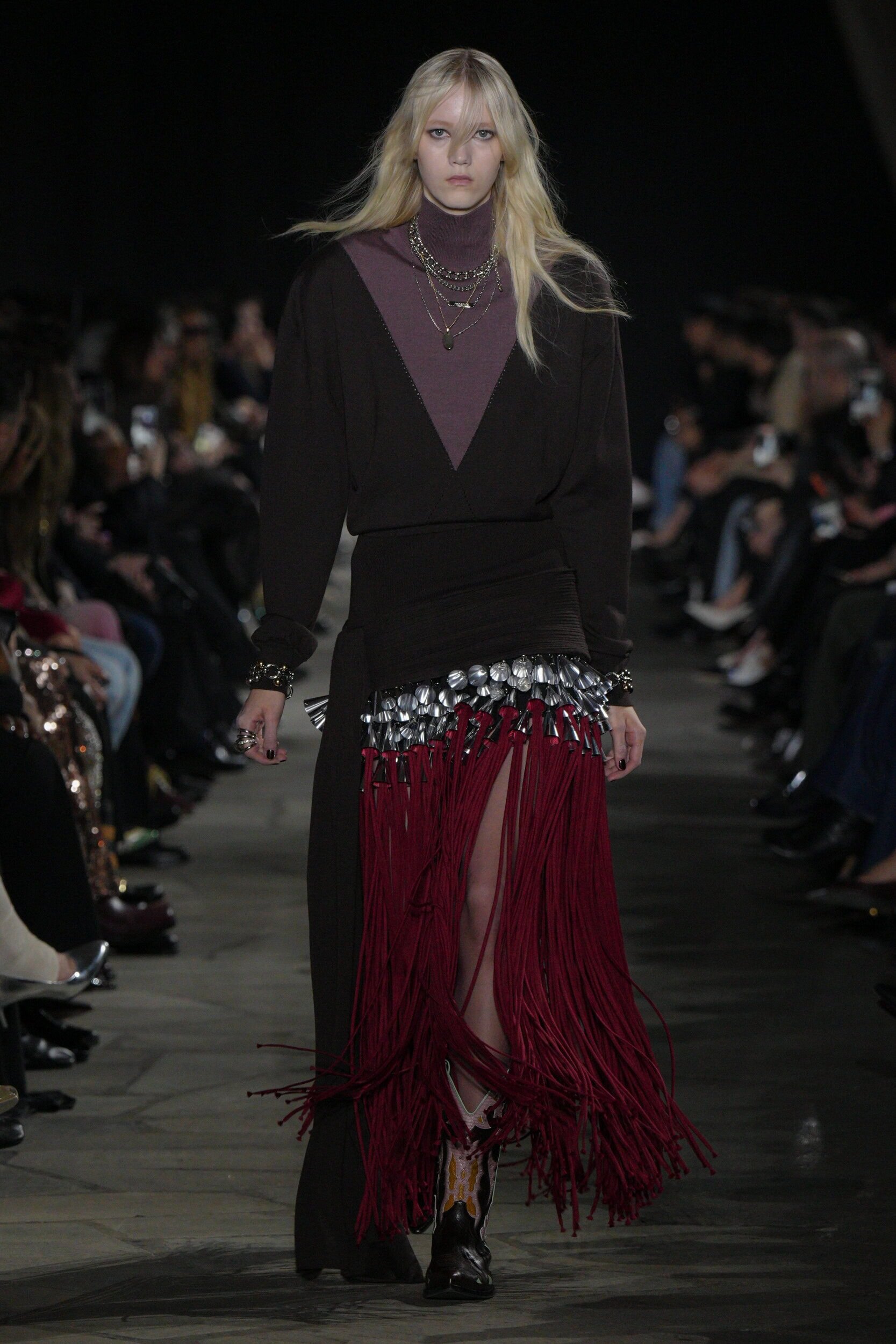
Dossena described the cast of characters almost like a small social ecosystem.
“There is the library girl,” he said. “There is the one who is going to fight, or to resist in a way.”
Resistance, in fact, became one of the collection’s quiet subtexts. Not the overt kind tied to slogans or spectacle, but something more subtle—an insistence on identity.
“They don’t look like they are there to enchant you,” Dossena said of his characters. “They are there because they affirm their identities. They resist in that sense.”
In conversation, he framed the idea almost playfully, acknowledging the political undertones without making them the point.
“Sometimes I play a game,” he said. “Is this collection from the right wing or from the left wing? This one—you could say it’s definitely for left wing people. That’s how I look at it. I don’t say it’s a resistance implied, but there is something around that which I find interesting, just to know where you are.”
If the historical reference came from the 1940s, the emotional tone was closer to the energy of youth culture. Dossena drew a line between wartime resilience and the rebellious spirit of post-punk communities.
“At the end, connections were made very easily,” he explained. “Cold wave, post-punk, those kids—they were drawn back to that spirit of resistance as well.”
Music played a central role in establishing that atmosphere. Just days before the show, Dossena changed the soundtrack to Justice’s “Stress,” a track from 2007 that instantly transported him back to his own early adulthood in Paris.
“I was living in the 10th at that time,” he recalled.
It was the moment when I was really going out in that community. We were going to clubs in that area, to dodgy bars and things like that. It’s a personal reference to that moment.”
Like much of the collection, the music was less about nostalgia than emotional memory—an echo of the social worlds that shape style long before designers translate them into clothes.
Even the smallest details reflected that intimacy. Accessories included tiny objects: a miniature airplane tucked into a pocket, a small spinning top, playful and slightly childlike gestures that felt personal rather than ornamental.
“It’s like a little object you have in your pocket,” Dossena said. “Something you play around with. It adds to the feeling of intimacy.”
That intimacy, ultimately, may be the thread connecting the many influences that ran through the collection. Rather than presenting a singular Rabanne archetype, Dossena offered a portrait of a community—people who dress not for perfection, but for meaning.
For Rabanne, a house historically associated with futuristic materials and radical silhouettes, the shift toward something more human felt quietly radical in its own way.
These were clothes shaped by history, by music, by neighborhoods and nights out and the cultural codes that bind groups of people together. Clothes that acknowledge that fashion rarely emerges from isolation; it grows out of scenes, friendships, and shared references.
In Dossena’s hands, Rabanne becomes less about spectacle and more about belonging.
A clique, as he calls it.
And like all the best cliques, it begins with the simple act of recognizing yourself in the room.