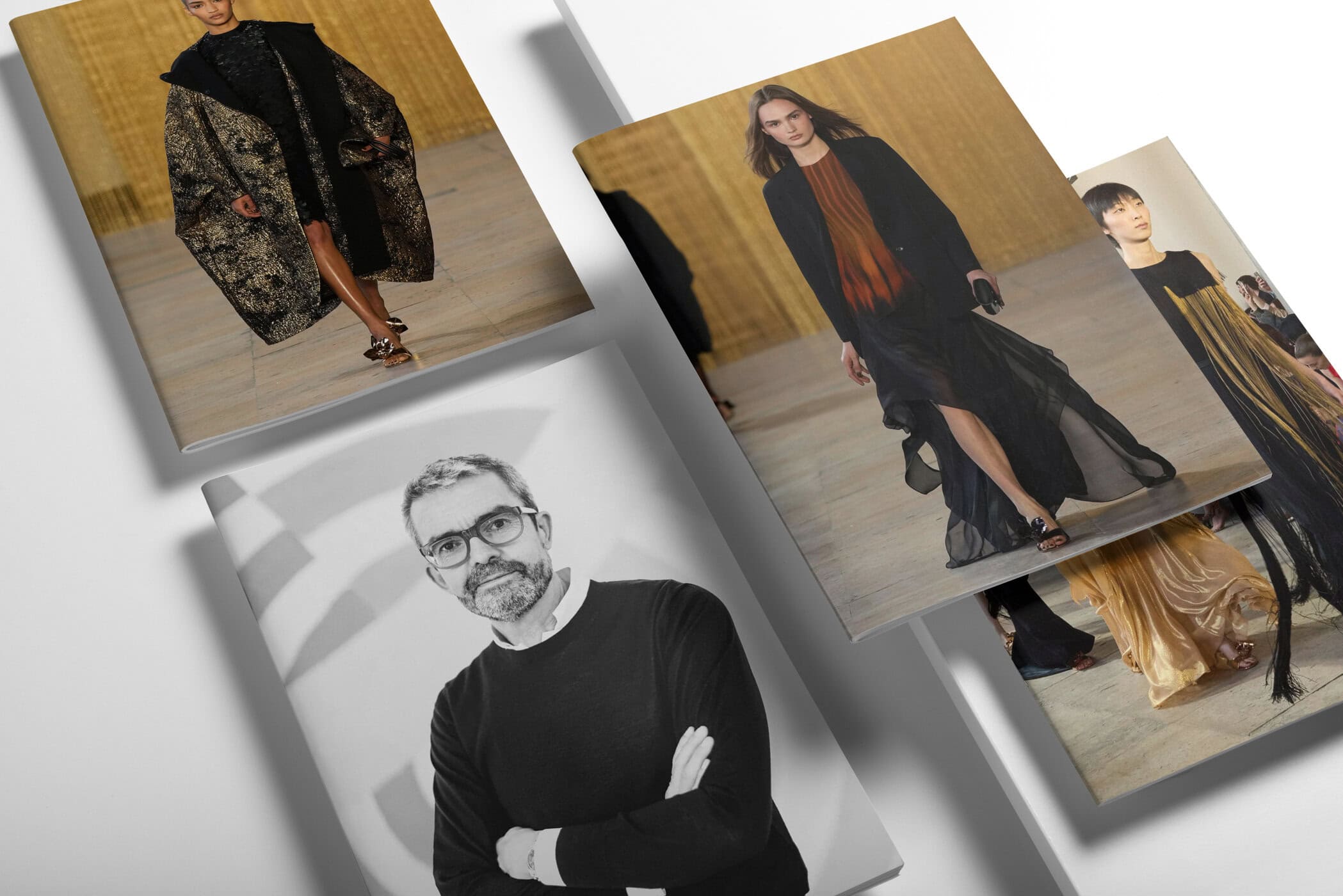
Inspired by the luminous textile works of Olga de Amaral, the designer translates fiber, light, and craft into a richly textured ready-to-wear collection.
By Mackenzie Richard Zuckerman
Backstage, Albert Kriemler was speaking less about silhouettes than about threads. The Akris designer approached the season with a keen focus on the language of materials – an approach shaped by the work of Colombian textile artist Olga de Amaral, whose luminous woven surfaces have long fascinated him.
The connection between the two practices has been quietly unfolding for years. Amaral’s work first came onto Kriemler’s radar nearly a decade ago, when he became captivated by the way she treats fiber not simply as a medium, but as a structure capable of holding light, weight, and emotion all at once. Her works – constructed from wool, cotton, silk, linen, and even horsehair – occupy a space somewhere between painting, sculpture, and tapestry. For a designer whose house has always placed extraordinary emphasis on fabric development, the resonance was immediate.
The relationship took on new immediacy last year when Kriemler traveled to Bogotá to visit Amaral at her Casa de Amaral, following the success of her major exhibition at the Fondation Cartier in Paris, which became one of the most visited shows in the city that year. Walking through the artist’s studio offered something deeper than visual inspiration; it revealed a shared philosophy of making.
“I had always admired her work,” Kriemler said backstage. “Not to reproduce it, but to translate the thinking behind it.”
At ninety-three, Amaral continues to work daily in her studio, surrounded by a small group of women who assist in preparing threads, weaving surfaces, and assembling the monumental textile works for which she is known. She refers to them affectionately as her “fourteen hands.”
“She told me, ‘I couldn’t do it without my fourteen hands,’” Kriemler recalled.
For the designer, the phrase felt instantly familiar. Design studios – and the workrooms where garments ultimately take shape – operate in much the same way. Creation rarely belongs to a single hand. It is built through repetition, refinement, and the quiet expertise of many artisans working toward a shared vision.
Rather than borrowing imagery directly from Amaral’s work, Kriemler focused on translating her approach to material into the vocabulary of ready-to-wear. The result is a collection where textiles are not simply a surface treatment, but the central narrative.
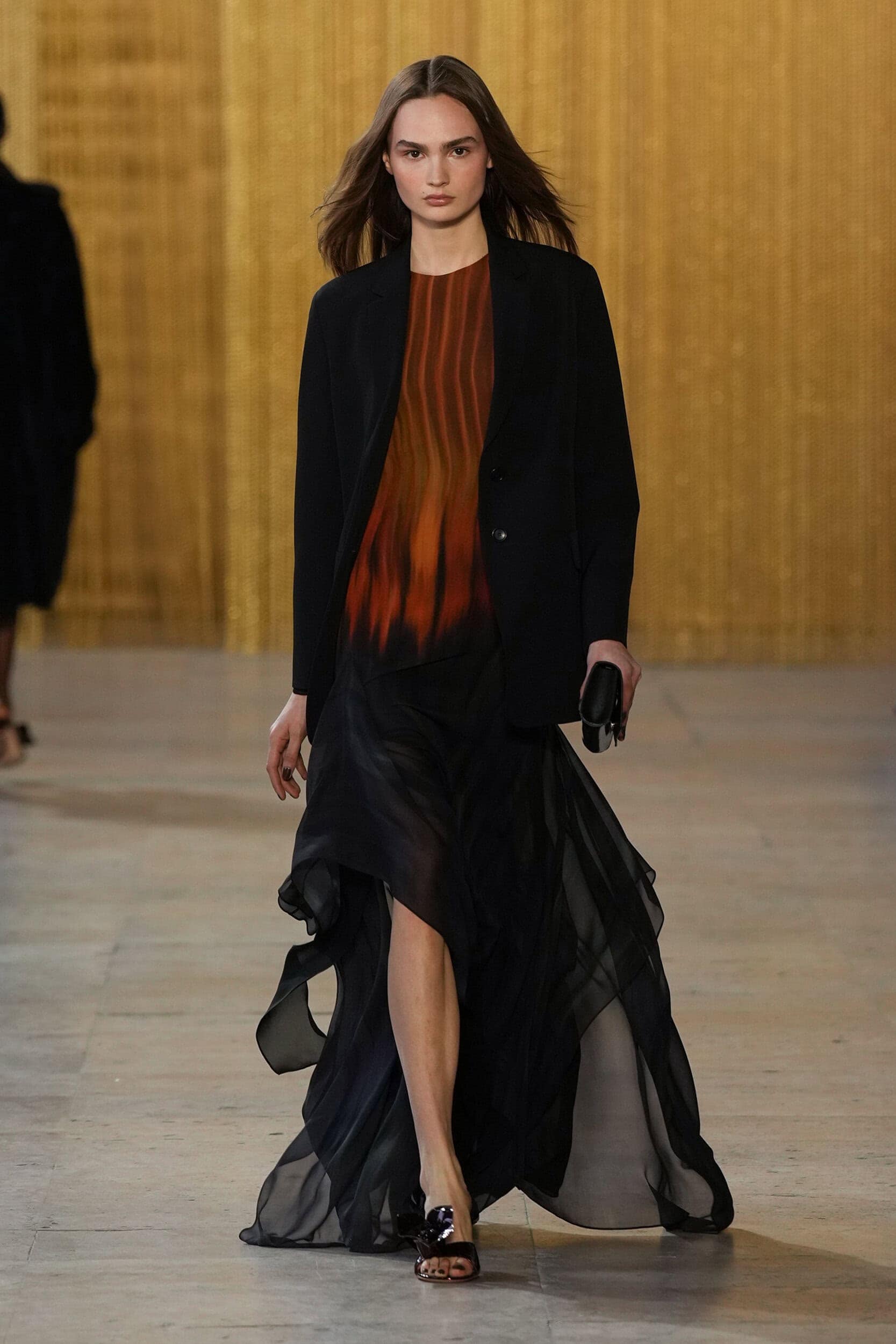
“I didn’t want to reproduce Olga de Amaral’s work,” he explained. “I wanted to translate her way of thinking about materials – to build what I would call a dense material world.”
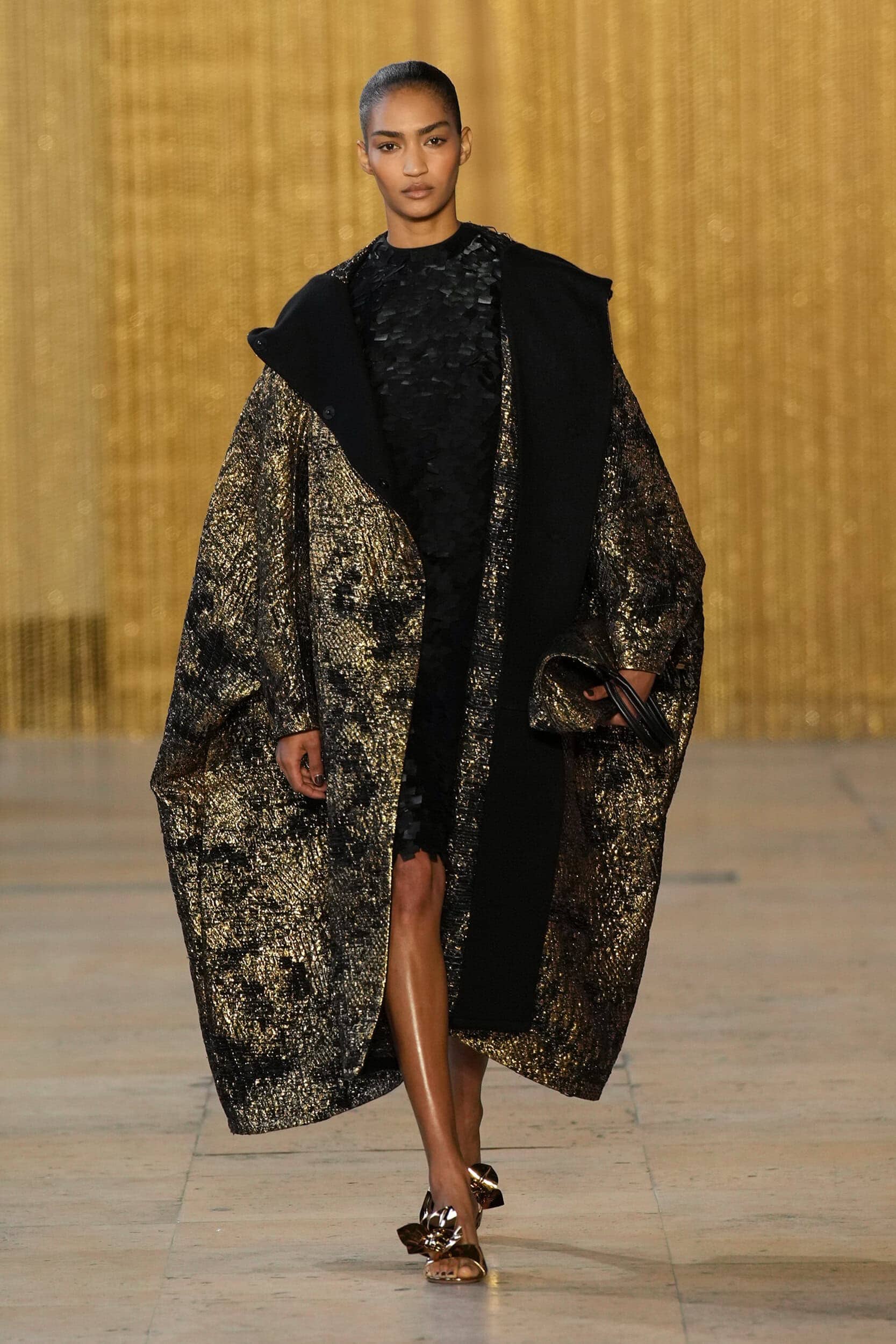
Throughout the collection, fabric becomes the primary protagonist. Brocades are engineered to feel unexpectedly soft, while surfaces layered onto tulle are manipulated so the base can later dissolve, leaving behind delicate fringed structures that echo the tactile complexity of Amaral’s woven works. Plaited constructions developed in the atelier evoke the logic of weaving, while specially woven horsehair pieces introduce both structure and movement, recalling one of the artist’s favored materials.
Elsewhere, leather appears with an unusually supple hand, balancing the more architectural textiles. In select moments, prints derived from one of Amaral’s paintings create a subtle visual bridge between the two practices – less a literal quotation than a quiet nod to the artist’s chromatic world.
Perhaps the most significant thread running through the collection is gold, a material Amaral once described to Kriemler as central to her artistic language. Growing up in the Andes, she explained, gold carried cultural significance beyond ornament. It represented luminosity – the ability to capture and release light within the woven surface.
“She told me, ‘Gold is there for the light,’” Kriemler said.
His response was characteristically restrained. Rather than presenting gold as spectacle, the collection explores it as atmosphere. Muted brocades, softened paillettes, and layered textiles catch light quietly, allowing luminosity to emerge through depth rather than shine.
Color unfolds with similar deliberation. The runway opens in tones of gold before moving gradually into greys, flax, and brown neutrals. Only later do richer hues begin to surface – greens, magentas – mirroring the tonal progression often found within Amaral’s own compositions.
“It builds,” Kriemler explained. “You begin with the gold, and then the colors emerge.”
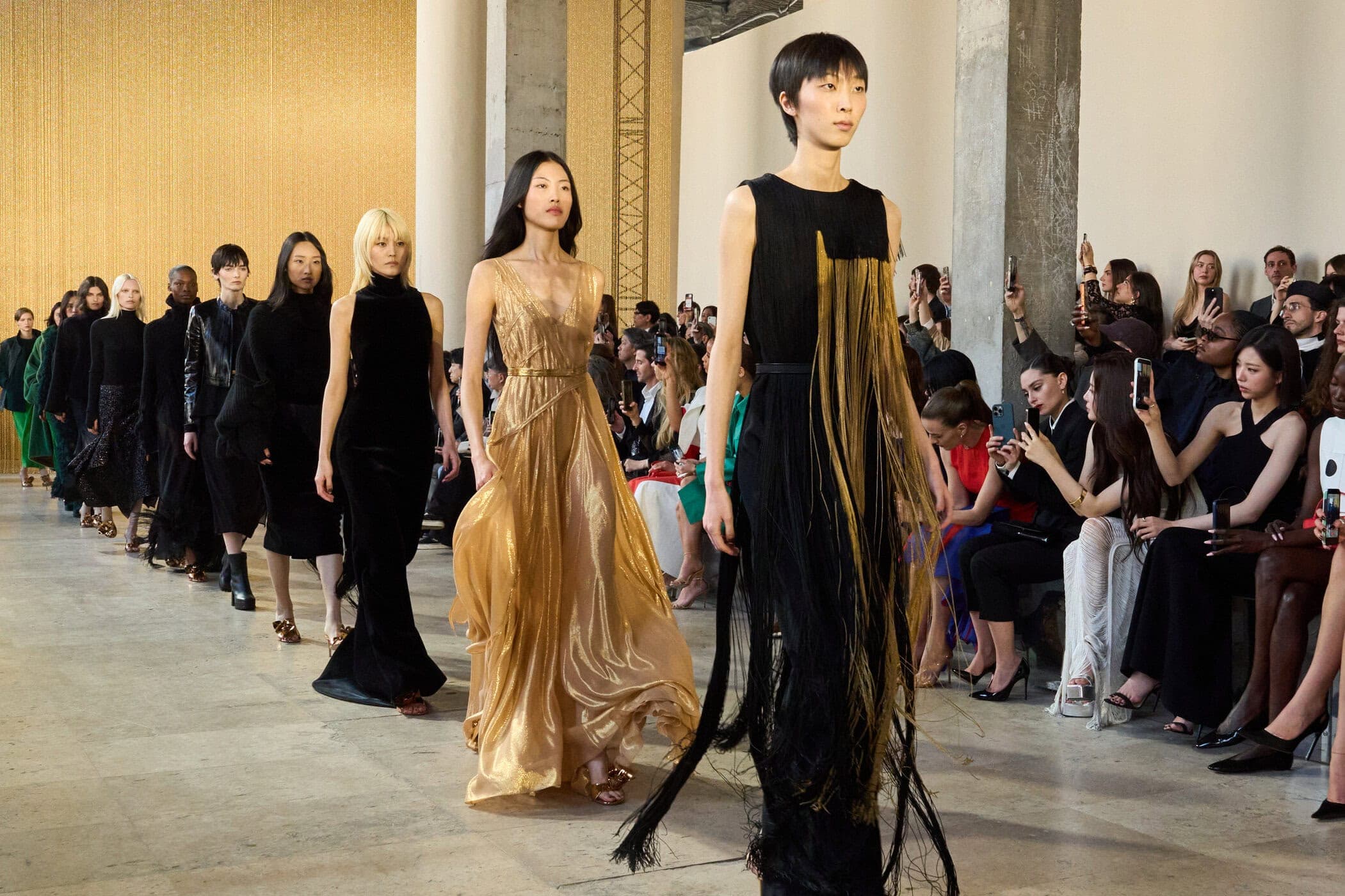
Seen in this light, the collection becomes less about referencing art and more about engaging with the deeper lineage shared by fashion and textile practice. Both disciplines originate in the same gestures: spinning fiber, weaving structure, layering surface, and shaping material through human touch.
For Akris – a house long defined by precision, restraint, and a quiet devotion to textile innovation – the dialogue feels particularly natural. The garments remain firmly grounded in the refined pragmatism of ready-to-wear, yet they carry the intellectual and tactile richness of a studio practice built on experimentation and craft.
In an industry often driven by image, Kriemler’s approach offers a reminder of where fashion’s true innovation often begins.
With the material itself.