
Retailer Prioritizes Efficiency And Portfolio Reset Amid Ongoing Market Pressures
H&M Group reported a decline in first-quarter sales, reflecting the impact of store closures and a broader restructuring of its retail network as the company shifts toward a more streamlined and profitability-focused model.
Sales for the three months to February 28 fell 1 percent in local currencies, with performance weighed down by a reduced store base. The group operated 163 fewer locations compared to the same period last year—approximately a 4 percent reduction—following a wave of closures that included the full exit of Monki’s physical retail footprint.
In Swedish krona, sales declined more sharply, down 9 percent, due to currency effects.

Chief Executive Officer Daniel Erver characterized the quarter as part of an ongoing transition, noting softer demand at the start of the period following strong Black Friday trading, before a recovery driven by spring collections. “Towards the end of the quarter, our well-received spring collections contributed to a positive sales trend, which also continued into March,” he said.
The results come as H&M continues to recalibrate its business model, placing greater emphasis on productivity, tighter inventory management, and an improved customer experience across both physical and digital channels. “We are continuing to focus on strengthening our core offering and creating a more inspiring shopping experience,” Erver added.
The company plans to continue reshaping its retail footprint, with approximately 160 additional store closures scheduled for 2026 alongside around 80 new openings. Expansion efforts are increasingly focused on growth markets, including Latin America, where new stores are planned in Brazil, and new market entries such as Paraguay and Malta. Digital expansion also remains a priority, with recent launches including e-commerce in Ukraine and Canada.
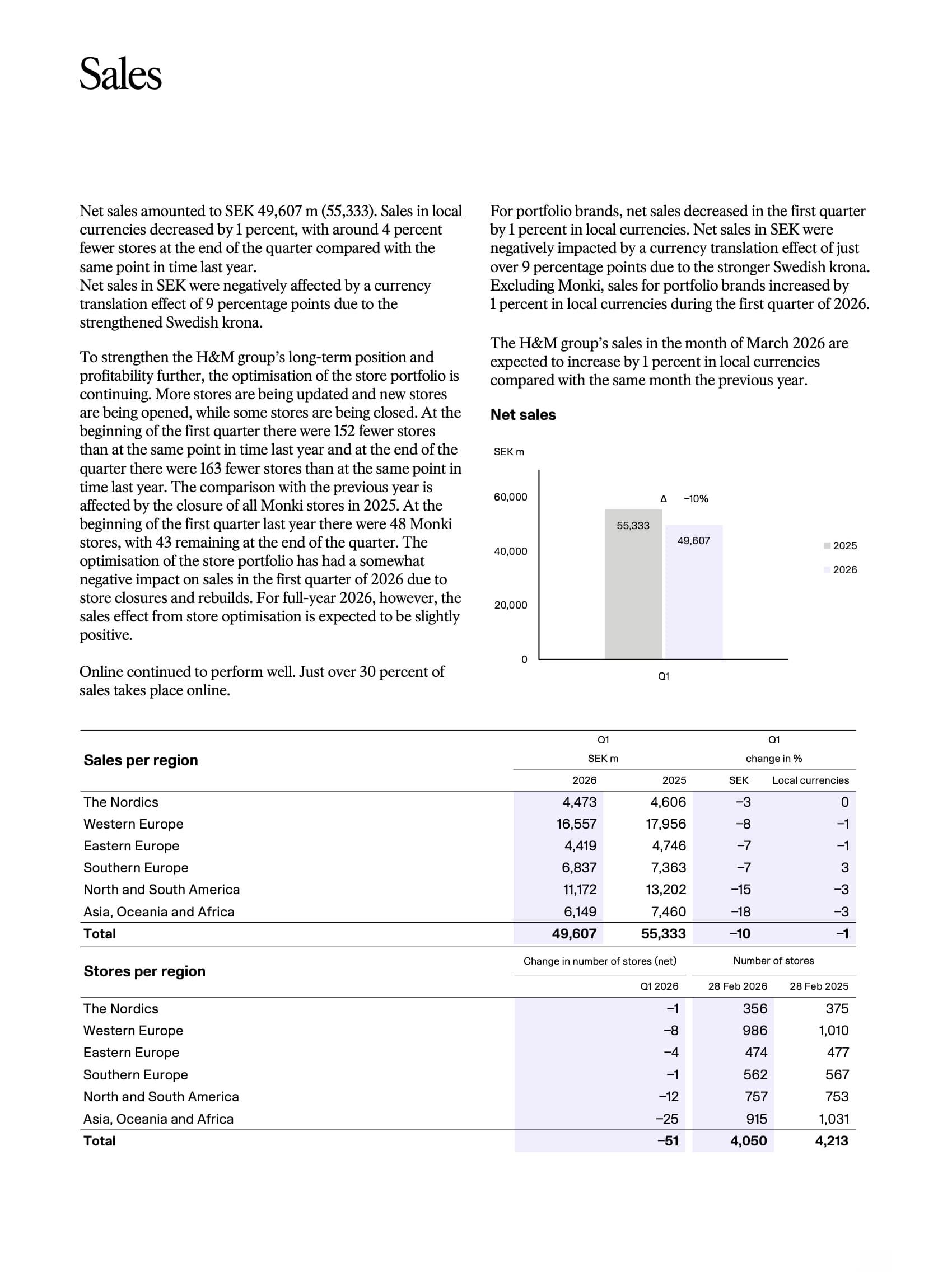
Performance across regions remained uneven, with sales in the Americas down 3 percent in local currencies amid continued competitive pressure in the mid-market segment. At the same time, online sales accounted for just over 30 percent of total revenue, underscoring the growing importance of digital channels.
The company’s more premium concepts continue to play a role in its repositioning strategy. Arket opened its first store in Greece during the quarter and is set to enter Lithuania, while Arket and & Other Stories expanded their presence on Zalando across several European markets. COS also recently launched online in Canada.
Despite weaker top-line performance, H&M pointed to improvements in operational discipline. Lower inventory levels and cost controls helped support margins, with operating profit reaching 2.1 billion Swedish kronor on net sales of 55.3 billion kronor.
Analysts described the quarter as softer than expected, noting that while H&M has taken steps to improve its product and positioning, progress remains uneven. The group continues to face pressure from both ultra-fast fashion players such as Shein and Temu, as well as more design-led competitors like Inditex’s Zara, which recently reported positive sales growth.
The exit from Monki and broader store optimization signal a willingness to simplify the brand portfolio and focus resources on core and higher-margin concepts. While these changes are weighing on short-term sales, H&M maintains that they are necessary to support more sustainable, long-term growth.