
A debut shaped by teenage devotion, house codes rediscovered, and a spirit that refuses to fade
By Kenneth Richard
There are moments in fashion when a designer steps into a house. And then there are moments when a designer returns to the place that made her.

For Meryll Rogge, Marni was not an abstract brand encountered in a showroom or studied in an archive. It was a teenage awakening. “Marni was one of the five brands that I really, really got attached to,” she says. It shaped her early understanding of what fashion could be: intelligent without severity, eccentric without noise, independent without apology. That attachment did not fade with time. It followed her through her twenties, into her thirties, through the formation of her own design language.
So when she arrived for her debut, the starting point was not strategy. It was memory.
Rogge and her team went back to the very first collections, retrieving them from an old hard drive in the Marni offices. What they discovered felt almost myth-breaking. The early palette was restrained: brown, black, white, gray. No prints. No exuberant color. The Marni that would later become synonymous with offbeat florals and intellectual chromatics began in quiet discipline. The first color, she notes, appeared only in 1995—a small red floral.
The opening look of her debut reflects that origin story. It is less homage than recalibration. “We really wanted to start from the roots,” she explains. Not to replicate, but to realign.
Rogge speaks often about “spirit.” For her, the Marni spirit is independent, culturally curious, and slightly subversive in its elegance. It has always appealed to more than the fashion-obsessed. “It’s broader than just fashion,” she says. It reaches those interested in art, in design, in the texture of culture itself.



Importantly, she rejects the idea that those origins belong only to a nostalgic few. Yes, some remember the Consuelo years intimately. Others discovered the house later. Many are only arriving now. But Marni, she insists, has always crossed generations. It once resonated with her teenage self and with her aunt, now in her eighties. Designing this debut meant speaking to all of them at once.
That conversation unfolds through construction as much as image. Rogge returned to the house’s intelligent use of materials—the tension between luxury and modesty. A sumptuous goat coat lined in simple cotton. Industrial stitching emphasized rather than concealed. Functional hardware rendered decorative by intention. Satin tops traced with bold contrast seams. These gestures carry the quiet wit that has long defined Marni: preciousness undercut just enough to feel human.
Silhouettes draw from the late ’90s and early 2000s, a period Rogge found unexpectedly relevant. Little shoulders. Knee-length coats. Skirts that land with decisiveness rather than drama. Boots referencing early Marni forms from 1993 and 1994 reappear, reengineered with strong toes and neoprene uppers designed to accommodate real bodies. Comfort, she notes, is not an afterthought. It is part of the code.

The dots return—on buttons recalling graphic punctuation from the past, rendered in mother-of-pearl or exaggerated into oversized paillettes. The Trunk bag resurfaces in new shapes. The Fussbett sandal re-enters the conversation. These are not museum pieces. They are objects meant to be worn, kept, and reinterpreted over time. Rogge smiles at the thought of the team placing personal orders. The desire is genuine.
Her own imprint threads through the collection naturally. She does not design head-to-toe looks from the outset; styling and casting are integral to her thinking. “The end process is as much part of the process as anything else.” Knitwear, in particular, carries her signature enthusiasm. It is tactile, thoughtful, and grounded in craft.
The scenography echoed that return to lived reality. Collaborating with Formafantasma, Rogge created a space that could read as home, office, gallery, or civic interior—an abstracted everyday. Mirrors, hand-painted by local artists from AI-generated images, blurred the boundary between technology and touch. Marni, she reminds us, was always meant to be worn from day to night. The clothes belong to life.
If Marni offers scale, Italy offers intimacy: proximity to fabric mills, to ateliers, to artisans whose knowledge runs generationally deep. Rogge speaks of this not as expansion, but as privilege—the privilege of making things well.
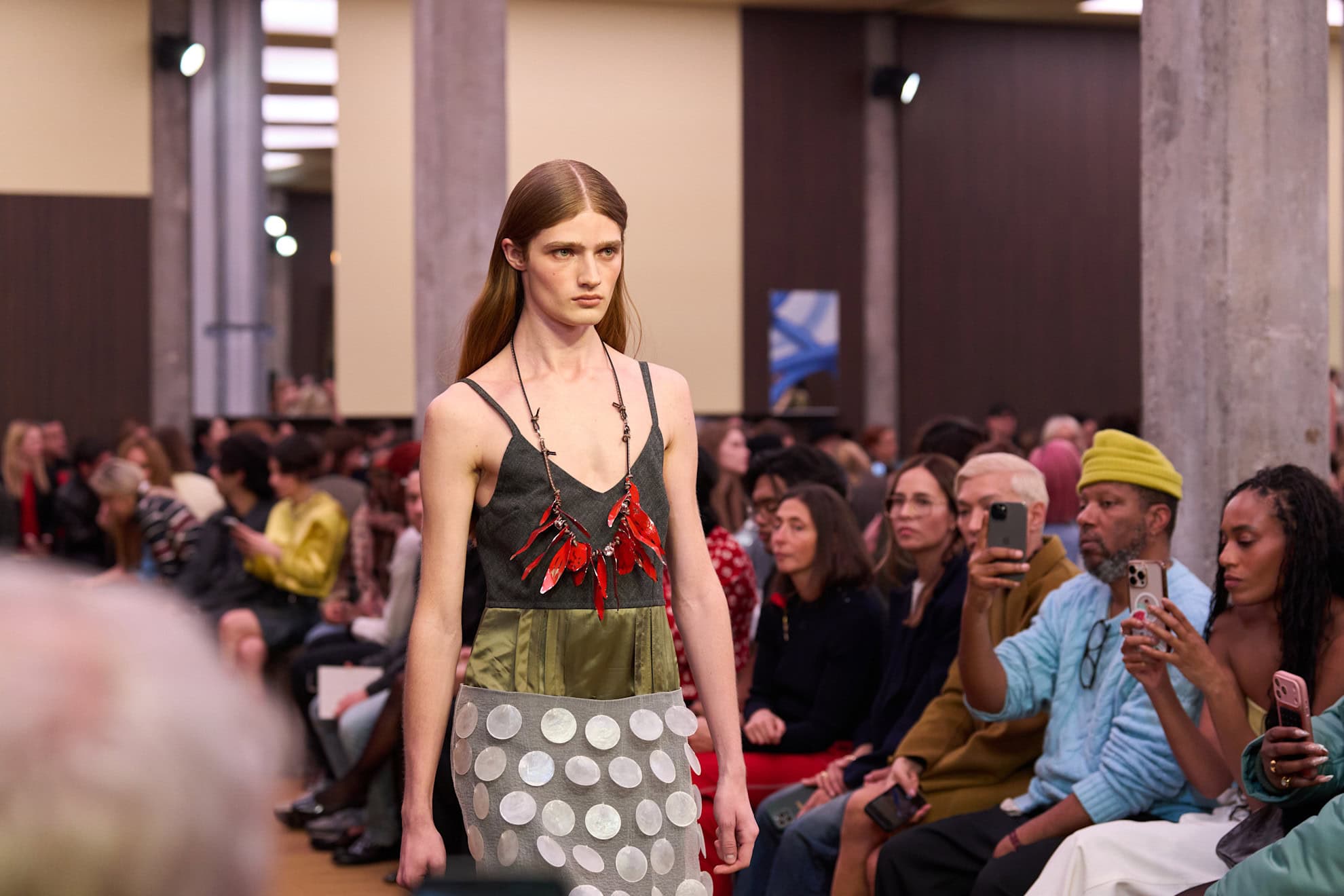
What makes this debut resonate is not the assertion of authorship, but the clarity of alignment. Rogge cannot design without giving something of herself. Yet what she gives feels less like imposition and more like recognition. The house that once shaped her now finds itself reflected back through her lens—older, perhaps wiser, but still unmistakably itself.
In the end, this was not simply a first chapter. It felt like reopening a beloved book and discovering that the story had been waiting patiently, ready to be read again—with fresh eyes, steady hands, and just enough mischief to keep it honest.