Miu Miu Slows Against Strong Comparisons as Versace
Integration Advances and Prada Invests
n Its Next Chapter
Prada Group reported revenue growth for the first nine months of 2026, supported by its established brands and the addition of Versace, although slowing momentum at Miu Miu and a challenging luxury environment tempered its third-quarter performance.
Net revenue reached €4.54 billion in the nine months ending September 30, an increase of 15% at constant exchange rates and 12% at reported rates. Excluding Versace, which contributed €441 million, organic growth was 4%.
Third-quarter revenue increased 11% at constant exchange rates, but underlying organic growth slowed to 1%, reflecting a more difficult environment across several key markets.
The performance illustrates the changing dynamics within a group that has emerged as one of luxury’s stronger performers in recent years. Prada continues to deliver modest but consistent growth, Miu Miu is adjusting to exceptionally demanding comparisons, and Versace is entering a new creative and commercial chapter under its new ownership.
“The environment remains complex and volatile, requiring focus, agility and rigorous execution,” said Patrizio Bertelli, Chairman and Executive Director of Prada Group. “Against this backdrop, we continue to build on the foundations of creativity, product excellence, and manufacturing know-how.”
Group Chief Executive Officer Andrea Guerra emphasized the importance of looking beyond individual quarters as weather, tourism patterns and regional demand become increasingly unpredictable.

He noted that the nine-month results provide a more meaningful view of performance in an environment where short-term fluctuations can obscure the underlying strength of individual brands.
Prada Maintains Momentum as Miu Miu Faces Tougher Comparisons
Prada remained the group’s largest business, generating €2.41 billion in retail sales during the first nine months, an increase of 2% at constant exchange rates.
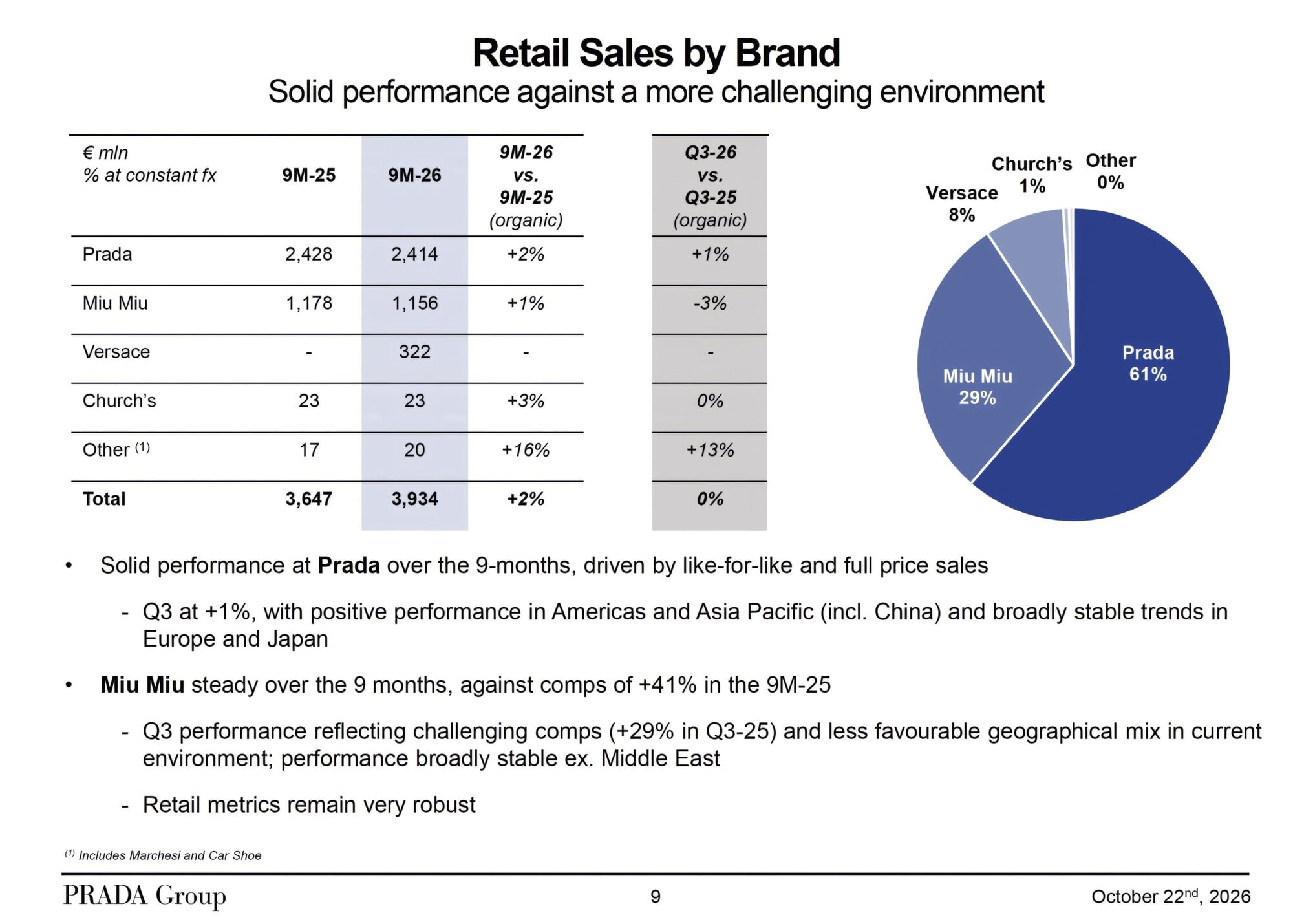
Third-quarter sales rose 1%, supported by positive performance in the Americas and Asia-Pacific, including China, while Europe and Japan remained broadly stable.
Management attributed the performance to continued full-price demand, product innovation and the brand’s ability to maintain cultural relevance.
The Spring 2027 women’s collection by Miuccia Prada and Raf Simons received a strong response, while new leather goods designs, including the Carry, Avoir and Boogie, contributed to a product offering that continues to balance established icons with newness.
Beauty also remained an area of development, with the Wisteria collection and new Paradoxe fragrances among the recent launches.
Guerra noted that Prada had performed particularly well with Chinese, Korean and American customers during the nine-month period, while European business, which started the year more slowly, was beginning to recover.
Miu Miu presented a more complicated picture.
The brand generated €1.16 billion in retail sales during the first nine months, representing growth of 1% at constant exchange rates. Third-quarter sales declined 3%, compared with an increase of 29% in the same period last year.
The slowdown follows several years of exceptional expansion. Miu Miu’s sales had increased 41% during the first nine months of 2025, creating a particularly demanding comparison.
Management emphasized that the brand’s underlying retail metrics remain strong and that, excluding the Middle East, third-quarter performance was broadly stable.
Guerra also pointed to the positive reception of Miu Miu’s Spring 2027 collection as an encouraging indication of the brand’s continued creative momentum.
The group has been expanding Miu Miu’s cultural and retail presence through initiatives including Miu Miu Vinyl Club, a series of temporary spaces combining fashion with music-inspired experiences, and a new hospitality-focused lounge at Shanghai IFC.
The challenge now is to sustain the desirability that drove Miu Miu’s extraordinary rise while navigating a period when growth rates are naturally becoming more difficult to maintain.
Versace’s New Direction Begins to Emerge
Versace contributed €441 million in net revenue during the nine-month period, including €322 million in retail sales, as Prada Group continued integrating the Italian fashion house into its operations.
The business remains in a transitional phase ahead of the debut of Creative Director Pieter Mulier, who is expected to unveil his first collection for Fall 2027 in early 2027.
During the earnings call, Guerra offered an encouraging update on the creative process, explaining that management has moved beyond discussions of concepts and is now reviewing actual products.
“We’re not just looking and talking about ideas, but we’re looking at products at this stage, and the team is ready,” he said.
The group continues to prioritize the quality of Versace’s revenue, with a gradual shift toward full-price sales, the closure of non-strategic stores and improvements to its organizational structure.
Prada also intends to bring its manufacturing expertise, retail capabilities and operational infrastructure to the house while allowing the new creative vision to take shape.
Guerra indicated that Versace’s performance was broadly consistent with management’s expectations, with revenue only slightly below earlier projections.
For Prada Group, the acquisition represents an opportunity to develop a third major fashion business alongside Prada and Miu Miu. The near-term focus, however, remains on establishing the foundations for a more sustainable commercial model rather than pursuing immediate growth.
The Americas Lead as Europe and the Middle East Weaken
Geographically, the Americas remained Prada Group’s strongest-performing market.
Retail sales in the region reached €851 million during the first nine months, increasing 13% organically and 33% including Versace at constant exchange rates.
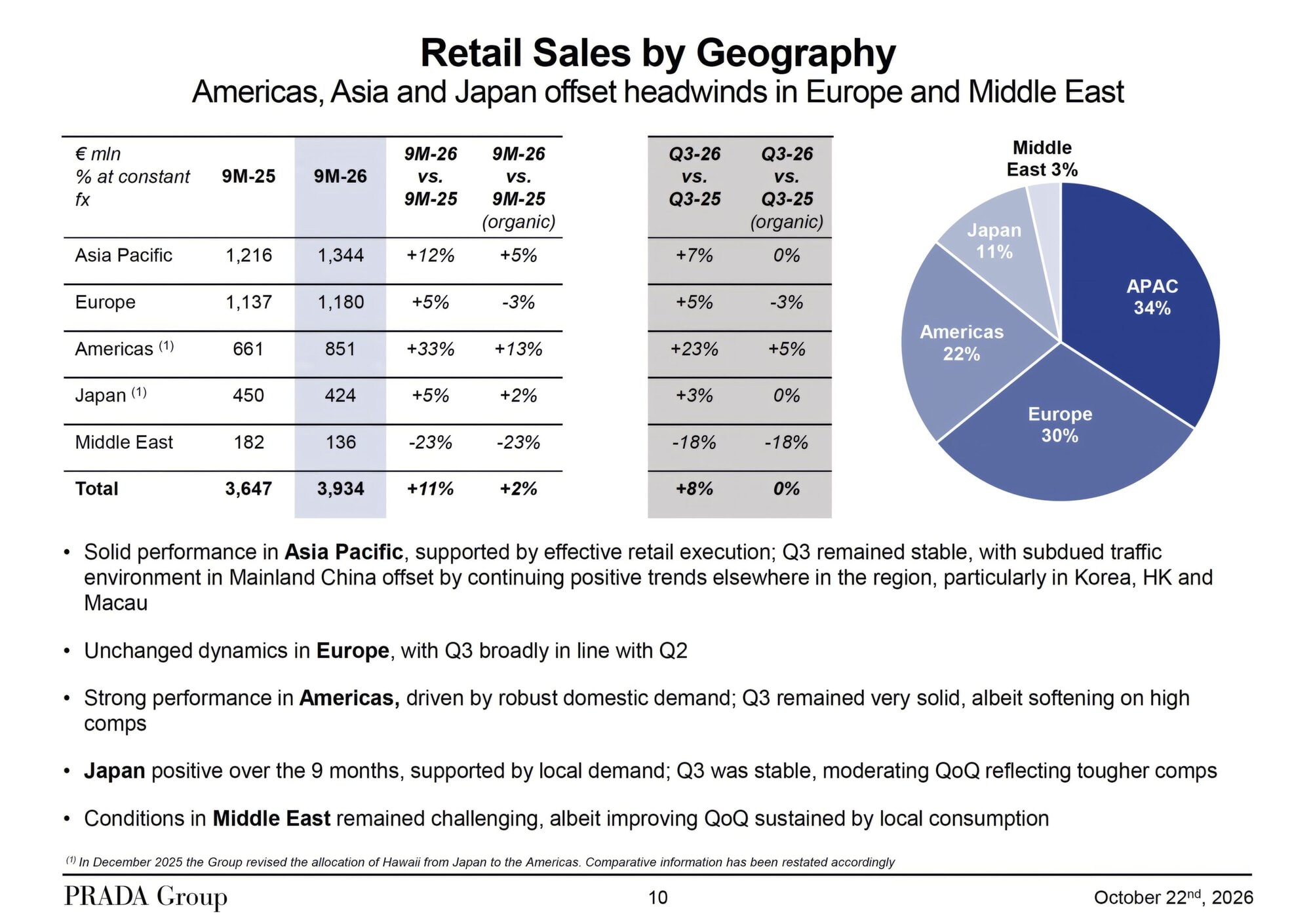
Third-quarter organic growth was 5%, supported by resilient domestic demand, although momentum moderated against strong comparisons.
Asia-Pacific generated €1.34 billion in retail sales, increasing 5% organically over the nine months. Third-quarter performance was stable, with softer traffic in mainland China offset by positive trends in South Korea, Hong Kong and Macau.
During the earnings call, Guerra acknowledged the difficult conditions facing luxury retail in China.
“For sure, the malls are emptier,” he said, while emphasizing that the group’s Chinese customer business remained positive.
He also highlighted the importance of maintaining direct relationships with consumers through culturally relevant experiences and distinctive retail environments.
Europe remained under pressure, with nine-month organic retail sales declining 3% to €1.18 billion. Third-quarter performance was similarly down 3%, reflecting weaker demand across the region.
Japan recorded organic growth of 2% over the nine months, with third-quarter sales stable.
The Middle East was the weakest market, with retail sales declining 23% to €136 million. Although conditions improved sequentially during the third quarter, the region continued to weigh disproportionately on Miu Miu’s performance.
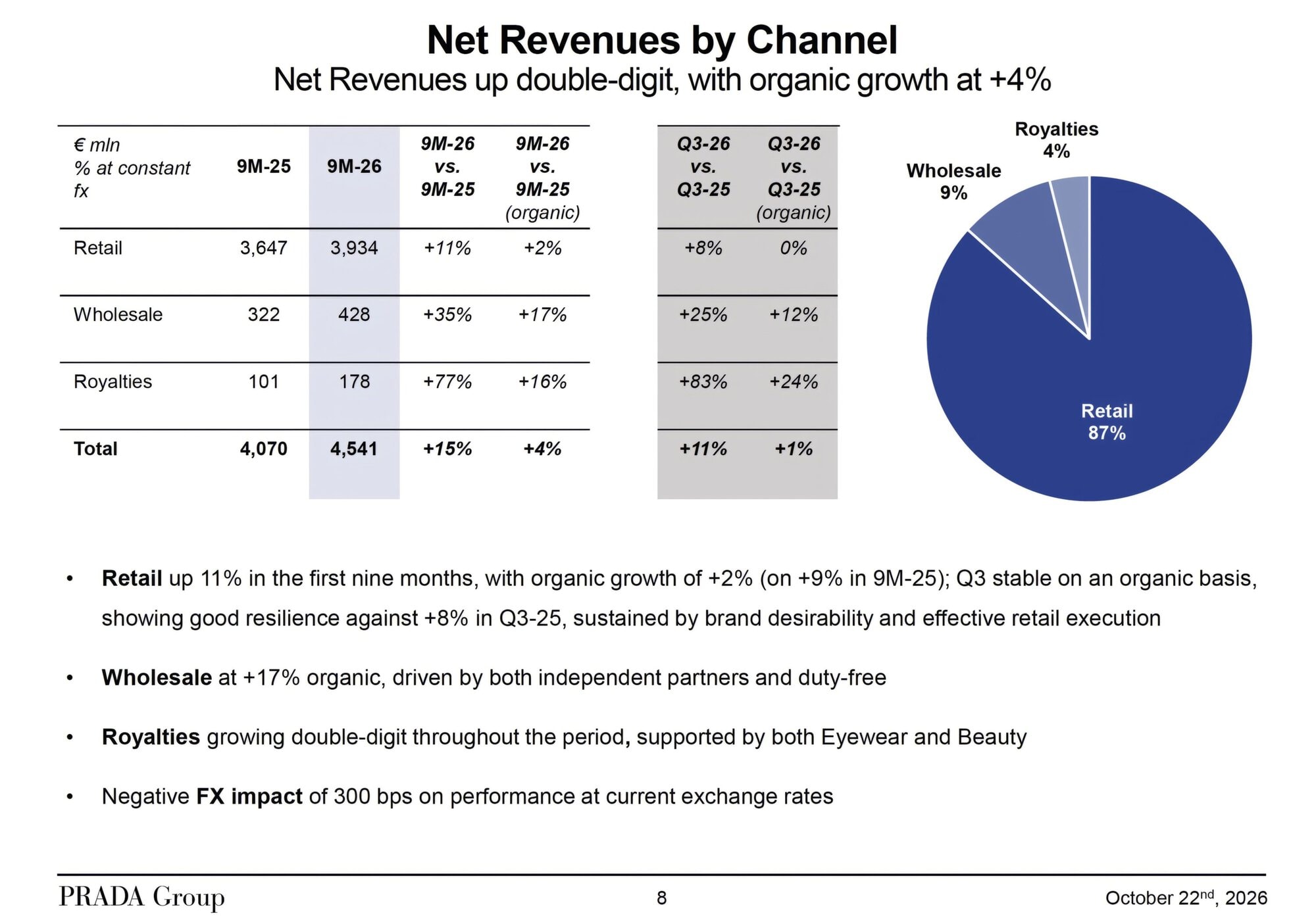
Across distribution channels, group retail revenue reached €3.93 billion, increasing 11% at constant exchange rates and 2% organically.
Wholesale grew 17% organically, supported by independent partners and duty-free distribution, while royalties increased 16% organically, driven by eyewear and beauty.
Prada Galleria Offers a Blueprint for the Future
Beyond the financial results, Guerra devoted particular attention to the newly unveiled Prada Galleria project in Milan, presenting it as an expression of the group’s longer-term approach to building brand value.
The multi-floor destination brings together retail, hospitality, cultural programming and the permanent Pradasphere exhibition, offering visitors an immersion into Prada’s history and creative identity.
For Guerra, the project represents something more significant than an ambitious flagship.
“Prada Galleria is our roots, our skin, our heart,” he said during the earnings call.
He described the destination as a place where customers can understand both Prada’s heritage and its future, while experiencing the brand through shopping, hospitality and cultural engagement.
“It’s a journey from the past to the future, and it’s also a place where to shop. It’s a place where to be hosted,” Guerra explained.
Importantly, he indicated that Prada Group intends to develop similar initiatives for Miu Miu and Versace as those businesses evolve.
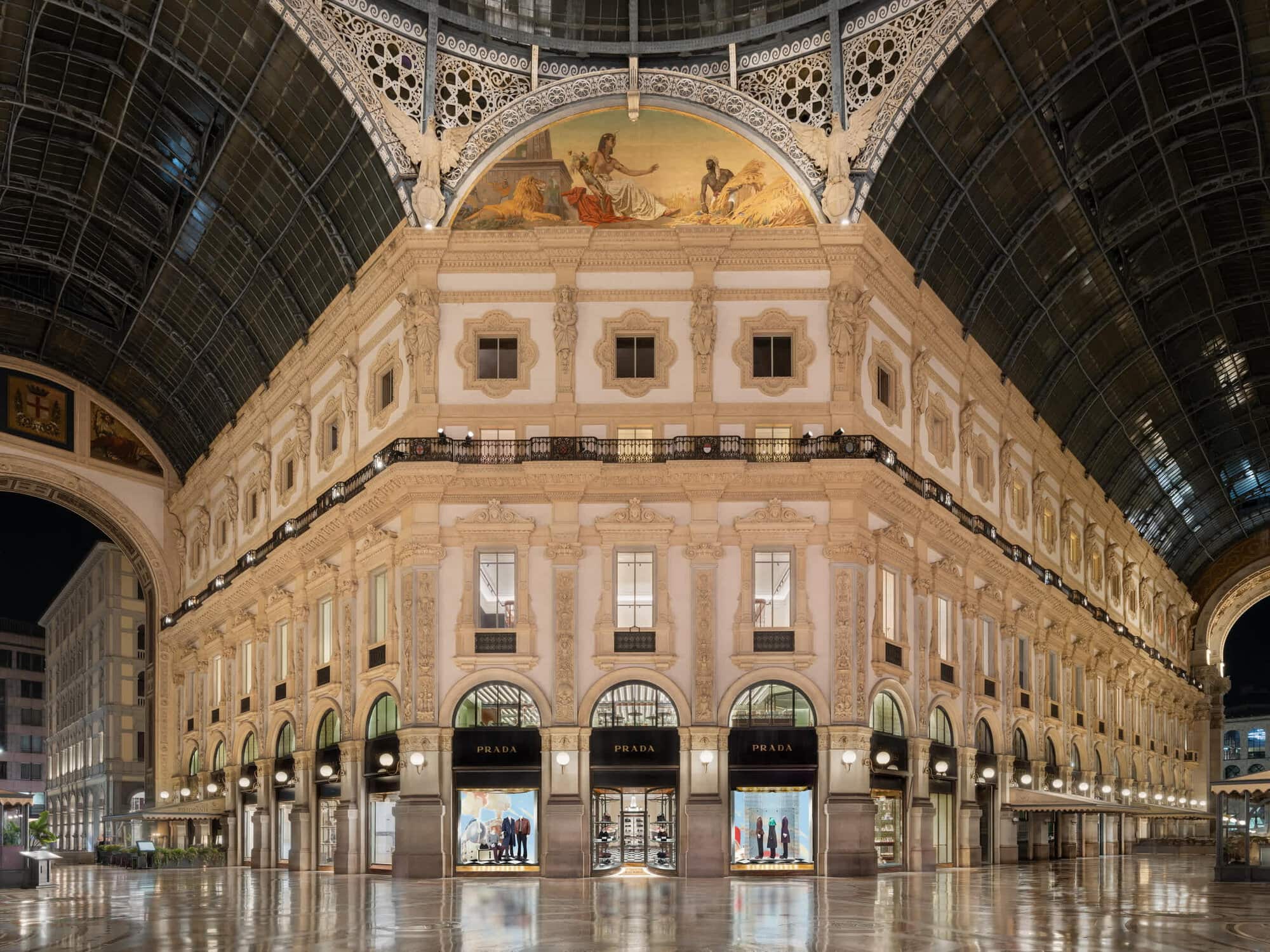
The remarks reveal an increasingly deliberate approach to luxury retail, one in which physical spaces are expected to communicate a brand’s cultural identity while also supporting commercial performance.
Guerra described the Galleria as both an exceptional brand destination and a meaningful revenue-generating location, underscoring the importance of connecting creative ambition with business results.
“We’re not a logo, we’re not a tag, but we have a DNA,” he said.
That philosophy may become particularly relevant as Prada Group develops Versace’s new identity. Rather than relying solely on product launches or traditional retail expansion, the group appears interested in building distinctive environments that deepen the relationship between its brands and their customers.
The Galleria also reflects Prada’s broader investments in manufacturing, retail excellence and digital capabilities, areas management considers essential to maintaining competitiveness as the luxury market becomes more demanding.
Building for the Long Term
Prada Group’s nine-month performance demonstrates the benefits of its expanded portfolio, but also the challenges of maintaining growth in a market where consumer demand has become less predictable.
Prada continues to benefit from a clear creative identity and steady full-price demand. Miu Miu remains commercially significant despite its slowdown, while Versace provides the group with a substantial opportunity for future development.
The group’s investments in manufacturing are also continuing. Bertelli highlighted the recent opening of a fully integrated leather goods production facility in Piancastagnaio, Tuscany, as evidence of Prada’s commitment to craftsmanship and long-term industrial development.
Management remains cautious about the wider environment, acknowledging that luxury industry growth may remain below earlier expectations.
Nevertheless, Guerra reiterated the group’s ambition to outperform the market through stronger retail execution, operational efficiency and continued investment in brand desirability.
The results suggest that Prada Group is entering a different phase of its development. Following years of rapid expansion at Miu Miu and the acquisition of Versace, the emphasis is shifting toward sustaining growth, strengthening execution and establishing the creative foundations for its enlarged portfolio.
The Prada Galleria offers perhaps the clearest indication of how management intends to approach that challenge: using the distinctive history and cultural authority of each house to create experiences that extend well beyond the product.
For Prada Group, the next stage will be measured not simply by how quickly its brands grow, but by how successfully they turn their creative identities into lasting commercial strength.