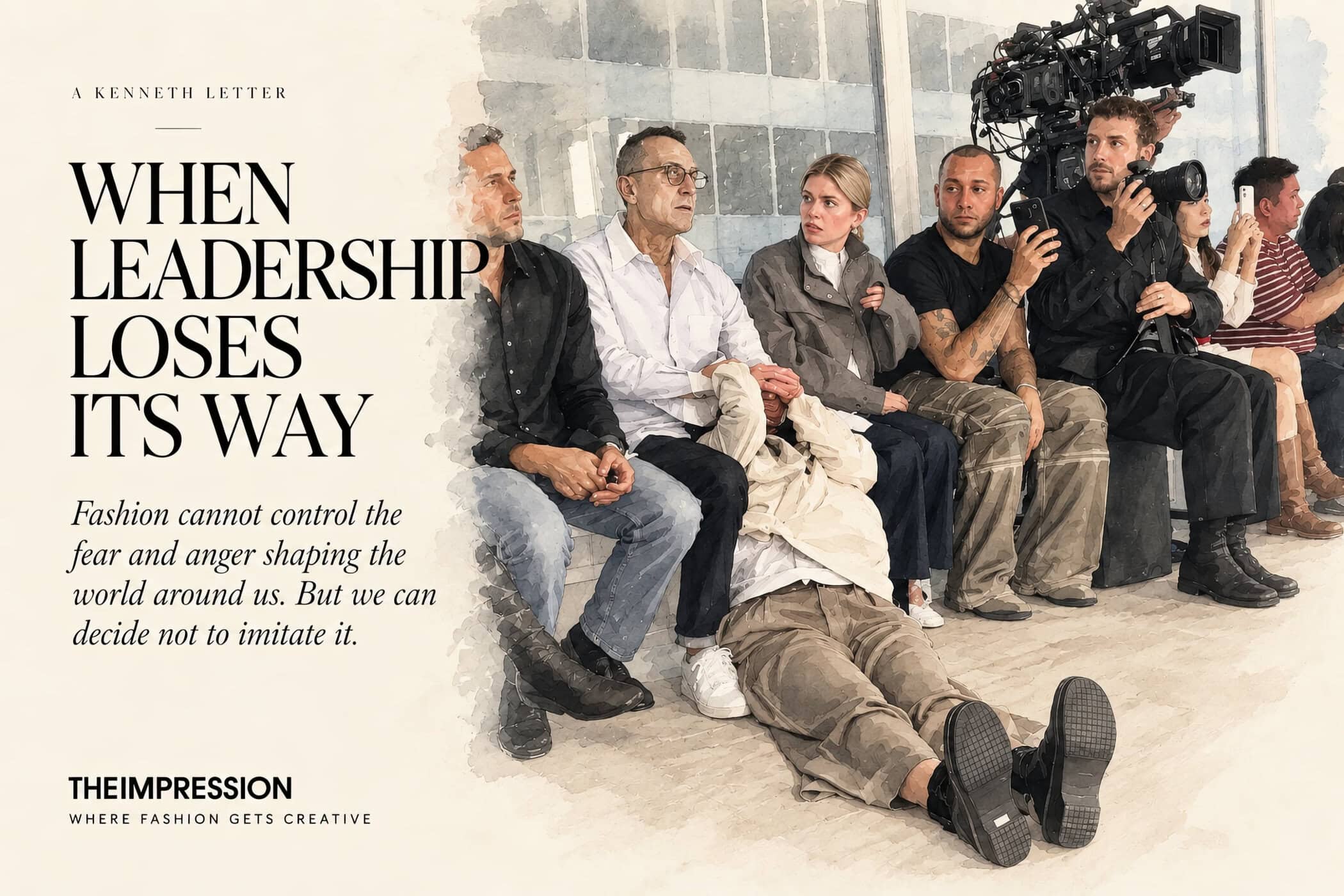
Fashion Cannot Control The Fear And Anger Shaping The World Around Us. But We Can Decide Not To Imitate It.
I built The Impression to lift fashion up. To celebrate creativity, introduce talent, recognize extraordinary work, and help the people who make this industry move forward. That doesn’t mean pretending difficult things don’t happen. Sometimes caring about an industry requires us to look directly at a moment we wish had never occurred.
Sunday’s COS show in New York was one of those moments.
During the show, PETA protesters entered the runway to protest the brand’s use of wool. Steven Kolb, President and CEO of the Council of Fashion Designers of America, physically intervened. Members of The Impression’s editorial team were there and witnessed what happened. We have footage of the incident.
Steven has since acknowledged that his actions were inappropriate. “It wasn’t my place to do so,” he said in a statement. “I should have let the security team handle the situation.”
He is right.
I don’t say that with satisfaction. I have known Steven for many years. I understand the frustration of watching people interrupt a fashion show that represents months of work by designers, models, production teams, publicists, and countless others. I also understand the instinct to protect that work.
And security, from what our team witnessed, was slow to respond. That matters. A runway disruption can become chaotic very quickly, and the organizers of any major fashion event have a responsibility to ensure that trained security personnel are prepared to intervene immediately.
But a slow security response does not transfer that responsibility to the people sitting in the audience. It may help us understand why Steven felt compelled to act, but it does not excuse how he acted. There is an important difference between understanding someone’s instinct in a difficult moment and accepting the actions that followed.
There is a larger reason this moment has stayed with me.
Lately, I find myself looking at a world increasingly governed by immediate emotion and fear. Anger answers anger. Fear answers fear. Provocation produces reaction before reflection has had a chance to enter the room. We see it across countries, cultures, and politics. Positions harden. People stop listening. Restraint is mistaken for weakness, while escalation is increasingly treated as strength.
It isn’t.
I don’t want fashion to become another reflection of that world.
Fashion has always been emotional. It should be. Creativity requires passion, conviction, and sometimes even confrontation. Fashion has also always been a place for disagreement. Designers challenge convention. Critics challenge designers. Activists challenge industries. Generations challenge the assumptions of the generations before them.
That tension has often moved us forward. But disagreement and disruption do not relieve us of our responsibility to one another.
You can disagree profoundly with PETA’s methods. You can believe that storming a runway is disrespectful to the designer and the hundreds of people whose work culminates in those few minutes. You can believe protesters should be removed immediately. None of those positions requires accepting unnecessary physical intervention by someone who was not responsible for security.
At the same time, holding someone accountable for an action should not require us to define that person entirely by his worst moment.
That distinction matters to me.
We are living through a period in which accountability too easily becomes destruction. Someone does something wrong and within minutes the machinery of social media begins deciding who that person is, what their entire life means, and whether they deserve a future.
I don’t believe that is particularly humane either.
Steven made a serious error in judgment. He has acknowledged that. Accountability now requires more than acknowledging what happened; it requires considering what the incident means for his ability to continue leading the CFDA.
That decision ultimately belongs to the CFDA Board, and I believe its members need to consider it carefully. The organization is larger than any one individual, and the standards expected of its leadership must reflect the values it asks the American fashion community to uphold.
I believe Steven should step down as President and CEO of the CFDA.
I don’t arrive at that conclusion lightly, nor do I believe it requires diminishing everything Steven has contributed to American fashion during his years of service. Accountability has meaning precisely because a person’s contributions and a serious failure of judgment can both be true at the same time.
Stepping down need not be an act of public humiliation. It can be an act of responsibility—and, in its own way, an act of leadership.
Because leadership is not demonstrated only when everything is going well. It is also demonstrated in what we choose to do after we have gotten something profoundly wrong.
The CFDA occupies an important position in American fashion, and its President represents more than himself in moments like these. Young designers look toward that institution. So do students, models, editors, retailers, international guests, and countless people trying to understand what American fashion stands for.
That makes restraint more important, not less.
There is another aspect of Sunday’s footage that has stayed with me: the reactions of the people immediately surrounding what was happening.
A photographer seated nearby spoke up. The woman sitting beside Steven appeared visibly distressed by what she was witnessing. Others seemed frozen, perhaps trying to understand an extraordinary confrontation unfolding within feet of them while the fashion show continued.
I don’t mention their reactions to judge them. Events can move faster than our ability to understand what we’re seeing, much less decide how to respond. But the scene has remained with me because it feels strangely representative of the moment we are living through. Something can escalate remarkably quickly when emotion takes over a room—and sometimes one voice saying this isn’t right matters.
We spend an enormous amount of time talking about the values of this industry: community, inclusion, creativity, expression, respect. Those words mean very little if they apply only when circumstances are comfortable.
Our values matter most when someone disrupts the runway. They matter when we are angry. They matter when we feel threatened. They matter when someone with whom we profoundly disagree is standing directly in front of us.

And they matter most for those entrusted with leadership.
Fashion cannot solve the fear, anger, and division consuming so much of the world right now. Perhaps it would be arrogant to imagine that it could.
But we can decide not to imitate it.
We can protect our designers without losing our humanity. We can disagree without dehumanizing. We can maintain order without abandoning restraint. We can hold people accountable without taking pleasure in destroying them.
And perhaps, in our own small corner of the world, we can demonstrate something that feels increasingly rare:
Strength does not always mean reacting. Sometimes strength is having the discipline not to.
With hope,
Kenneth Richard