The Designer Talks Sportswear Elegance, New Faces, and the Appeal of Making the Ordinary Feel Newly Desirable
By Mackenzie Richard Zuckerman
In Conversation With The Impression
Speaking with The Impression, Miuccia Prada discusses the sportswear everyone is wearing now, bringing elegance to the everyday, her fascination with opposites, casting “people now,” and why the ordinary might be exactly what fashion should elevate.
The Impression Intelligence
Creative Director: Miuccia Prada
House: Miu Miu
Collection: Spring/Summer 2027
Presented: Paris Fashion Week
Interview: Mackenzie Richard Zuckerman for The Impression
Key Themes: Sportswear, elegance, normality, opposites, everyday dressing, individuality, contemporary culture
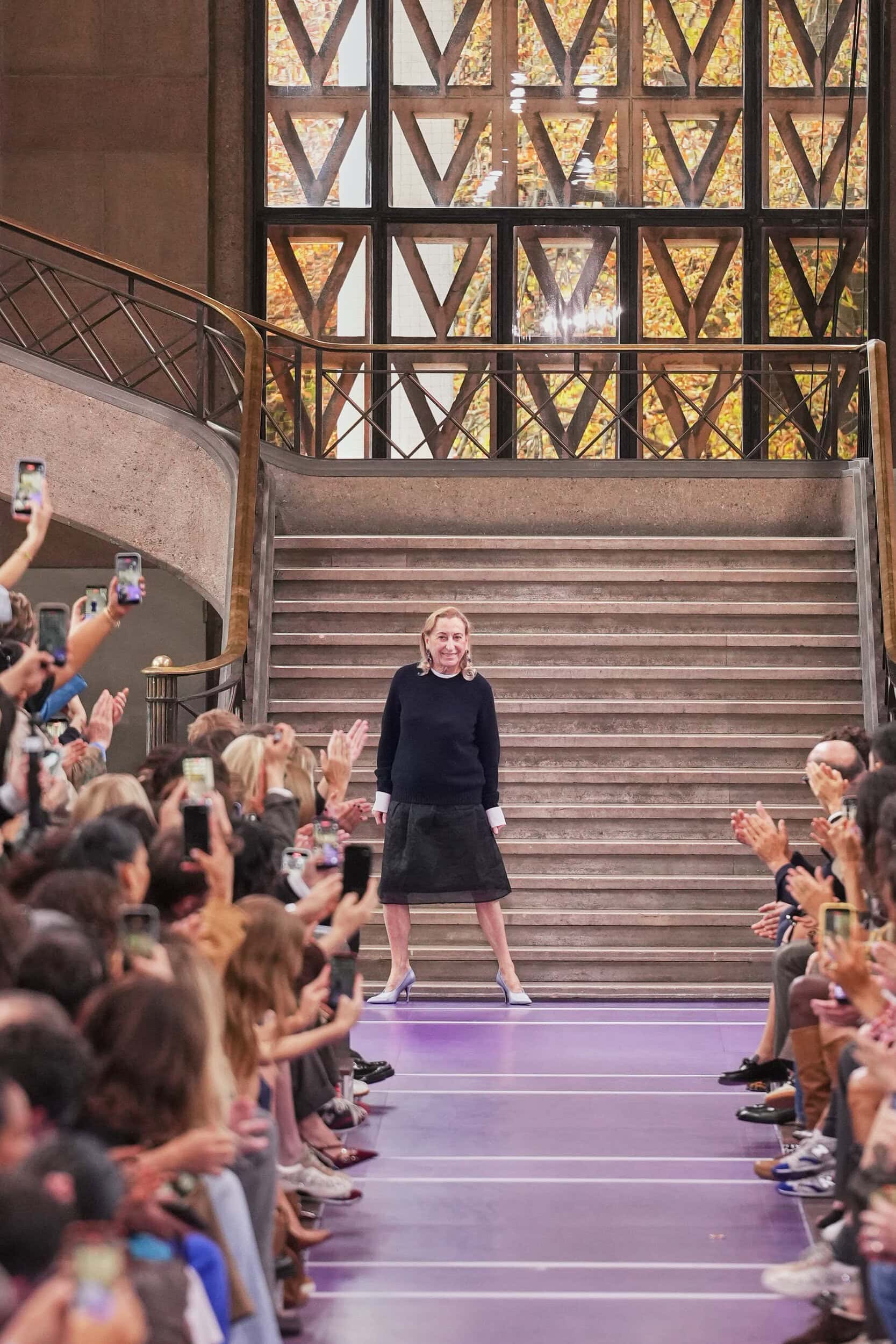
Fashion spends an extraordinary amount of energy trying to tell us what comes next. Miuccia Prada has always been just as interested in what is already right in front of her.
At Miu Miu, that meant looking around and noticing something almost too obvious to mention: everyone is wearing sportswear. Hoodies, trousers, sneakers, jeans—the anonymous uniform of contemporary life. Rather than escape that familiarity, Prada decided to give it a promotion.
“Probably we will talk too much about sportswear in this period,” she said after the show. “So it was the idea of being in the moment, in the time, and seeing everybody really wearing sportswear. And then I thought, to lift up the sportswear, to pair it with elegance. So, to put elegance with sport, and vice versa.”
It sounds simple. In Prada’s hands, simple rarely stays that way.
Her definition of sportswear is refreshingly unsentimental. Asked what it represented to her, she didn’t reach for athletics, performance, youth culture, or any grand sociological explanation.
“Casual,” she said. “People, like normal people, use those hoodies and trousers. It’s how everybody is dressing. Those normal, everyday clothes.”
And there is the Miu Miu proposition: if these are the clothes through which contemporary life is actually being lived, why shouldn’t fashion take them seriously?
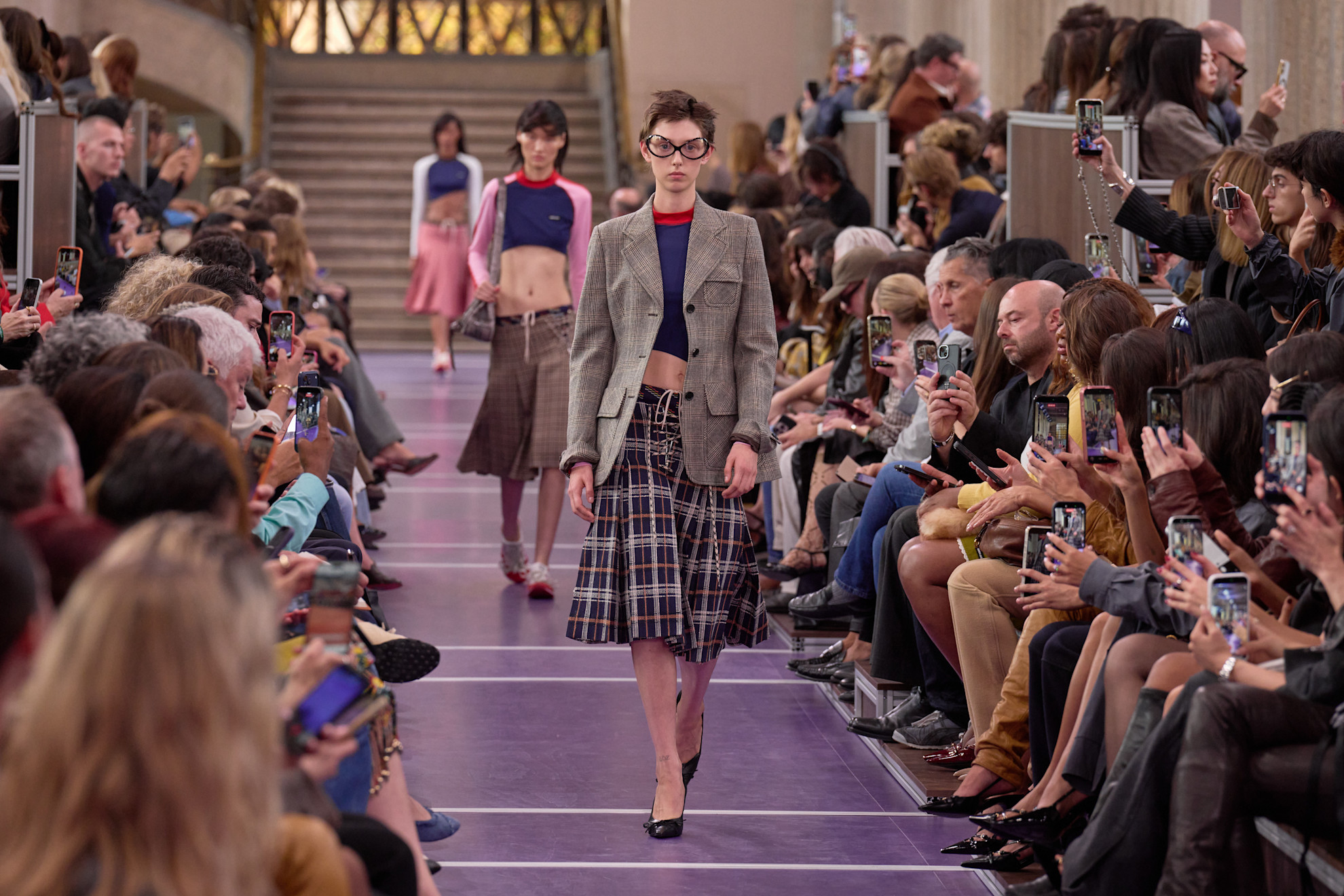
The collection played with that question by repeatedly pushing the familiar into unfamiliar company. Sportswear, knitwear, leather, and vintage pieces met tailored suits, chemisiers, embroidered evening dresses, satin, and gauze. Rather than separating the ordinary from the elevated, Prada let them rub up against one another until the distinctions began to loosen.
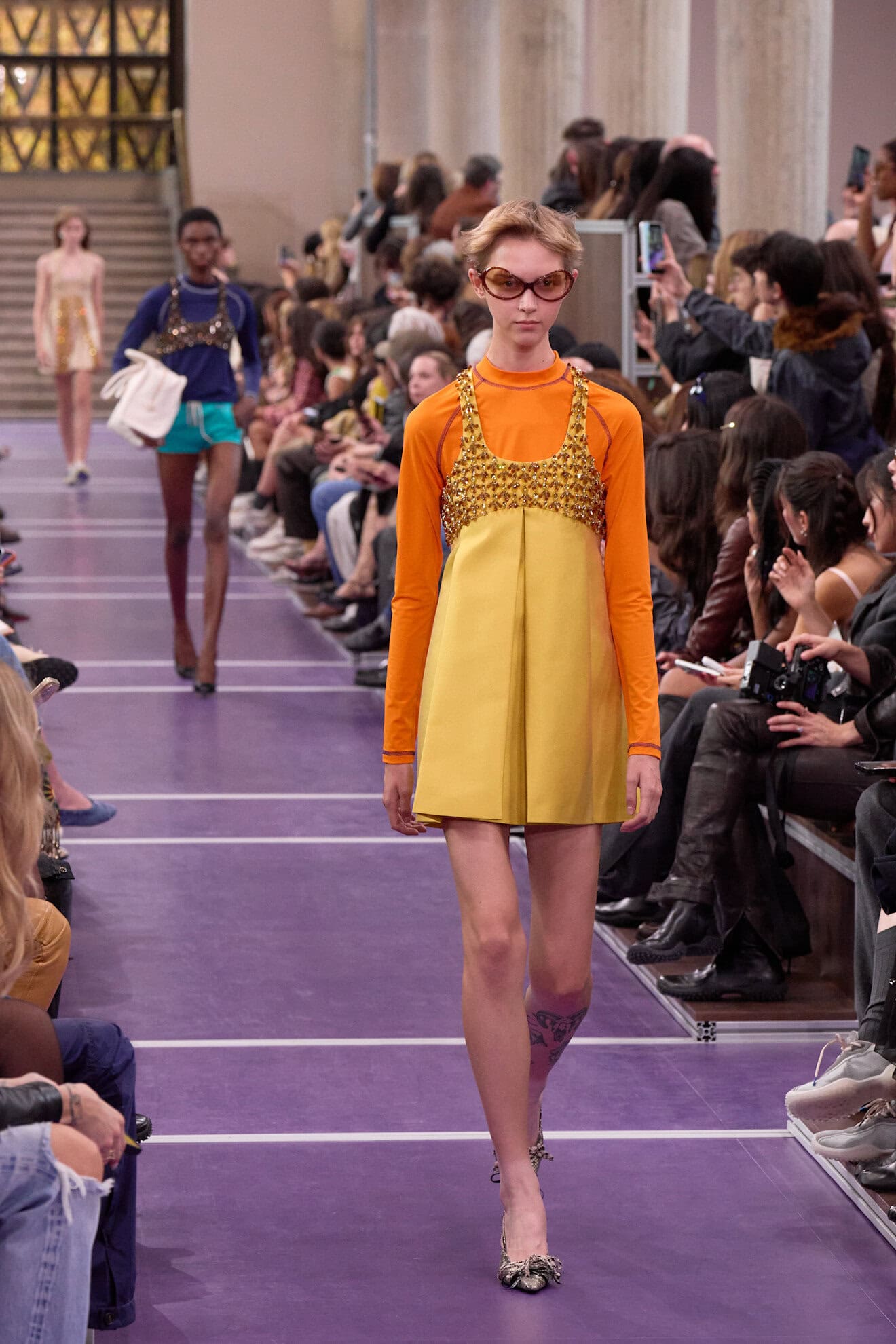
“We always do a project of opposites,” she said. “We use different devices, but this is a mix for me.”
And mix she did.
Crossed lacing became one of the collection’s recurring gestures, pulling together jeans, skirts, dresses, and shoes. Prada admitted that its proliferation began with something considerably less theoretical.
“I fell in love with the lacing,” she said. “We put it on the jeans, we put it on the skirt, we put it on the dresses. That’s why.”
Sometimes fashion really can be that straightforward.
The Wrangler collaboration made the idea particularly visible. Vintage examples of the American brand’s late twentieth-century jeans were reworked with Miu Miu’s crossed lacing, taking one of the most recognizable objects in everyday dress and giving it a decidedly different life.
Elsewhere, performance jerseys were abbreviated into small tops, embroidered fragments migrated onto sportswear shapes, and satin and gauze were crushed and mixed with metal. Even the colors worked against expectation. When asked whether the palette deliberately referenced an earlier period of sportswear, Prada quickly rejected the suggestion.
“No. No, actually, we tried to change the colors, so they wouldn’t be typical,” she said, explaining that the intention was “to make them elegant—not really the colors of sportswear.”
The interesting part is that elegance never required the casual pieces to pretend they were something else. A hoodie could remain a hoodie. Denim could remain denim. A racing sneaker could still look built for movement, even as Miu Miu’s latest collaboration with New Balance reconstructed the lightweight RC150 in technical mesh and shifted it into a more sophisticated palette.
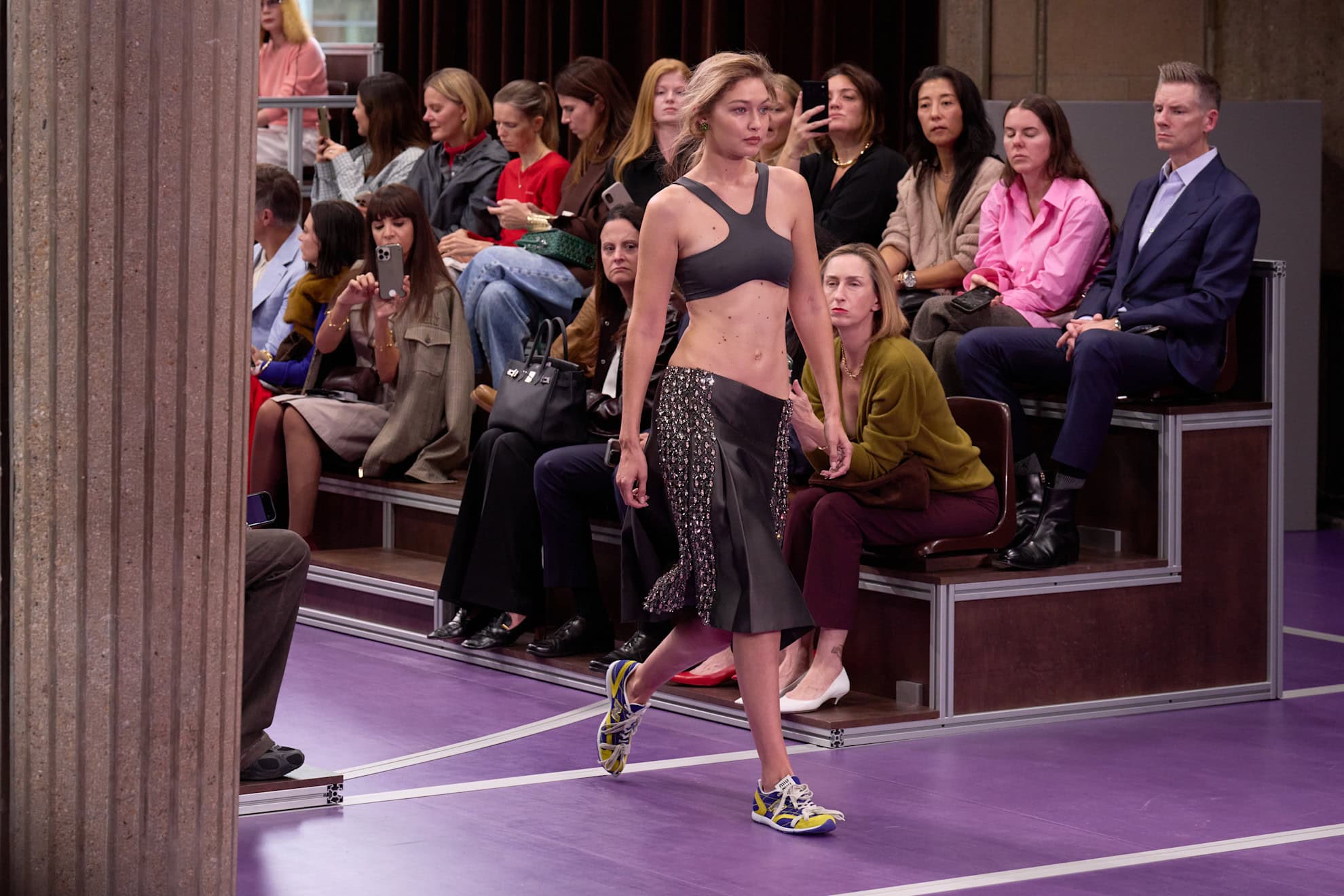
Prada was elevating the everyday without scrubbing away the everydayness that attracted her in the first place.
The casting extended the idea beyond clothes. Prada wanted “people now,” and the runway brought together young newcomers, older women, men, models, actors, artists, and other personalities rather than insisting on a single Miu Miu archetype.
“The casting—we tried to do all young, new faces, and some older women, some men, some different characters,” she explained. “But what I was mainly interested in was people now.”
People now.
It is a wonderfully uncomplicated description of what Prada was after. Not an invented woman waiting somewhere in fashion’s future. Not an idealized wardrobe asking us to abandon the clothes we already live in. She began with the familiar sight of people walking around in hoodies, trousers, jeans, and sneakers and wondered whether fashion could simply make more of it.
“Because it’s all about what people wear,” she said. “I think that maybe we should elevate the normal.”
For Miuccia Prada, the ordinary has never been a place where fashion ends. More often, it is exactly where she likes to begin.