
For Spring 2027, The Designer Mixes Memory, Mischief, and a Little Tough Love Into Marni’s Next Chapter
By Kenneth Richard

There is a particular challenge in taking over a house you once admired from afar. The closer the connection, the greater the temptation to protect it too carefully.
Meryll Rogge knows that feeling well. She discovered fashion as a teenager with Marni among the handful of houses that first pulled her into its world. Years later, she finds herself on the other side of that relationship, no longer simply looking at Marni, but shaping what it becomes next.
That history gives her a certain affection for the house, although affection, in Rogge’s hands, does not appear to mean reverence for reverence’s sake. Her Spring 2027 collection instead considers what happens when a designer enters an established language and begins deciding what should stay, what should disappear, and what can be made slightly stranger.
Consuelo is always going to be the best at doing Consuelo Marni,”
Rogge says of Marni founder Consuelo Castiglioni. “And I have to find my own. I have to find my own way to honor the brand, to honor the values, and to make hopefully people, you know, young people dream, and you know, other generations dream. Like she did for me back in the days.”
It is perhaps the clearest explanation of Rogge’s approach to Marni so far: admiration without imitation.
The collection grows from that tension. Rogge describes an ongoing conversation within the studio about what a designer brings to a house and, just as importantly, what a designer takes away. That idea of positive and negative became both conceptual and literal, appearing through empty spaces, open backs, cutaways, accessories, and silhouettes that reveal as much through absence as through addition.
“We really felt like it was important to give a sense of continuity, but we also had a lot of conversations over the season about, you know, when you enter a brand, what do you bring, but also what do you take away,” she explains.

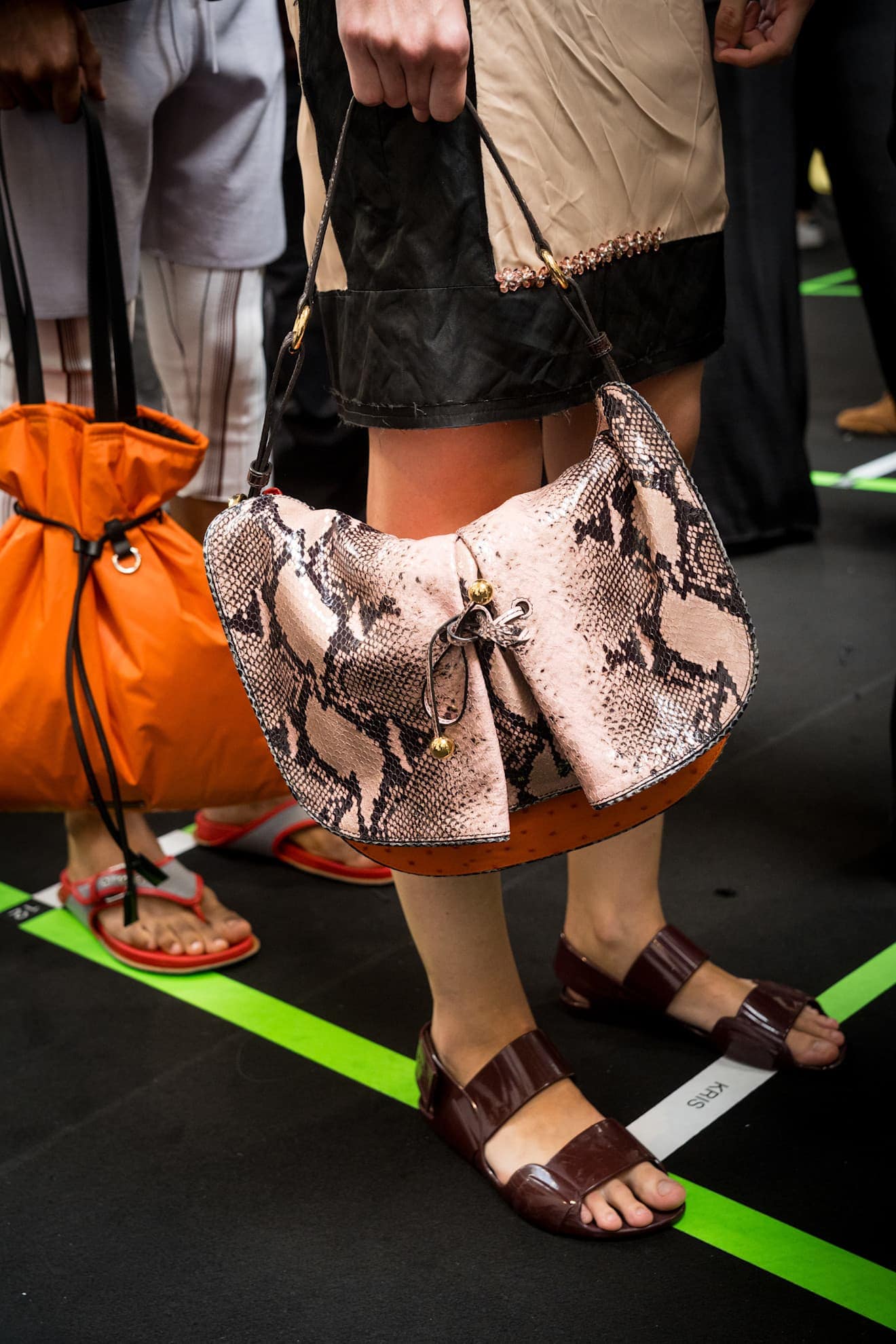
That instinct toward subtraction does not mean Marni has suddenly become restrained. Rogge still enjoys the collision of things that seemingly should not belong together. She talks about juxtapositions, contradictions, industrial stitching, triple stitching, hardware used as decoration and then decoration layered upon decoration. Eyelets appear on sequins. Practical surfaces acquire ornamental interruptions. Familiar codes are given an extra twist simply because Rogge seems to enjoy seeing what happens when one more thing enters the equation.
She calls it “a tough love kind of approach to making clothes.”
That phrase may be one of the more useful ways of understanding her Marni. There is warmth here, but little preciousness.
Rogge is clearly aware of the weight of the archive. She is equally clear that it cannot become an instruction manual.
“We love to go to the archive because it’s fantastic, but we also don’t feel chained to it,” she says. “So it’s a bit that liberty that you have to find your own way of approaching it.”
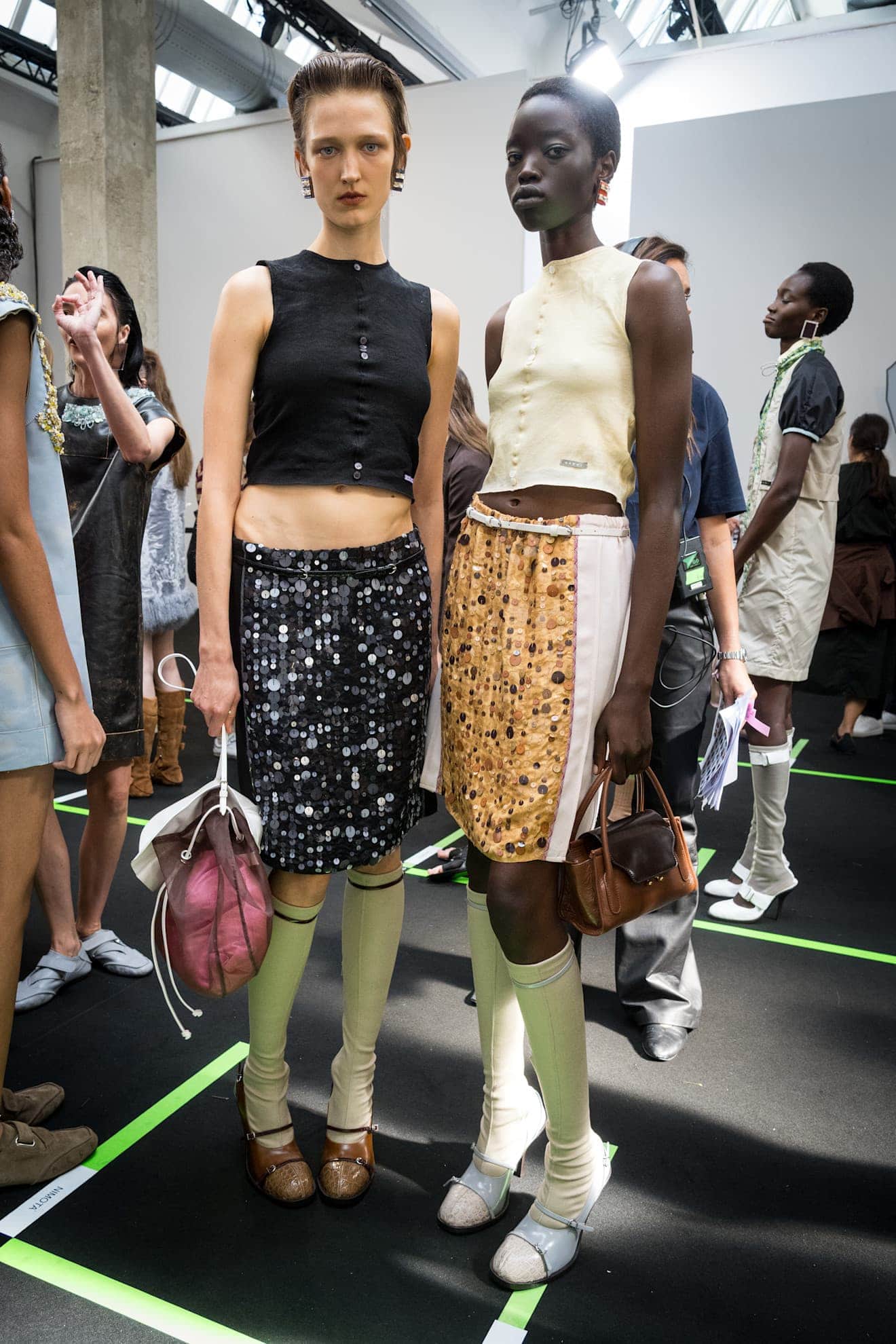
For a designer stepping into a house with such recognizable visual codes, that liberty matters. Too much distance and the identity disappears. Too much fidelity and the designer risks becoming a custodian.
Rogge seems more interested in treating Marni as a living language.
That can mean keeping something familiar and interrupting it. It can mean stripping something away. It can mean allowing an odd proportion, an unexpected combination, or what she describes as something that “doesn’t really make sense” to remain precisely because it creates friction.
There is also something more personal underpinning the collection. Rogge describes this period of her life as a new chapter both professionally and personally, and that idea led her to think about how clothes move with people through very different stages of their lives.
Marni, in her mind, should be capable of doing the same.
She tells a story about the house’s recently launched bag. The first customer, according to Marni’s Retail Director, was a 17-year-old girl. The second was an 80-year-old woman.
“I couldn’t wish for more,” Rogge says.
I mean, I think that’s just so wonderful, and I love that Marni can accompany people in different phases in their life.”
There is something revealing in her excitement over that age gap. Fashion often speaks about youth while quietly relying on everyone else. Rogge seems genuinely interested in the possibility that Marni can exist across generations without flattening itself into something generically accessible.
That breadth may ultimately become one of the more interesting tests of her tenure.
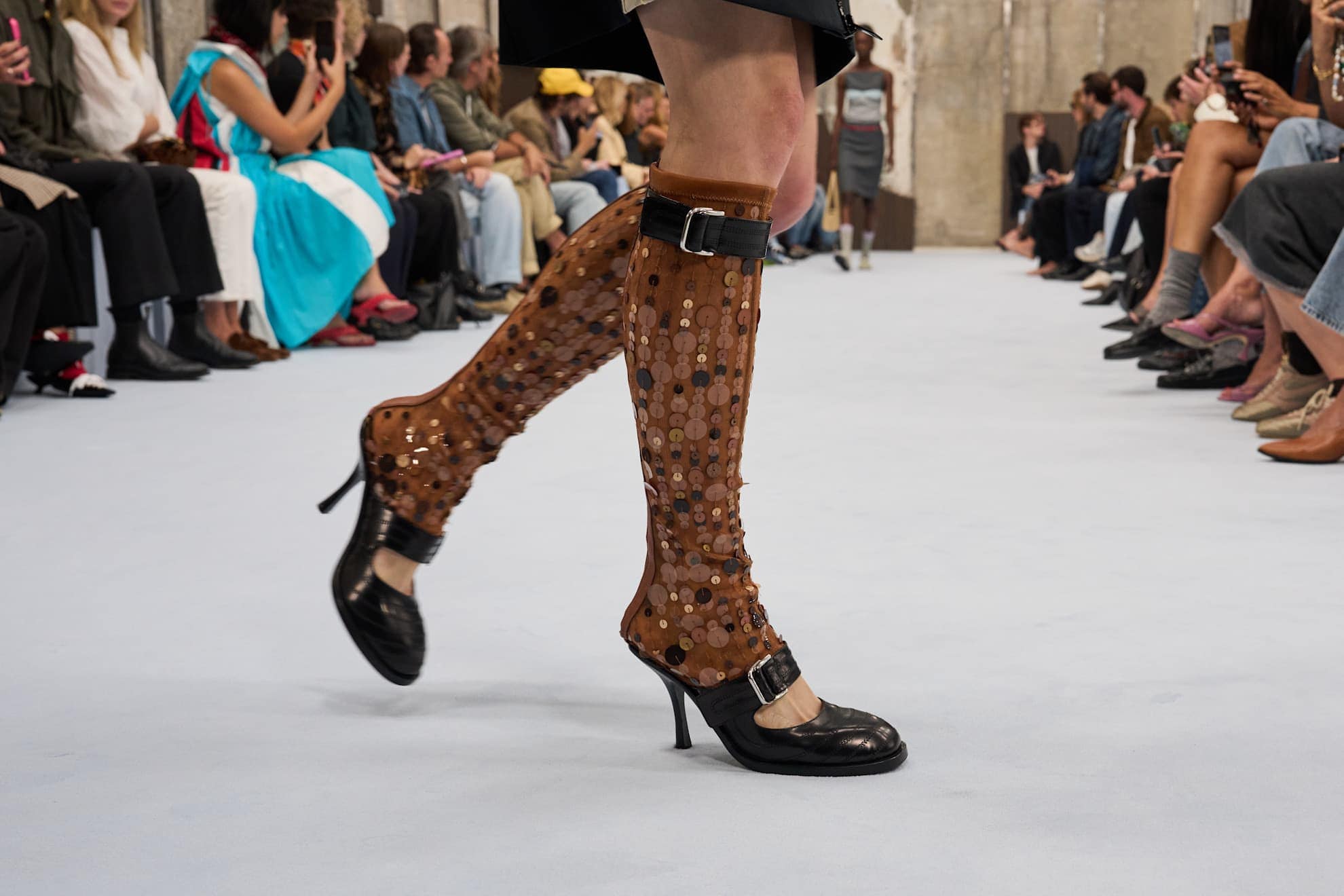
Because Rogge’s Marni does not appear interested in being one thing at once. It can be sentimental and industrial, decorative and stripped away, familiar and slightly peculiar. The contradictions are not problems she is trying to solve. They are increasingly becoming the point.

Even the environment around the collection follows that philosophy. Working again with Formafantasma, the team reused much of the material from the previous show, preserving the structure while removing layers and revealing different aspects of what was already there. Rogge describes it almost as another form of editing: continuity through rearrangement rather than reinvention for its own sake.
That seems particularly fitting for where she is with Marni now.
Her relationship with the house began with admiration. Her responsibility today is considerably more complicated.
She must know the archive without becoming beholden to it. Recognize the codes without reenacting them. Respect the designer who shaped her own early understanding of fashion while refusing to pretend that another era can simply be reproduced.
And somewhere inside all that responsibility, there still has to be enough room for fun.
Rogge appears to understand that instinctively.
Marni already has history. What she is adding now is movement, contradiction, a little irreverence and, increasingly, a point of view that feels like her own.
A little more mischief may be exactly what helps get it there.