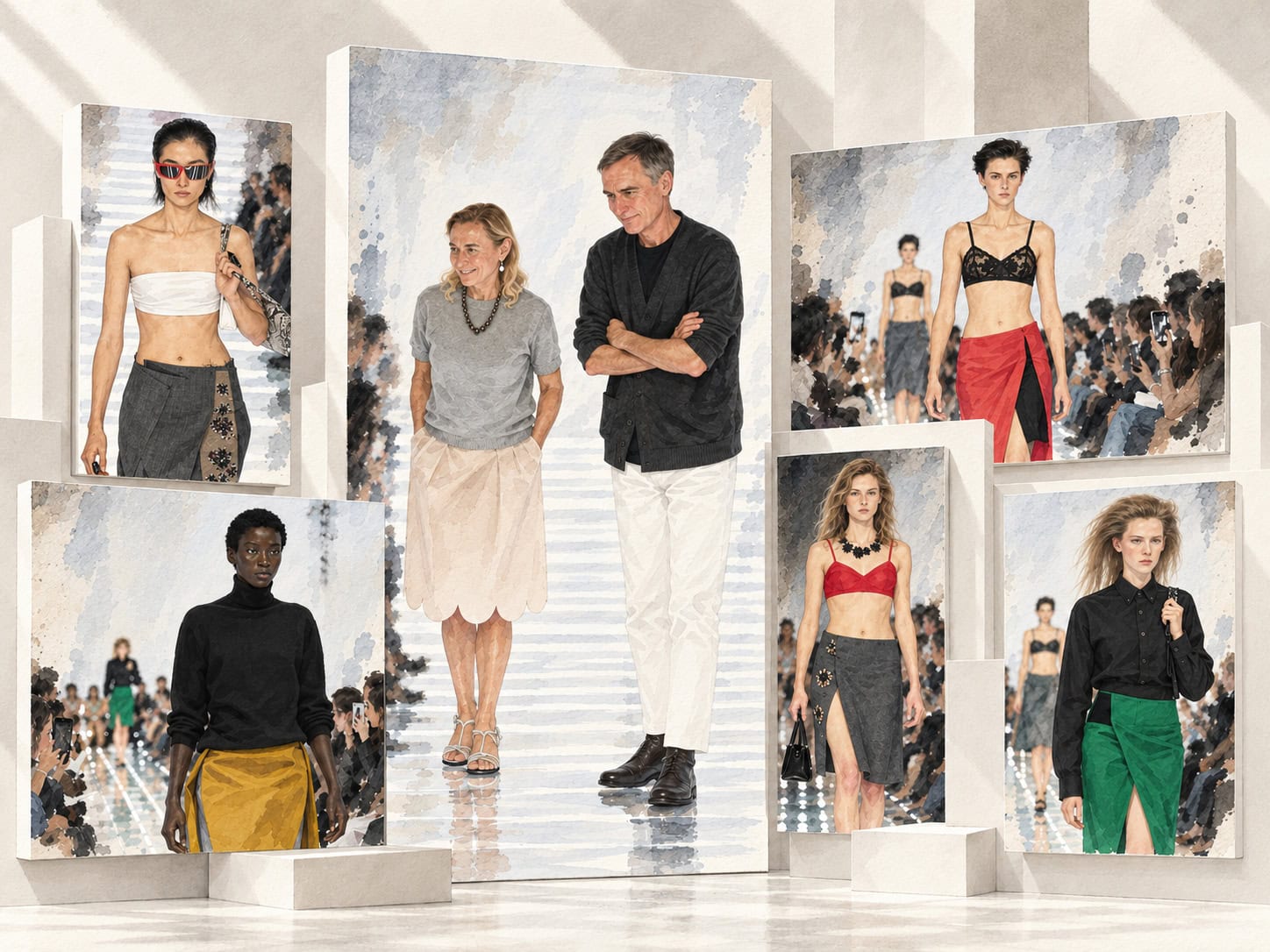
For Spring The Designers Reduce Fashion To One Of Its Most Elemental Garments — The Skirt — And Use It To Consider Freedom, Contradiction, Beauty, And The Difficulty Of Being Only One Thing
By Angela Baidoo
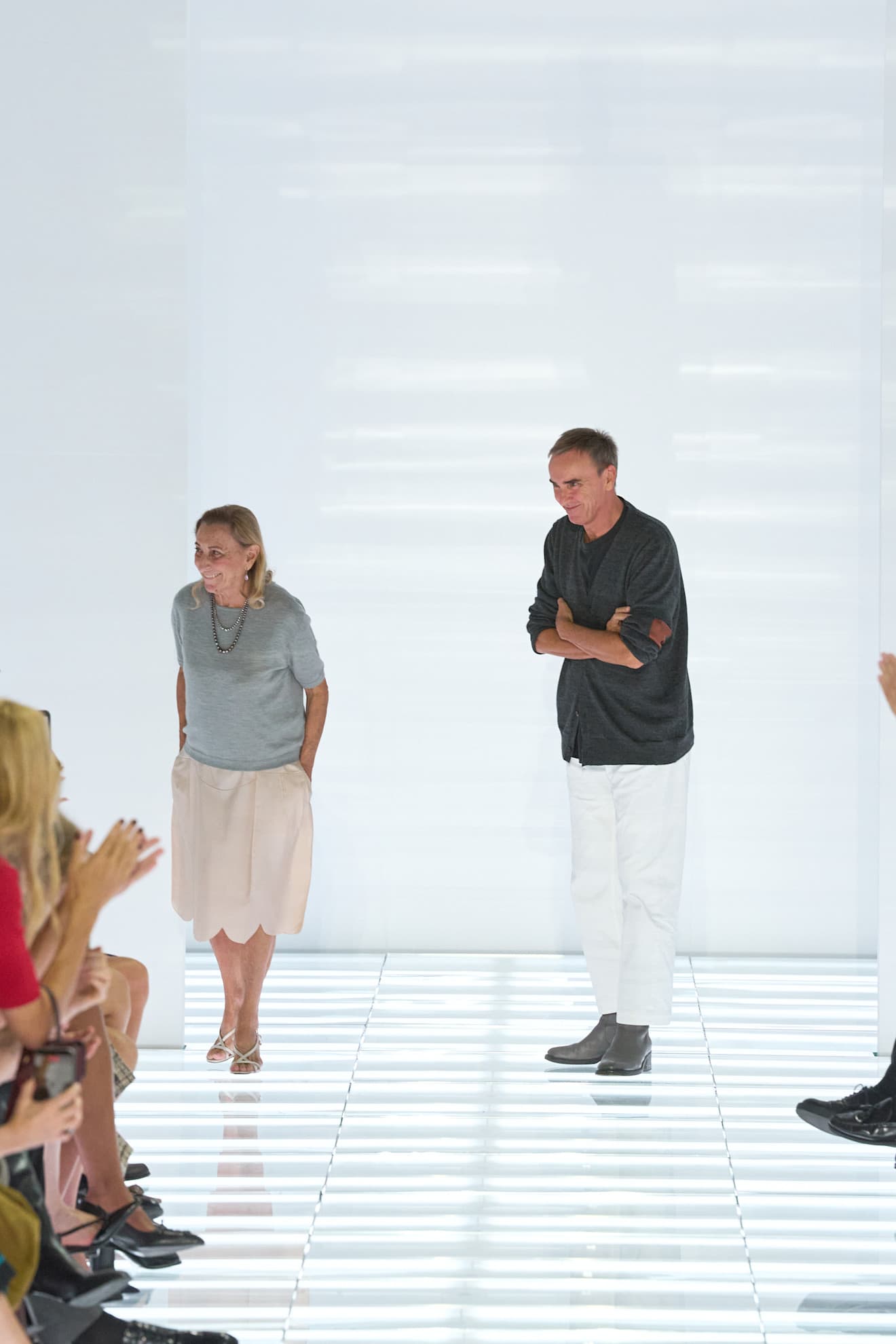
An increasingly complicated world led Miuccia Prada and Raf Simons somewhere surprisingly simple: a rectangle.
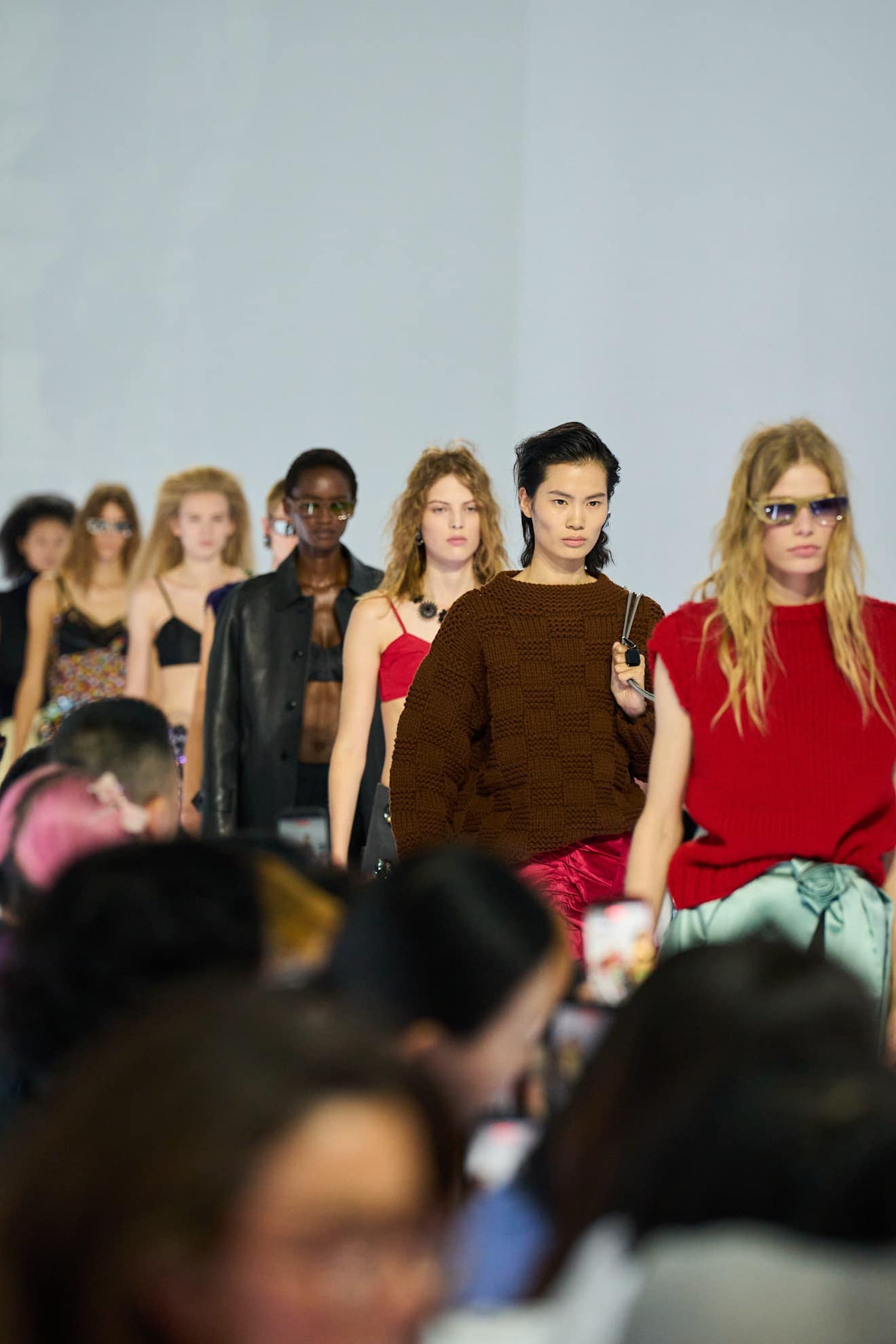
Ahead of Prada’s Spring 2027 show, the designers described a collection built almost entirely around the skirt. No trousers. No dresses. One familiar garment instead became the structure for a much broader conversation about femininity and toughness, sophistication and innocence, decoration and industry, exposure and protection, beauty and ordinary life.
The decision came instinctively. Simons recalled the moment when the thought surfaced: what if they simply made a show of skirts? Once imposed, the limitation opened up possibilities. Rather than narrowing the collection, the skirt gave the designers a fixed point from which almost everything else could move.
For Prada, its appeal is also personal. Skirts have long been central to her own wardrobe, but what interests her is where they sit on the body. She prefers to concentrate fashion away from the face, leaving the upper part of a person freer and allowing the ideas to gather below the waist.
The skirt becomes a frame.
That instinct connects easily to the larger Prada language. The house has rarely been interested in clothes that offer a neat summary of the woman wearing them. Beauty is interrupted by awkwardness, femininity by severity, luxury by banality. Good taste becomes more compelling once something unsettles it.
Spring 2027 turns that longstanding tension into an unusually direct proposition.
“Everything is so complex and how can it be just one thing?” Prada said. “And also when you express yourself, it’s not that you are feminine, sexy, masculine, so you are so many things together.”
Everything is so complex and how can it be just one thing?
– Miuccia Prada
Fashion has spent much of its history assigning identities through clothes. Silhouettes once signaled class, occupation, gender, age, propriety, rebellion or sexuality with remarkable precision. Even breaking those conventions could eventually become another recognizable uniform.
The contemporary wardrobe is less obedient. Someone can move through several identities in the course of a day, sometimes all at once. Sportswear lives alongside luxury. Underwear becomes outerwear. Masculine and feminine codes trade places freely. A garment can suggest one thing while the rest of the look argues another.
Prada and Simons are interested in that instability.
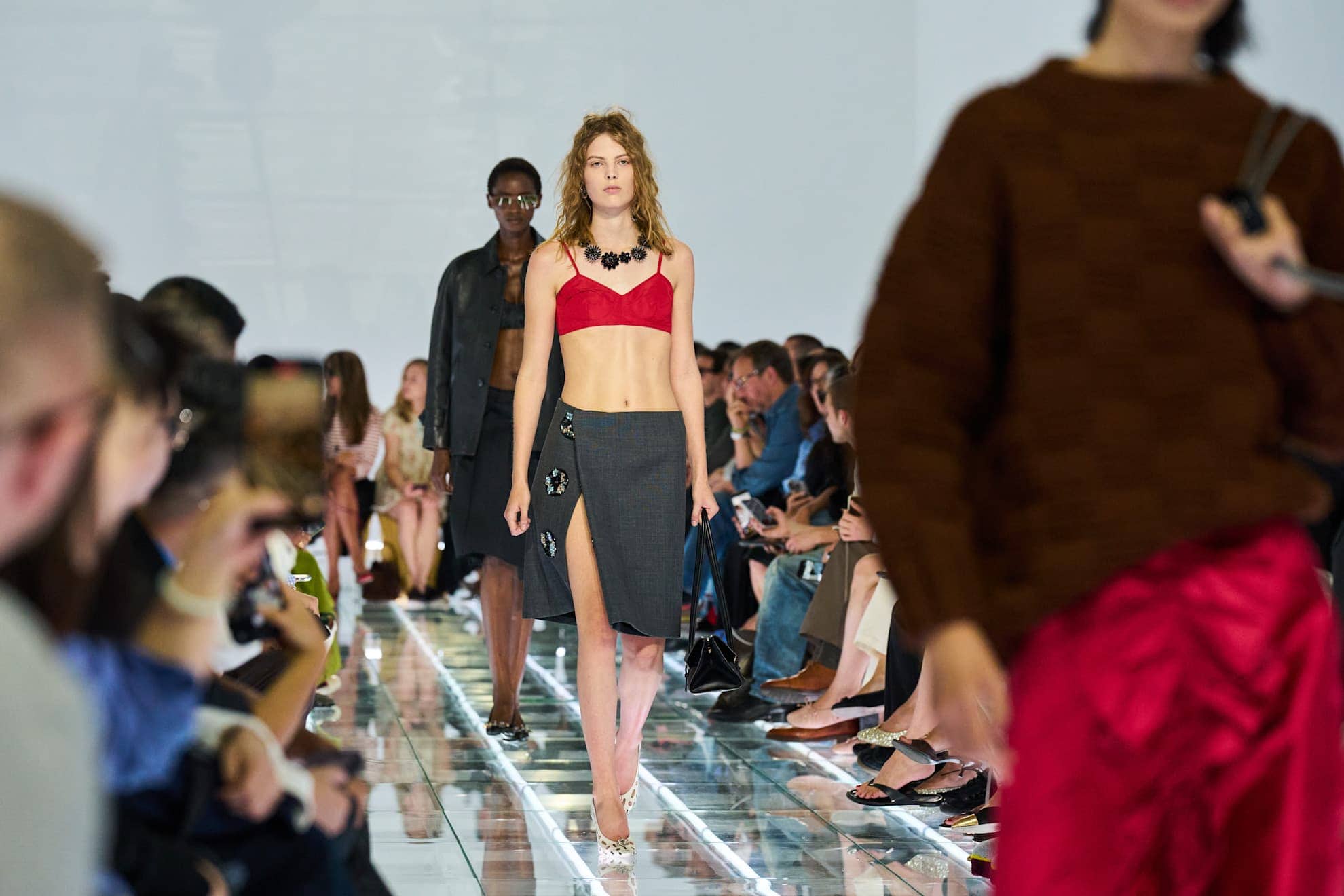
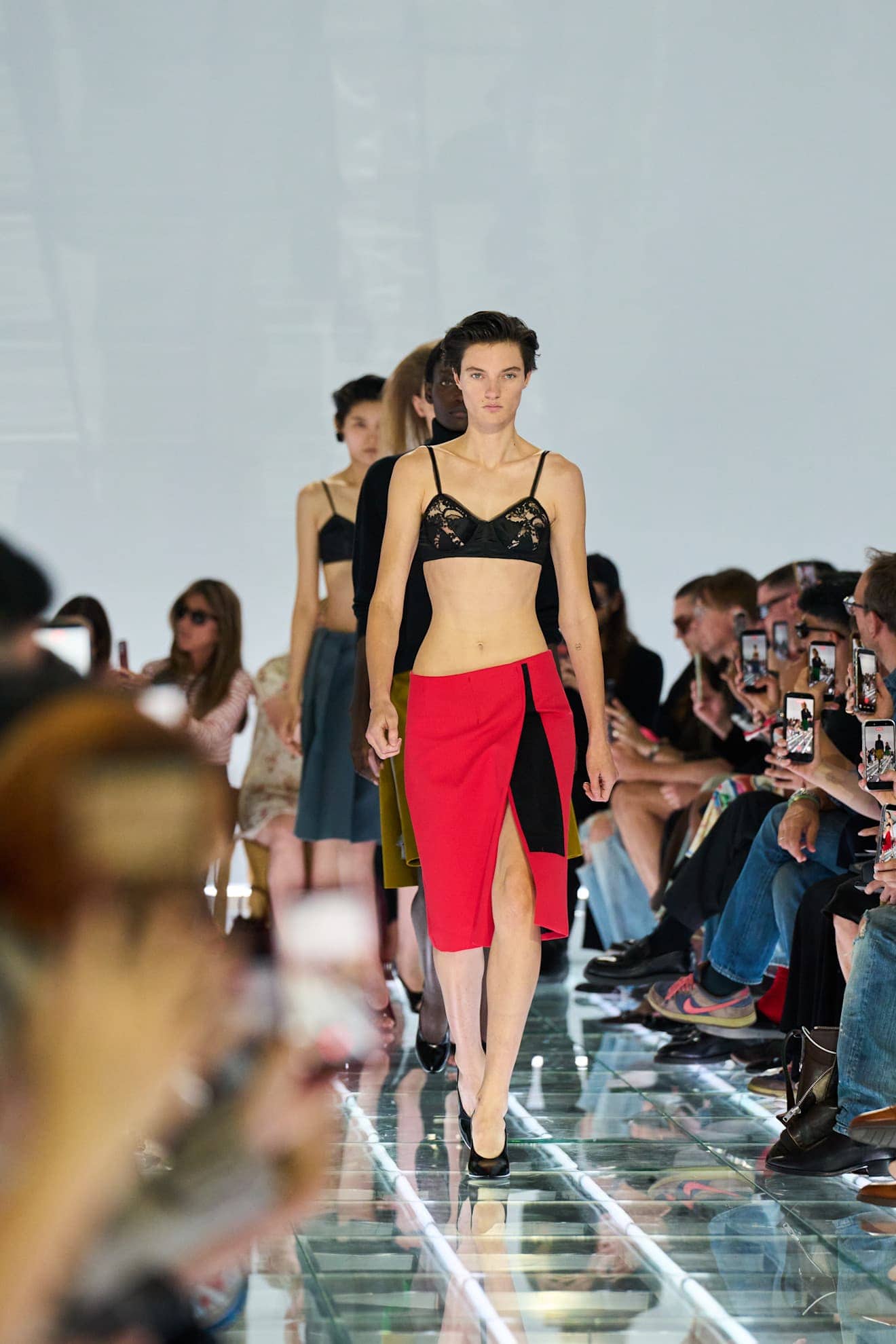
A lace bra with a severe skirt, an innocent flower beside an industrial fastening, a plain knit against something overtly decorative: these combinations are not being used merely to create visual friction. They are intended to describe a person who cannot be reduced to a single quality.
“That’s why what looks like styling is not styling, it is the complexity,” Prada said.
The skirts gave them an efficient structure for working through that idea. Many began with simple, linear shapes, often based on rectangles. From there came pleats, transparency, raw edges, floral surfaces, tailoring fabrics, embroidery and technical constructions. Industrial Velcro operated simultaneously as fastening and decoration, allowing a skirt to open, close, rise or fall according to the wearer. Delicate embroidery appeared directly over materials associated with utility.
Crin, normally hidden inside clothing to support a silhouette, was brought outside. Instead of quietly shaping a garment from within, it became visible and altered the behavior of the fabric beneath it.
Moving familiar elements out of their expected positions has always been one of Prada’s most effective tools. Here the technique keeps the clothes slightly unsettled. A material associated with construction becomes decoration. Something precious meets something industrial. A conventional skirt acquires an unexpected degree of agency.
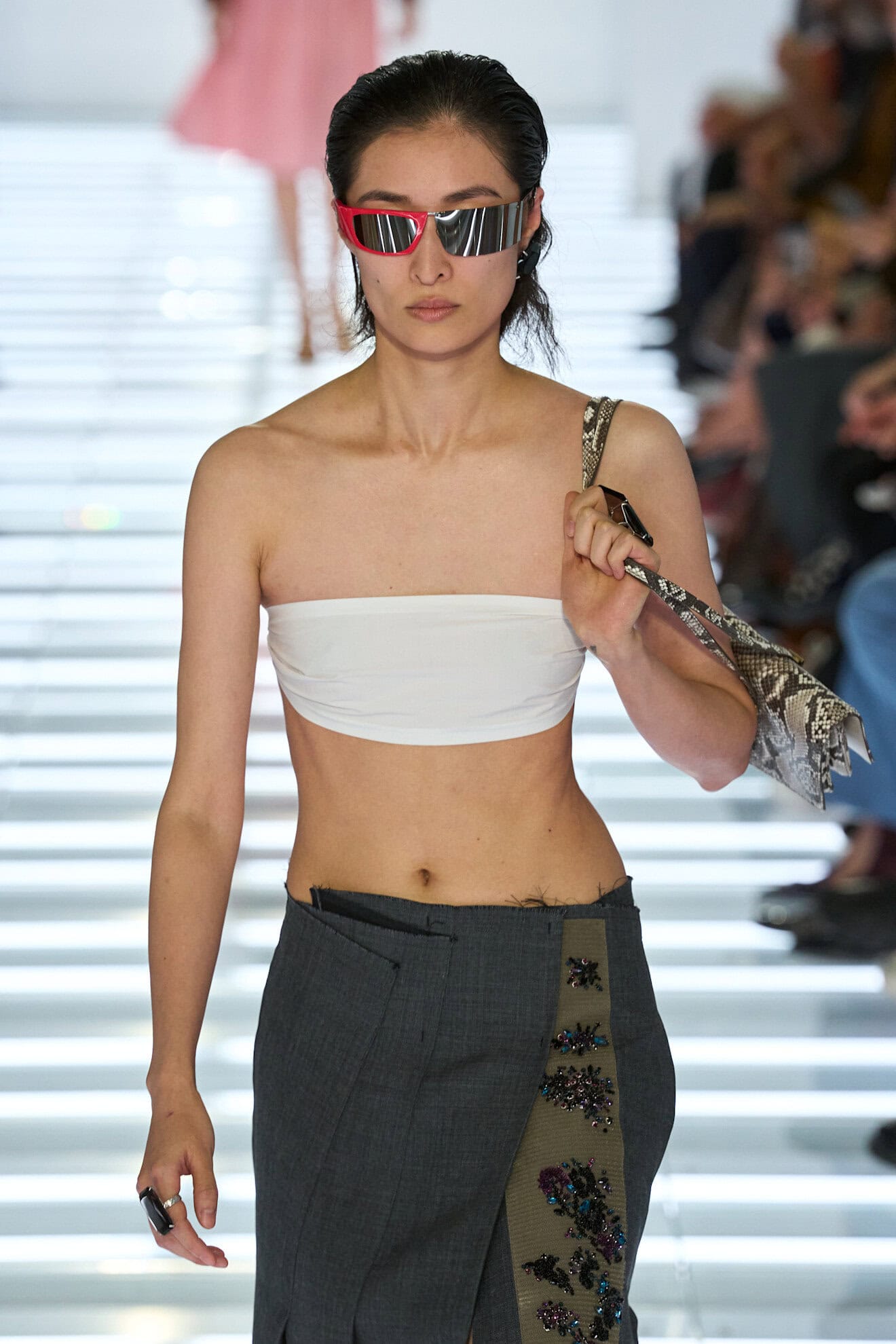
We constantly want to work with the contrasts and things that you know and things that are familiar. How can you rethink and how can you reintroduce.
– Raf Simons
Simons repeatedly returned to the possibilities the skirt leaves open. A dress arrives with far more decisions already made. A skirt leaves the upper body unresolved. It might meet a bra, a shirt, knitwear, leather or something as ordinary as a T-shirt. Its character changes with each choice.
The opening looks made the idea especially clear. Black tops created a controlled backdrop, while the skirts shifted underneath them. Yet even the black was handled differently — a turtleneck, a lace bra, a button-down shirt. The designers established a framework without prescribing a complete identity.
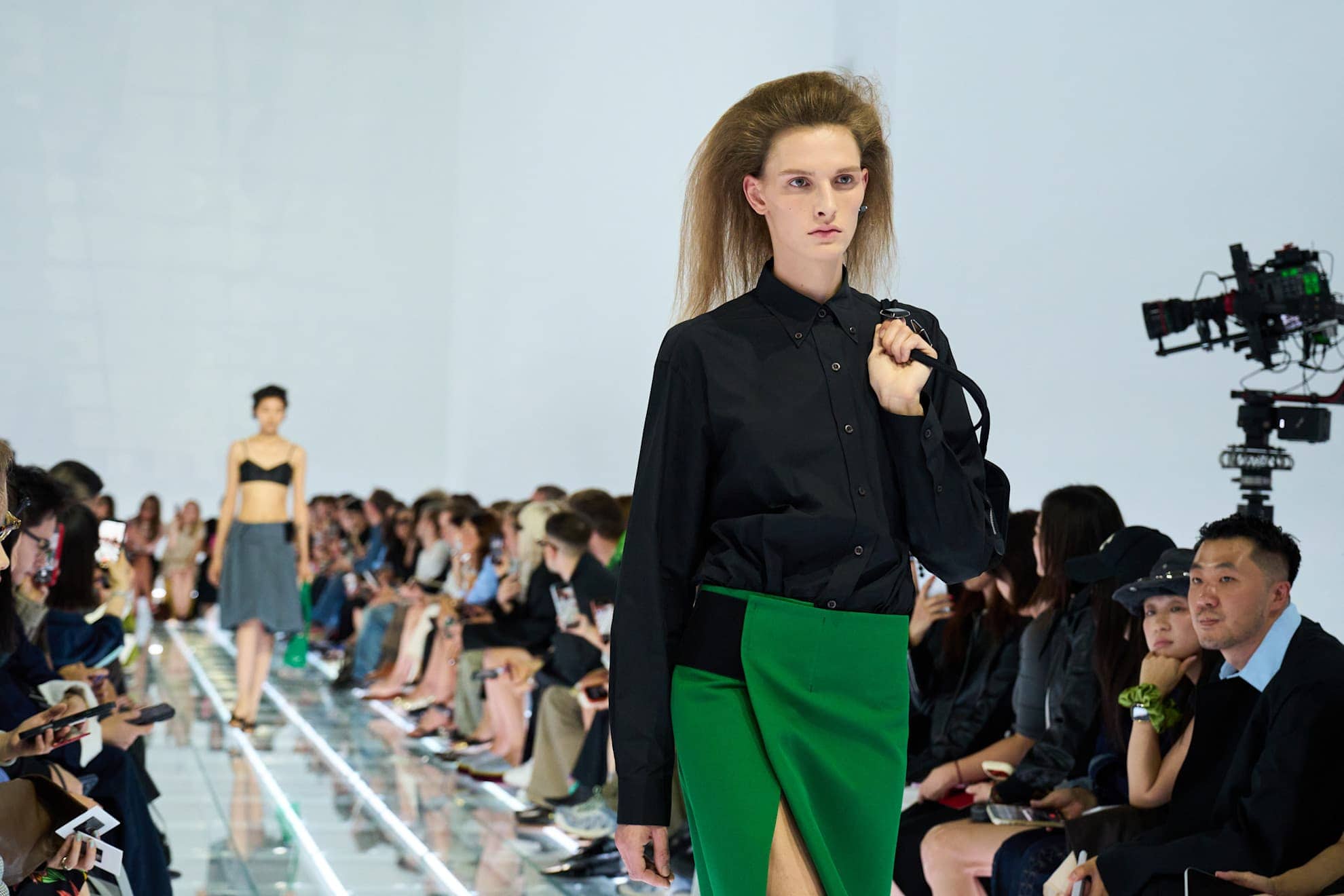
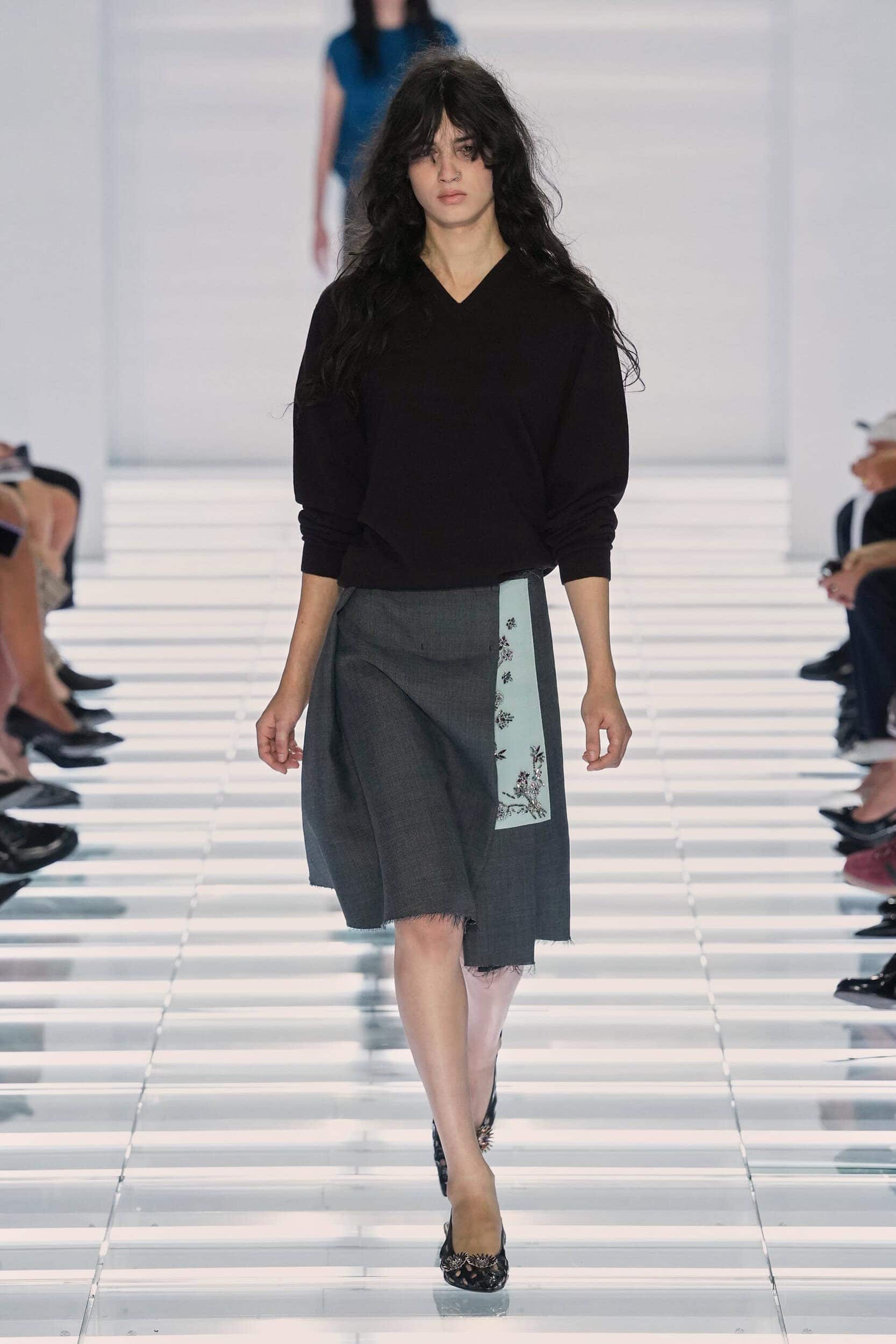
There is a generosity in that approach. Runway fashion can be highly controlling: this coat with that shoe, this proportion with that gesture, this woman inhabiting this specific world. Prada and Simons instead seem increasingly interested in leaving enough room for the wearer to interfere.
Simons described that interference as one of the greatest compliments a designer can receive. The object leaves the studio, and somebody else gives it a life the designer could not entirely predict.
The freedom is physical as well as conceptual. Velcro allows adjustment. Wrap constructions open and shift. Rectangles can be manipulated around the body. The garment proposes rather than commands.
Prada, however, complicates even the idea of freedom. Her relationship with beauty has never been uncomplicated, and during the conversation she returned to the difficulty of carrying beauty into everyday life.
You need to camouflage the beauty so that you can live with people.
— Miuccia Prada
Luxury traditionally amplifies beauty. It isolates it, perfects it and draws attention toward it. Prada has often preferred beauty once something has rubbed against it. A beautiful skirt can become easier to inhabit beside a plain knit. Delicate embroidery becomes sharper against Velcro. A traditionally feminine gesture gains energy when something tougher pushes back.
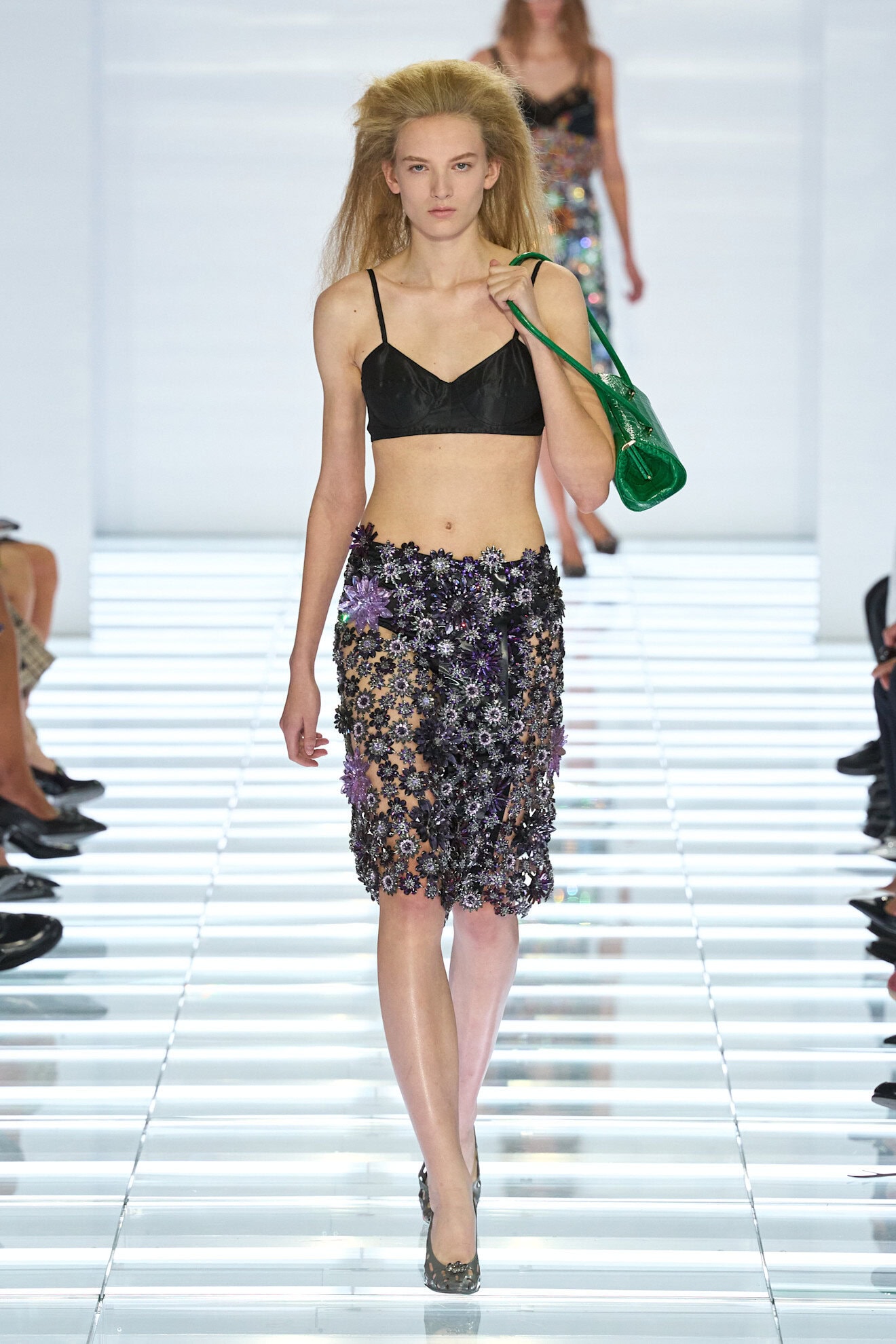
Spring 2027 is filled with those collisions. Grey skirts are interrupted by jeweled elements. Transparent layers soften familiar constructions. Dense floral embellishment sits against severe tops. Bright color appears on utilitarian shapes. Bras expose the body while many of the skirts hold to an almost conventional knee length.
Simons described pieces that could feel luxurious and childish, tough and delicate, innocent and sexy. None of those qualities cancels another out.
It is difficult not to see the collection through the conditions of the present. Contemporary culture is remarkably efficient at sorting people. Algorithms convert taste into categories. Brands seek easily recognizable identities. Social media encourages individuals to make themselves legible at a glance. Fashion increasingly circulates through images that need to announce their meaning almost instantly.
Prada and Simons offer a less convenient proposition.
People contradict themselves. Someone can want comfort and sensuality, anonymity and attention, romance and severity. A woman can move between work, family, social life and private life without changing into a completely different person for each role. Clothes can accommodate those shifts without explaining them.
The skirt works because it leaves part of the thought unfinished.
That’s why what looks like styling is not styling, it is the complexity.
— Miuccia Prada
Prada also pointed to the skirt’s almost primitive history. In its simplest form, it is among the oldest garments: material wrapped around the body, used by men and women long before modern clothing accumulated its elaborate social codes.
There is no nostalgia in their return to that simplicity. The rectangle functions as a design tool. Within it, they can embroider, pleat, cut, expose, conceal, industrialize or decorate. The simpler the starting point, the more possibilities it can absorb.
For a collection so rigorously focused on one garment, Spring 2027 ultimately argues against singularity.
A skirt can be feminine or masculine, elegant or ordinary, sensual or practical. It can be decorated until nearly every inch is occupied or reduced to something close to nothing. Prada and Simons set the frame and fill it with contradictions, then leave enough room for another person to finish the thought.
That freedom may be the most Prada idea of all.