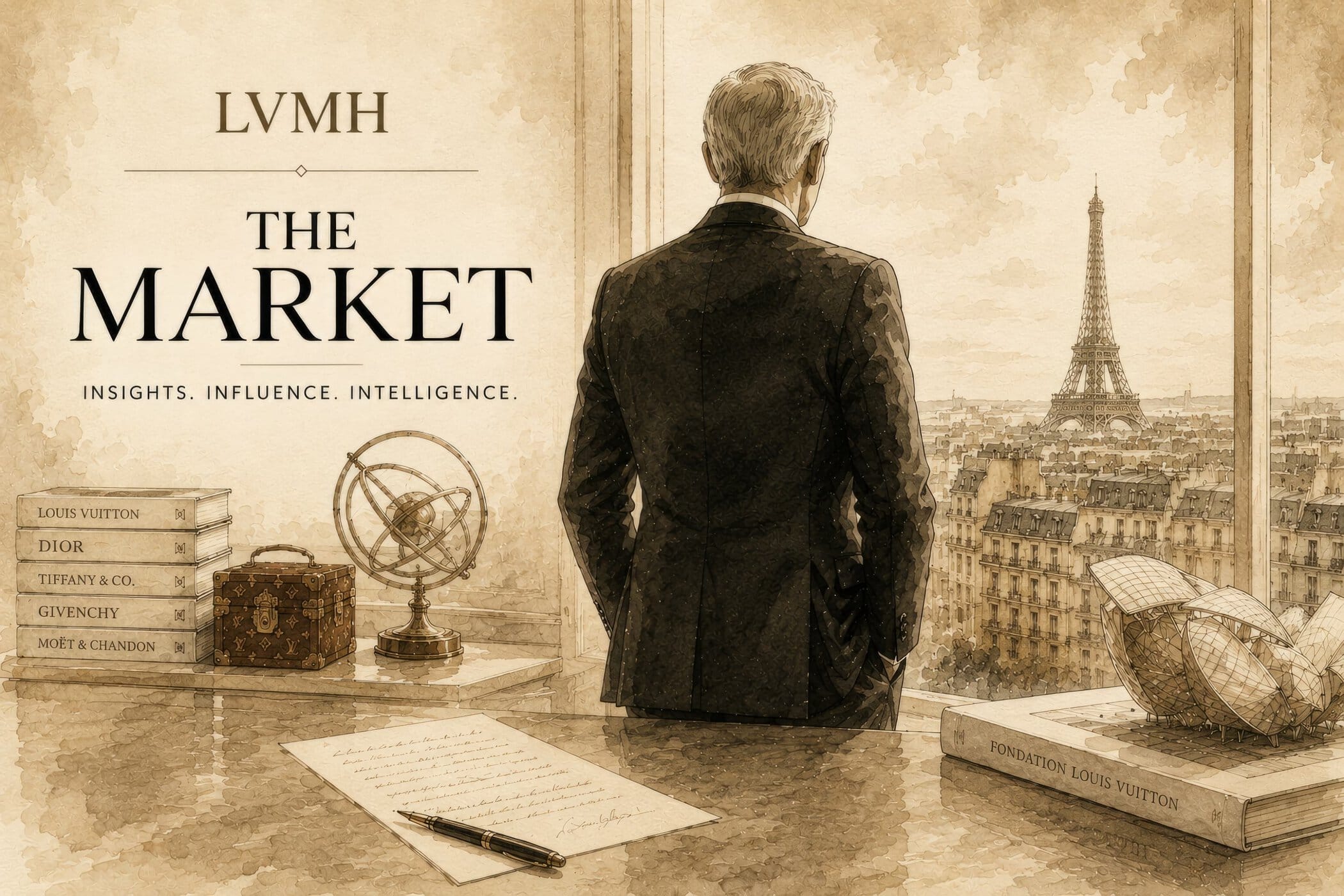
Bernard Arnault’s unexpected letter reveals why personality may be luxury’s newest competitive advantage
One of the privileges of this profession is spending time with the people who quietly shape fashion long before the rest of us see the results. Season after season, I find myself sitting across from CEOs, chairmen, founders, and creative directors whose decisions ultimately influence what appears on the runway, what reaches stores, and, increasingly, how entire brands are perceived.
The unedited conversations are almost always more interesting than one imagines.
Away from quarterly earnings, shareholder meetings, and prepared remarks, many of these leaders reveal a wit, warmth, curiosity, and self-awareness that rarely reaches the outside world. It is one of luxury’s great paradoxes. The people leading some of the world’s most admired companies are often far more engaging than the carefully managed corporate voices speaking on their behalf.
Which is why Bernard Arnault’s recent open letter caught my attention.
Not because he responded to criticism. Great leaders have always defended the organizations they build. What surprised me was how he chose to do it.
Rather than issuing a carefully polished corporate statement, the Chairman and Chief Executive Officer of LVMH responded to Le Monde‘s six-part investigative series in his own voice. There was irony. There was humor. There was confidence. There was even a willingness to laugh at himself. When the newspaper observed that his executives all appeared remarkably slim, Arnault dryly apologized for this “failure of bodily diversity” and joked that he would discuss the matter with the company canteen on Monday.
It was funny.
More importantly, it was unexpected.
For decades, luxury has been built on mystique. Brands perfected the art of saying less, believing distance created desirability and that silence reinforced authority. Their leaders often adopted the same philosophy, allowing the maisons to speak while they remained comfortably behind the curtain. Designers became the public faces. CEOs built the businesses. The separation felt deliberate.
Arnault’s letter suggested that equation may be changing.
What fascinated me wasn’t simply that he displayed a sense of humor. It was that he sounded unmistakably like Bernard Arnault rather than the chairman of a multinational corporation. His response wasn’t written in the language of crisis communications or corporate affairs. It felt personal. Readers weren’t encountering an institution defending itself; they were hearing from the man who had spent four decades building it.
That distinction matters because trust increasingly belongs to people rather than organizations.
Consumers today follow founders, chefs, architects, artists, and entrepreneurs as much as they follow the companies they lead. Personality has become a form of credibility. Authenticity, once considered almost incompatible with luxury’s carefully protected mystique, has become one of its most valuable assets.
Arnault understood something else that is easy to overlook.
Beneath the wit, he quietly reframed the entire conversation. Rather than allowing LVMH to be defined solely by acquisitions, succession planning, or market capitalization, he redirected attention toward what he believes the company has contributed to France: hundreds of production workshops, thousands of apprentices learning traditional crafts, billions contributed to the public treasury, the Fondation Louis Vuitton, the restoration of Notre-Dame, and a business carrying French craftsmanship to nearly one hundred countries.
Whether one agrees with every argument he makes is almost beside the point.
He chose to tell the story himself.
That, perhaps, is the real shift.
Luxury has spent decades perfecting brand storytelling while often overlooking leadership storytelling. Yet brands are ultimately shaped by people, and people naturally connect with other people. We don’t admire vision in the abstract. We admire the individuals capable of articulating it.
The irony is that many of fashion’s leaders already possess these qualities. Over the years I’ve met executives whose humor, generosity, intellectual curiosity, and passion for craft never appear in public because somewhere along the way luxury decided that personality should remain backstage.
Perhaps it shouldn’t.
This isn’t an argument that every CEO should become a social media personality or compete for attention with influencers. Quite the opposite. Luxury has always valued restraint, and that remains one of its strengths. But restraint and humanity are not mutually exclusive. There is room for leaders to reveal conviction, humor, vulnerability, and perspective without diminishing the mystique of the brands they steward.
Bernard Arnault didn’t dismantle luxury’s aura with one open letter.
He reminded us that there is a human being behind it.
In an era increasingly shaped by algorithms, artificial intelligence, and corporate messaging polished until every sentence sounds interchangeable, that may prove to be one of the most luxurious qualities of all.
Being unmistakably yourself.
Warm regards,
Kenneth Richard