Five Years Of Leadership Changes At Kering And LVMH Suggest That Fashion’s Executive Offices Are Every Bit As Restless As Its Creative Studios
By Kenneth Richard
Another week in fashion, another shuffle of the creative deck. This time, Pierpaolo Piccioli is leaving Balenciaga, with Martine Rose announced as his successor. Following recent changes at Saint Laurent and McQueen, Kering has given us plenty to talk about. At this rate, keeping track of who’s designing what may soon require air traffic control.
The conversations, of course, follow a familiar script. Who was the right choice? What went wrong? Who should take over next? And how soon can we start speculating about their replacement?
We’ve become rather accustomed to treating creative directors like movie stars. We celebrate their arrivals, scrutinize their performances, and speculate about how long they’ll remain in the leading role. When the reviews are good, they’re geniuses. When the box office disappoints, we start discussing the next casting. Often before the closing credits.
But fashion houses are considerably more complicated than that.
Behind every creative director is a team making decisions that can be just as consequential as anything we see on the runway. Yet when a house struggles, the spotlight has a remarkable tendency to settle on one person. It’s an arrangement that makes for excellent headlines, if not always a particularly complete picture.
And while we’ve been watching fashion’s creative revolving door, another has been turning just as quickly.
Across 14 fashion houses at Kering and LVMH, we counted 17 CEO appointments over the past five years, compared with 13 creative leadership appointments.
The executive offices have revolving doors, too. They simply attract fewer photographers.
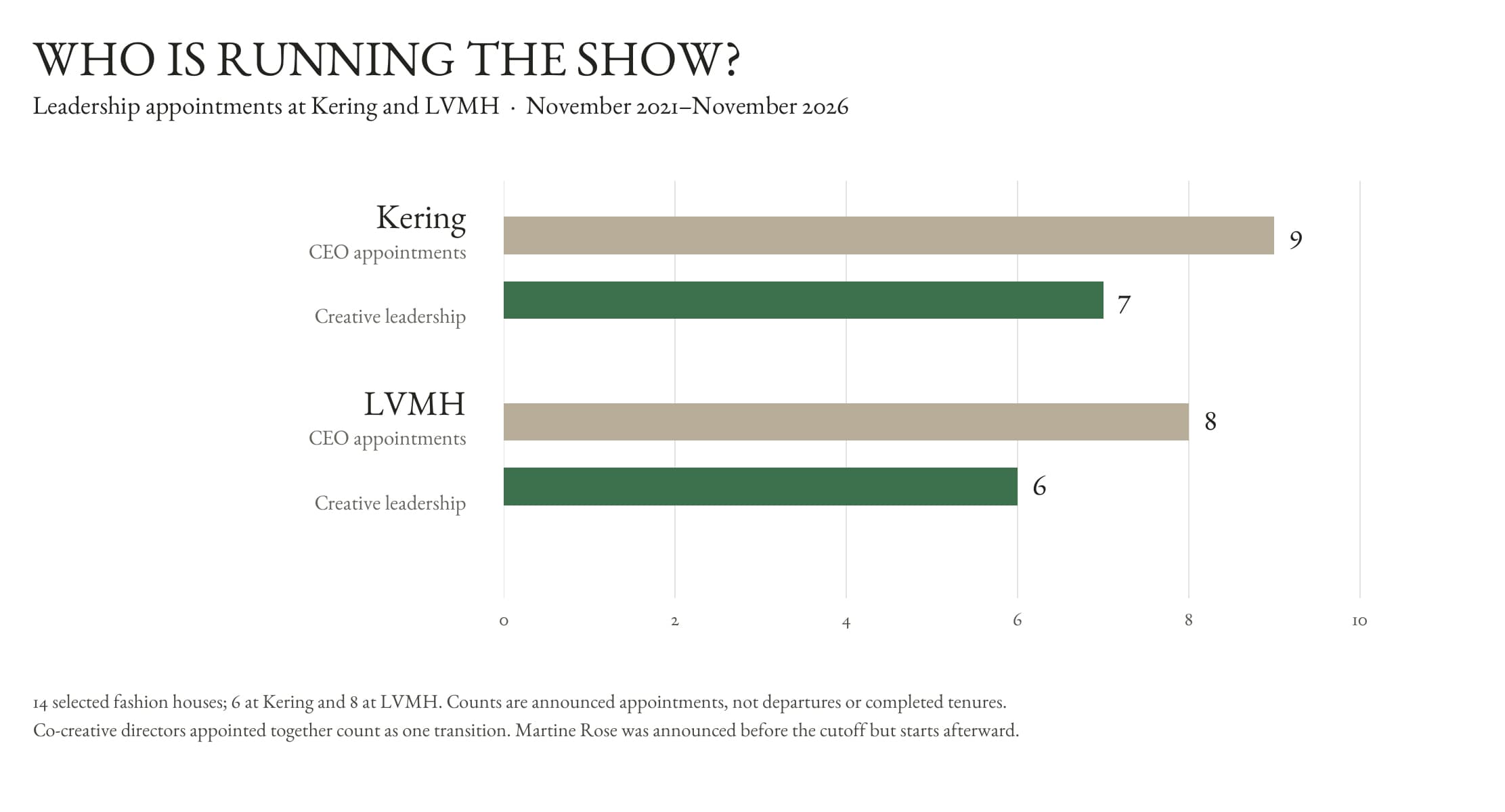
Of course, these changes aren’t always independent. A new CEO may arrive with a mandate to rethink a house’s direction, and a new creative director can be part of that plan. Sometimes the two appointments are simply different acts of the same production.
Still, it’s curious how much attention we devote to who’s designing the clothes, and how little to who’s running the house. We can spend weeks debating whether a designer understands a founder’s legacy, while the person responsible for the entire business can change without so much as a front-row whisper.
I’ve always found the relationship between a creative director and the wider team one of fashion’s more fascinating dynamics. At its best, it’s a meeting of extraordinary minds. At its worst, it’s a very expensive exercise in everyone nodding politely.
I’ve seen brilliant creative directors make questionable decisions about advertising campaigns or show presentations, with nobody around them quite willing to suggest there might be a better way. When someone is celebrated as a creative genius, disagreeing can require a certain amount of courage. Particularly when everyone else in the room has already declared the idea a masterpiece.
And sometimes the problem isn’t a lack of courage. It’s a lack of equally strong talent.
A great creative director deserves an equally great CMO, merchant, and communications team. And often, an outside creative director with the imagination, and nerve, to challenge the vision.
I’ve seen houses where the designer’s ideas go unquestioned, and the only outside talent brought in is there to execute them. The result can be a beautifully produced campaign that nobody thought to ask whether it was a good idea in the first place.

We hear a great deal about everyone being aligned. But a room full of people agreeing on a bad idea is still a room full of people agreeing on a bad idea. Even in a beautifully designed conference room.
Perhaps the more interesting question isn’t whether a fashion house has found the right creative director, but whether it has assembled the right people around them.
The numbers don’t prove that CEOs are more responsible than designers, or that every leadership change signals trouble. They do, however, suggest that our fascination with the disposable designer and the seemingly immovable executive could use a little updating.
After all, finding a genius is impressive. Building a team of people talented enough to challenge as well as support one is considerably more difficult.
And considerably more valuable.
Warm regards,
Kenneth Richard
Chief Impressionist