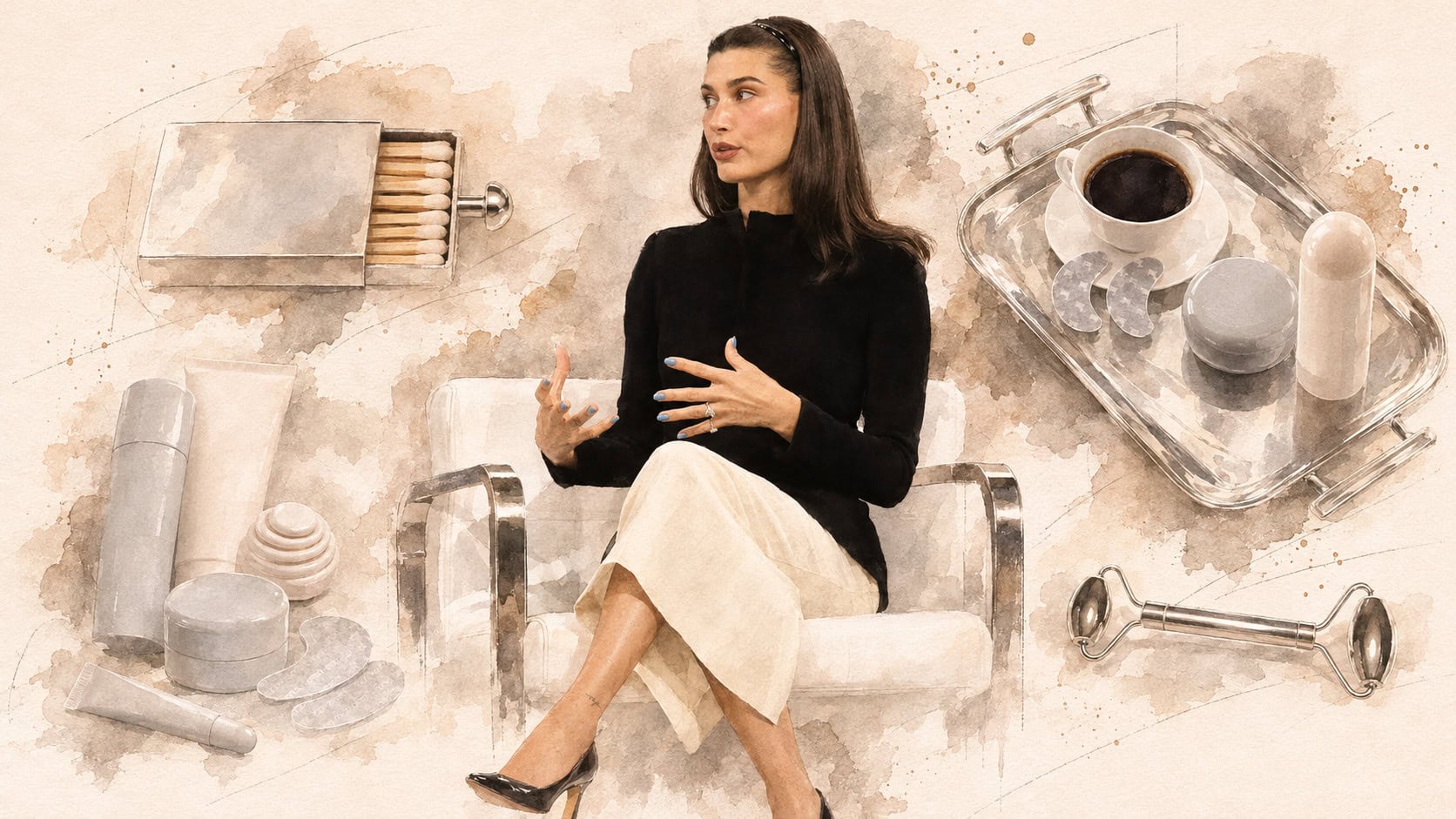
The reaction to her DealBook appearance raises questions about corporate credibility, the limits of reputation management, and what audiences now expect from an interview.
By Mackenzie Richard Zuckerman
Hailey Bieber had helped build a beauty business that secured an acquisition worth up to $1 billion. A casual answer soon overshadowed that achievement.
At The New York Times’ DealBook Summit on November 18, Andrew Ross Sorkin asked what had given her confidence in that billion-dollar ambition. Her response—“optimistical delusion”—struck some viewers as aloof. The resulting outrage turned attention toward her personality and preparedness, leaving the business behind the answer less examined.
There is a distinction worth preserving: a founder’s ambition does not establish a transaction price. Reaching that deal required a willing buyer and negotiated terms. An unconvincing explanation does not undo the commercial achievement.
Celebrity also does not automatically make someone an experienced public speaker or chief executive. A founder’s contribution may lie in creative judgment, cultural influence, and customer relationships, supported by colleagues with different expertise.
For fashion and beauty, this raises questions about how that expertise is explained, how teams prepare founders to represent the business, and how an interview can reveal more than another reason to love or dislike its most recognizable face.
How much of a company’s credibility should depend on its founder’s public performance?
Rhode’s commercial record provides context that a viral clip cannot. According to e.l.f. Beauty, the company generated $212 million in net sales in the year ending March 2025. The acquisition included $800 million at closing, with a potential additional $200 million tied to future growth.
Those figures establish a basis for discussing the business beyond its founder’s interview performance. They also make questions about how it achieved that growth worth asking.
An interview can reveal how clearly a founder explains their contribution, understands the company’s direction, and accounts for its decisions. Its usefulness depends on distinguishing those insights from judgments about confidence, delivery, or likability.
Celebrity-led companies are particularly exposed to that distinction. The founder’s public identity can help customers recognize and trust the brand long before they understand the organization behind it. Under scrutiny, the same association can encourage audiences to treat an unsatisfying answer as evidence of a weak business.
For brand leadership and communications teams, the consequence is a concentration of reputational responsibility. One person’s performance can shape perceptions of capabilities distributed across an entire company.
The more closely the brand identifies with its founder, the more consequential it becomes to explain where that individual’s contribution sits within the wider enterprise.
What gets lost when a collaborative business is presented as one person’s success story?
The celebrity founder narrative gives a company a recognizable identity. It can also make the distribution of responsibility difficult to see.
Rhode’s corporate structure offers a more collaborative account. At the time of the acquisition, e.l.f. outlined Bieber’s responsibilities as chief creative officer and head of innovation, alongside co-founders Lauren Ratner, president and chief brand officer, and Michael D. Ratner, co-executive chairman, as well as CEO Nick Vlahos. The company described distinct responsibilities across its leadership.
Public storytelling rarely gives each function equivalent visibility. The founder’s personality provides continuity across campaigns, products, and appearances; the organization becomes the background to their story.
That creates an asymmetry. A founder can receive credit for the company’s collective achievements while also being expected to explain decisions well beyond their individual remit.
The familiar debate about whether someone is the face or the brains of a brand does little to resolve this. Creative direction, audience development, product judgment, and operational leadership are different contributions. Understanding how they interact offers a more useful assessment of the business.
A joint appearance can reveal that collaboration. At DealBook, the expertise was nearby: Sorkin thanked Bieber’s co-founders in the audience at the conclusion of the interview.
Their presence raises a question about how companies choose to represent themselves. A singular founder narrative is powerful. Its clarity can come at the expense of a fuller understanding of the enterprise.
Does the industry fully account for the commercial value of cultural influence?
Celebrity can attract attention. Building a durable business requires that attention to become something commercially meaningful.
For a founder whose identity is embedded in the brand, their contribution may include an ability to recognize an emerging preference, establish a visual language, or understand how a product fits into a customer’s desired identity. These capabilities can influence demand even when they are difficult to describe in conventional executive language.
That difficulty creates a problem of translation.
An audience may recognize the outcome—a desirable product, a coherent aesthetic, a highly engaged community—without understanding the decisions that produced it. Equally, a founder’s familiarity with their own instincts may make those decisions seem too obvious to explain.
The useful questions concern the connection between judgment and results. What did the founder recognize about the customer? Which choices followed from that understanding? How did the company distinguish initial interest from a relationship that could support repeat purchases?
These are business questions about cultural expertise.
Beauty’s capacity to create substantial value is already established. L’Oréal’s 2023 agreement to acquire Aesop, for example, valued that business at $2.525 billion. The company’s announcement set out those terms. The more revealing inquiry concerns what makes a particular company valuable within that market.
For celebrity founders, articulating that contribution can clarify their authority. For the wider industry, understanding it can improve how creative expertise is evaluated, credited, and incorporated into a company’s growth strategy.
When does protecting a founder’s image start to obscure the business?
In Bieber’s case, the public image surrounding Rhode includes both intense admiration and persistent hostility. That polarization is part of the environment in which the brand attracts attention, builds relationships, and is judged.
The interview exposed those competing attachments directly. A follow-up question could register with supporters as another instance of unfair treatment. A hesitant answer could give critics confirmation of an opinion they already held. The business discussion became entangled with narratives about Bieber that existed long before she took the stage.
That complicates what a successful communications outcome looks like. An appearance that leaves some viewers unconvinced may reinforce loyalty among others. Defending the founder can become an expression of identification with the brand, while criticism can sustain its visibility. Neither response, on its own, tells us much about the company’s capabilities or commercial performance.
For a business whose identity is closely connected to its founder, these reactions create a tension. The same personal attachment that helps make the brand compelling can make an independent assessment of the organization more difficult.
Protecting Bieber from every unfavorable interpretation would be an impossible objective. The more consequential question is whether the company’s story remains understandable amid those interpretations: what she contributes, what her colleagues contribute, and how their decisions translate into results.
That is where the distinction between representing the founder and representing the business becomes significant. An interview can leave existing loyalties intact while giving people a more substantive basis for evaluating the company. When the response becomes entirely about defending or dismissing the person, that opportunity recedes.
Where do the interests of the company, its communications team, and the interviewer diverge?
An independent interview brings different objectives into the same room.
The company may want to establish confidence in its direction. Its communications team may be balancing that objective with the founder’s reputation and the expectations of existing customers. The journalist is responsible for pursuing an account that serves the audience.
Those interests can align. They can also produce productive friction.
A question about an ambitious valuation can invite a founder to explain their judgment. A question about beauty and insecurity can ask how the company’s commercial activities relate to its stated values. Neither requires a hostile encounter, although delivery and context affect what the exchange produces.
Editorial control matters. Where subjects approve questions or retain approval over the finished conversation, those arrangements shape what audiences receive. Independent questioning offers credibility partly because the subject does not wholly determine the outcome.
Access creates pressure on the other side of the relationship. If a journalist fears that an uncomfortable question could jeopardize future interviews or invitations, that concern may constrain the conversation before it begins.
For the industry, the value of the relationship depends on its ability to accommodate legitimate disagreement. Companies gain an opportunity to explain their reasoning; journalists retain the freedom to examine it; audiences receive something more informative than a rehearsed account.
Who decides whether an interview has been a success?
The reaction to Bieber’s appearance exposed competing measures of success.
The phrase traveled. Attention followed. That may have value for the brand, but commercial benefit remains a hypothesis. Virality alone establishes neither increased demand nor lasting damage to the business.
An appearance can strengthen identification among existing fans while leaving prospective partners with unanswered questions. It can attract substantial coverage without giving audiences a clearer understanding of the company. It can also include useful explanations that are overshadowed by its most shareable moment.
Those outcomes matter differently to different stakeholders.
For the business, credibility may depend on whether its capabilities and direction become more understandable. For communications teams, the appearance may be assessed through several objectives, including reputation, reach, and the audience it reaches. For the interviewer, its value includes what the conversation establishes or reveals.
Audience trust runs through all three.
When a founder’s relationship with customers becomes a corporate asset, questions about how that trust is used become commercially relevant. Sorkin’s discussion of beauty and insecurity opened one such question: how does awareness of those pressures inform a company’s choices about imagery, claims, and marketing?
A founder’s personal experience can enrich that discussion. An explanation of the company’s practices can give it further substance.
Bieber’s interview cannot settle the value of her contribution or define the strength of Rhode. It does illustrate the gap that can open between a business’s achievements and its public explanation of them.
For celebrity-led companies, the opportunity is to make the relationship between influence, expertise, and execution clearer. An interview can give that relationship detail—and give the people behind the business room to explain what they have built.
Key Takeaways
- Founders and their PR teams need a clear account of the founder’s commercial contribution.
In fashion and beauty, taste, creative direction, and community relationships can be central business assets. Specific examples—how a founder shaped a product, identified customer demand, or influenced a campaign—give those contributions substance beyond a familiar face. - Public appearances can make the wider leadership team more visible.
A founder interview and a joint conversation with an operating partner reveal different things. Including another executive can make the relationship between creative vision and execution clearer, while giving the business greater visibility beyond its most recognizable person. - PR preparation needs to account for the audience as carefully as the format.
A founder may be speaking simultaneously to loyal customers, prospective retail partners, industry peers, and journalists. An answer that strengthens familiarity among fans may leave a commercial audience wanting more detail. Preparation needs to account for those different expectations. - A polarizing founder still needs an understandable business story.
Celebrity-led brands inherit existing loyalties and criticism. Defending the founder can deepen audience attachment, but it can also consume the conversation. The company still needs a clear account of its products, leadership, and performance that holds up beyond those personal allegiances. - PR teams and journalists have distinct responsibilities in an independent interview.
PR preparation can help a founder explain decisions and navigate follow-ups without scripting every exchange. The credibility of an independent interview comes partly from the audience knowing that the company does not control the entire conversation. - A founder’s personal positioning needs support from the teams making business decisions.
When a founder speaks about consumption, inclusivity, or customer wellbeing, those statements invite questions about the business. Product assortments, launch schedules, imagery, and marketing claims give audiences concrete ways to assess that connection. - Brand leadership and PR teams need measures of success beyond attention.
Customer engagement, confidence among retail partners, understanding of the founder’s role, and corporate credibility are distinct outcomes. Evaluating an appearance against its intended purpose gives the business and its PR team a more useful assessment than the reach of its most viral clip.