Love, Worn In
Review of Coach Spring 2027 Fashion Show
By Mackenzie Richard Zuckerman
For Coach’s 85th anniversary, Stuart Vevers resisted the obvious pull of nostalgia, celebrating the house not through a retrospective but through the youthful, imperfect, and increasingly recognizable language he has built for its future.
Anniversaries present heritage houses with an obvious temptation: open the archive, parade the icons, and remind everyone why the brand matters. Vevers consciously chose another path. Spring 2027 did not arrive as a grand survey of eight decades, nor did it treat heritage as something fixed behind glass. Instead, it approached legacy as something worn, softened, customized, and passed forward.
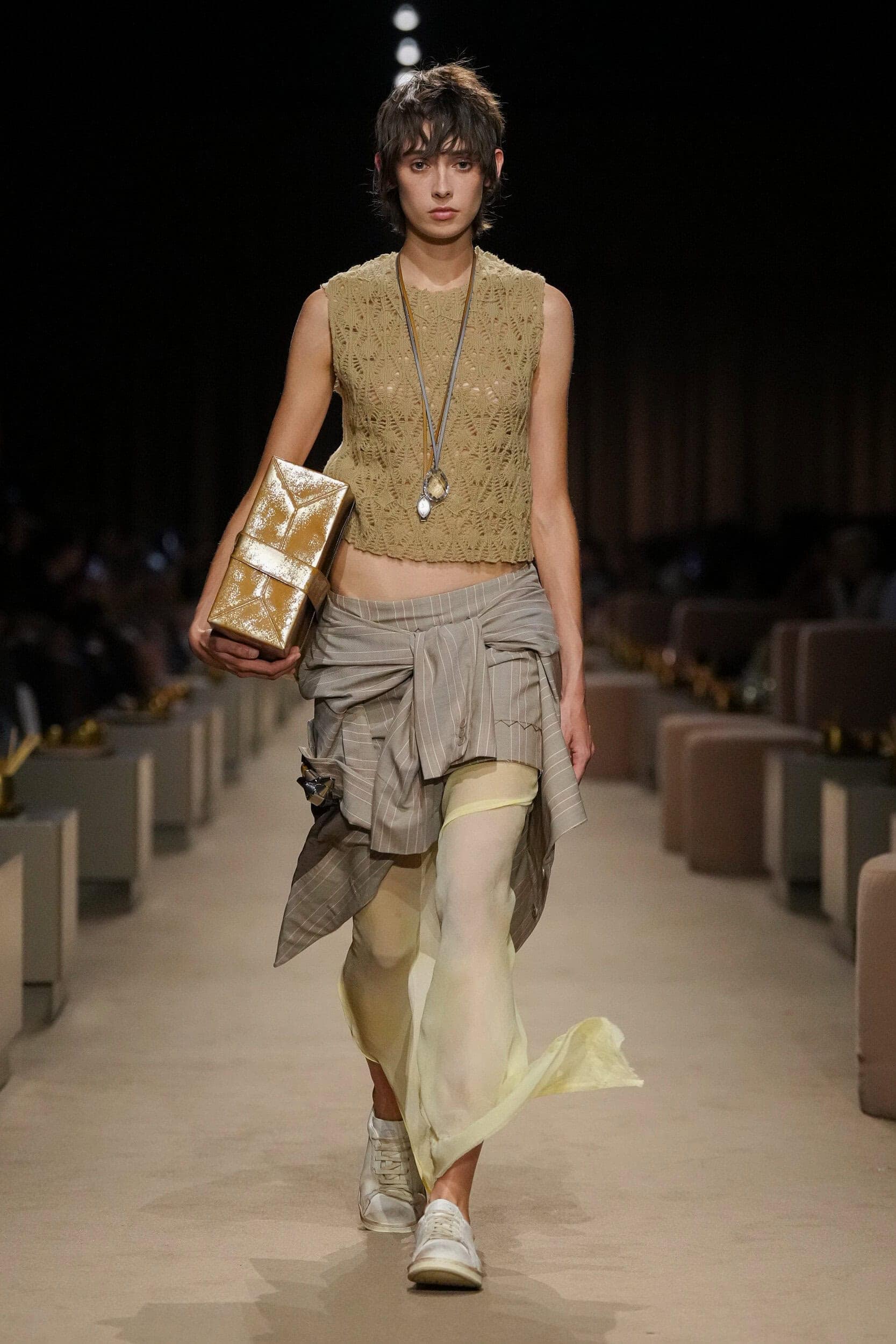
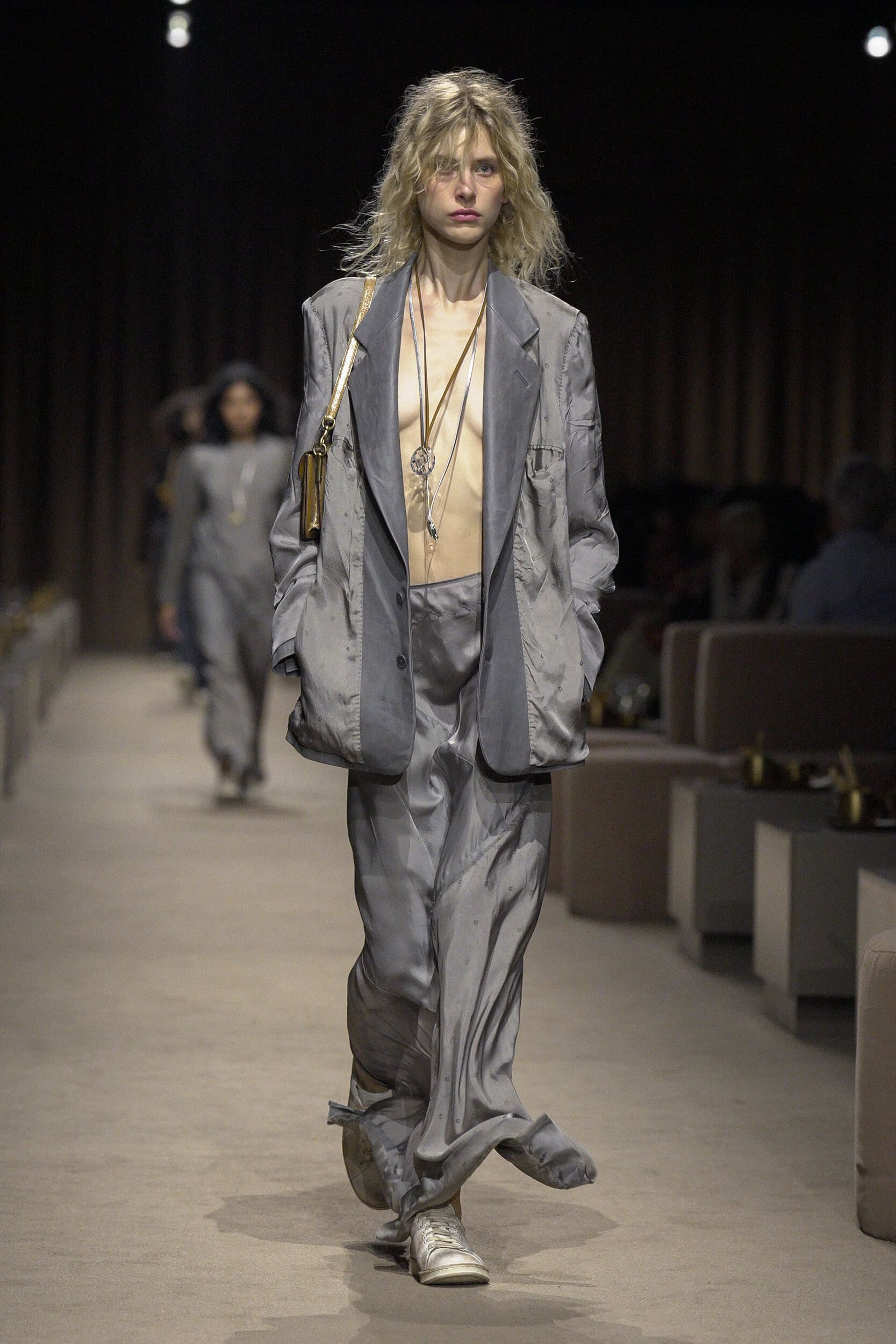
There was something almost counterintuitive about the way Vevers chose to mark Coach’s milestone. Rather than begin with fanfare, the collection arrived looking decidedly undone. Slouching suits, elongated jackets, loose trousers, bare chests, and quietly distressed layers established a mood that felt more like an after-party than an anniversary gala. Clothes sat low and easy on the body, while tailoring seemed deliberately relieved of its formality. The palette, too, initially resisted celebration, moving through blacks, charcoals, browns, and softened neutrals.
And then the party arrived.
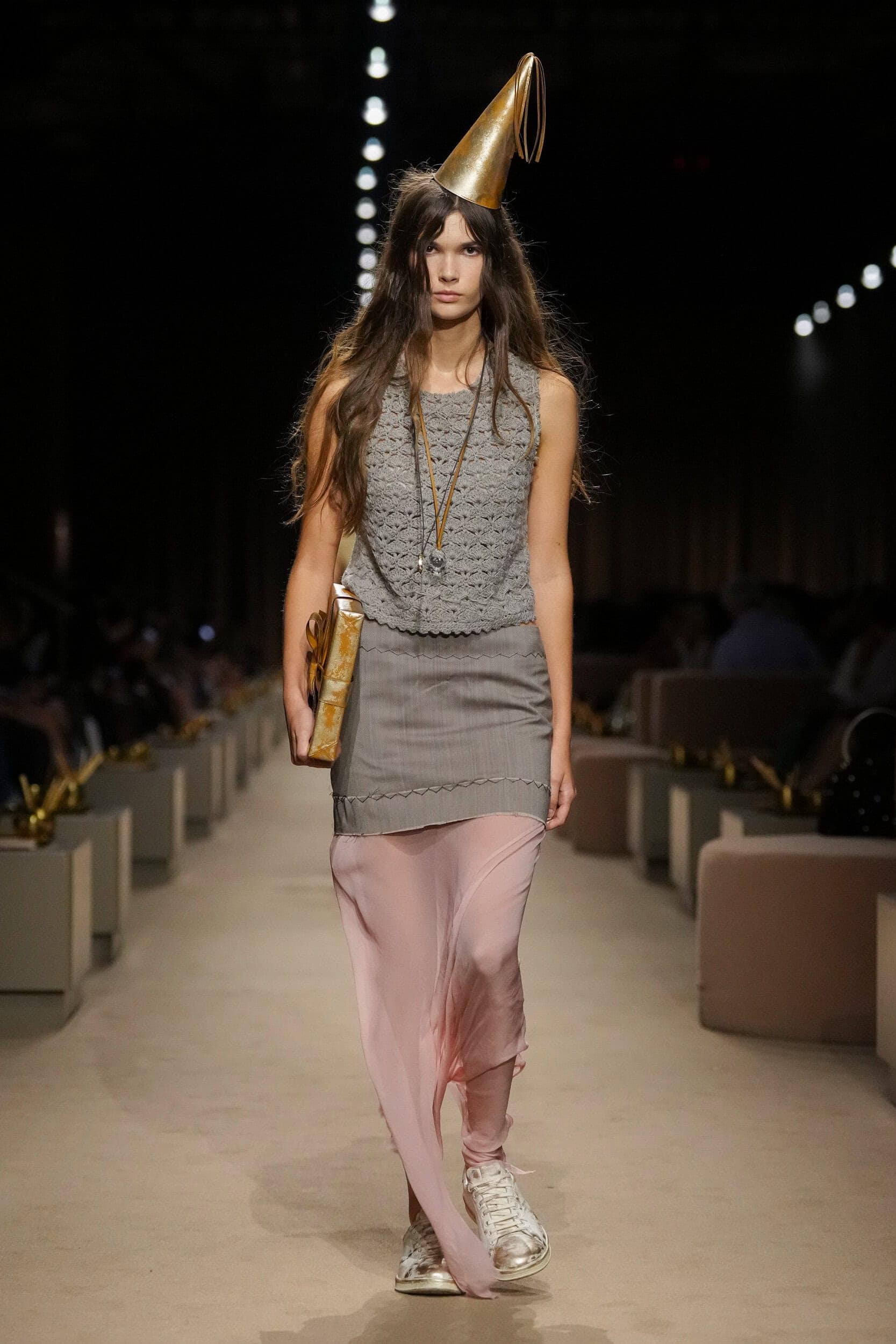
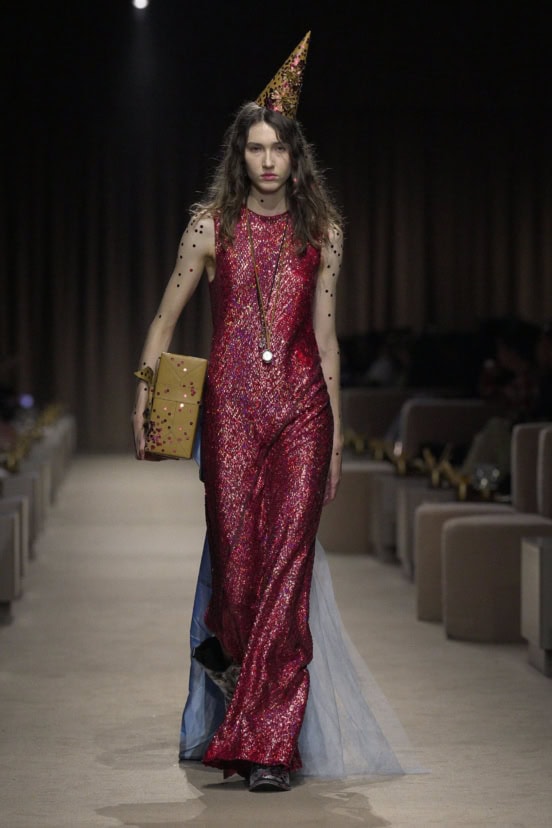
Metallic gold, faded florals, and increasingly exuberant surfaces began to interrupt the restraint before the collection finally tipped into full celebration: glitter, shimmer, party hats, and a finale that made the earlier austerity feel almost like a setup for joy. Beneath all of the anniversary language, this was not really a collection about Coach’s age. It was about affection.
THE COLLECTION
THE VIBE
Worn-In Romance, Archive in Motion, & After-Party Americana

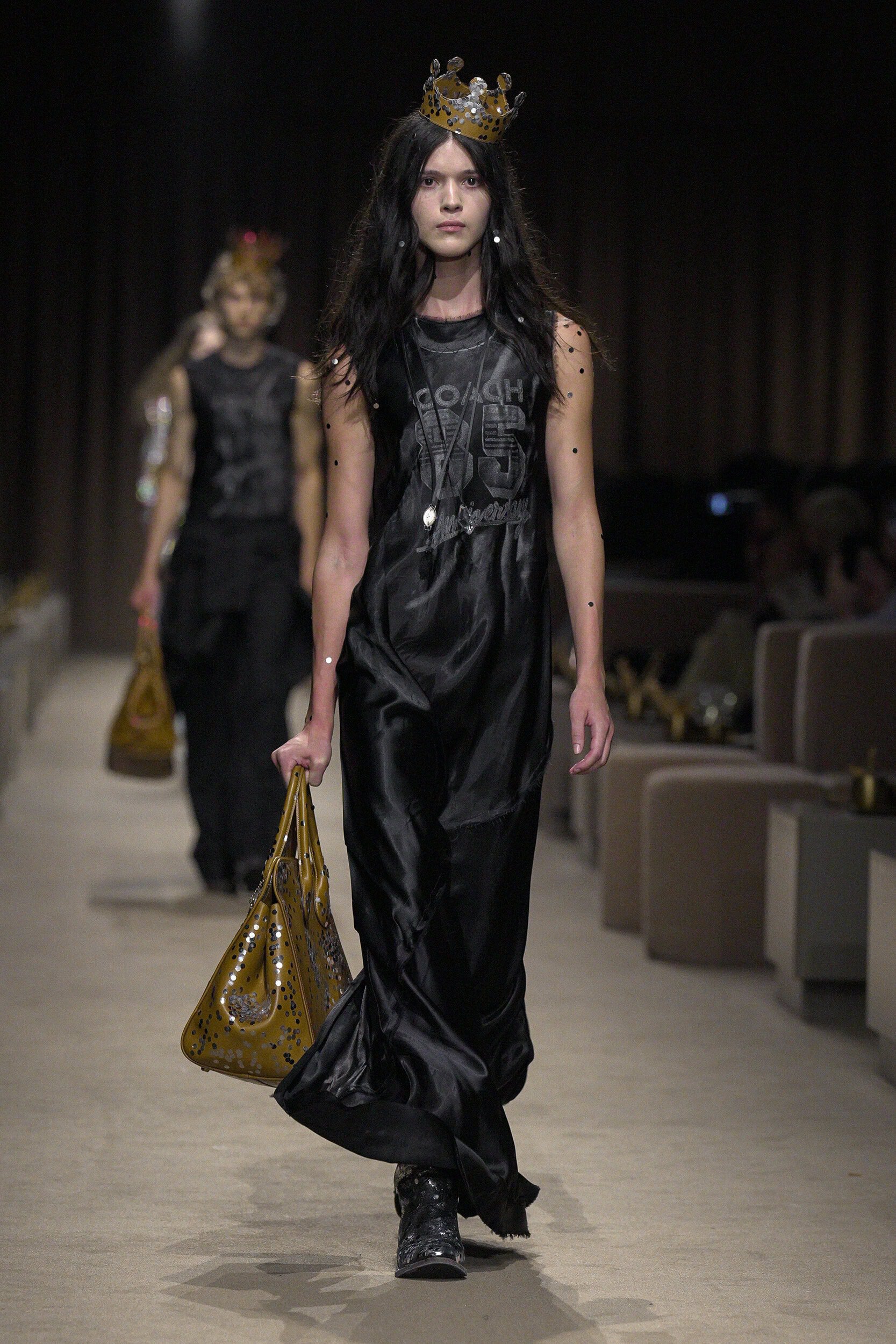
Coach’s leather heritage remained present, as did familiar house codes and archival ideas, including a new version of the Turnlock Tote based on a 1970 Bonnie Cashin design. But Vevers’ more compelling approach to heritage has increasingly been to treat those codes as material rather than monument. He does not polish the archive into distance. He wears it down, loosens it, personalizes it, and hands it to another generation.
There is confidence in that decision. Coach does not currently need to prove that it has an archive. It needs to show that the archive can continue producing culture. Over 13 years, Vevers has gradually shifted the center of gravity of the house away from polished American aspiration toward something more instinctive: American clothes as they are actually worn, accumulated, damaged, borrowed, customized, and loved.
Spring 2027 continued that project. Rather than manufacture a new visual identity for an anniversary moment, Vevers trusted the language he has already established. That continuity is both the collection’s strength and its limitation. The oversized tailoring, languid trousers, distressed surfaces, and studied sense of youthful nonchalance are increasingly unmistakable as Vevers’ Coach. There is real value in that recognition, particularly at a moment when so many houses are searching for an identity every few seasons. But familiarity also makes the question of progression more pressing.
For a collection explicitly positioned around looking forward, there were moments when one wished the clothes themselves would push that proposition further, not by abandoning the vocabulary Vevers has built, but by stretching it somewhere less expected. Perhaps that is why the closing sequence worked so well. Its sudden shine disrupted the restraint and reminded us that evolution need not mean erasure. Sometimes it is simply an unexpected emotional register entering a familiar language.
“There are references to Coach in there, but I thought the best way to celebrate this anniversary was actually to look forward.” – Stuart Vevers


THE WRAP UP
The smartest thing about Coach’s 85th-anniversary collection may be that Vevers did not allow the milestone to overwhelm the clothes. There was no grand archive parade and no attempt to turn heritage into spectacle for its own sake. Instead, history operated quietly beneath a wardrobe that remained firmly connected to the people Vevers imagines wearing it now.
That may be the real strength of his Coach. The house’s legacy is not treated as a fixed inheritance, but as something emotional, usable, and alive. A worn leather bag, a distressed jacket, a slouched suit, a burst of glitter, a faded floral dress: these pieces suggested that love can be a design strategy, especially when it allows the past to move without becoming precious.
For a designer who has spent more than a decade shaping one of American fashion’s most recognizable houses, looking forward does not require severing the thread. At 85, Coach looked backward only long enough to know what it could afford to leave behind. The celebration was not in the archive itself, but in the permission to keep making it young.