Stone Island and Asian Demand Provide Support as Warm Weather and Weaker European Tourism Pressure Moncler
Moncler Group reported a 6% increase in revenue at constant exchange rates to €1.89 billion for the first nine months of 2026, but growth stalled in the third quarter as unseasonably warm weather and subdued tourist spending weighed on its flagship brand.
Third-quarter group revenue reached €605.5 million, unchanged at constant exchange rates from a year earlier. Moncler brand sales declined 1%, while Stone Island continued to outperform with growth of 5%.
The results revealed a widening contrast between regions. Moncler’s Asian business grew 15% at constant exchange rates over the first nine months, while Stone Island recorded increases of 23% in Asia and 26% in the Americas. Europe remained the principal weakness, with slower tourist flows and unusually warm temperatures affecting demand for winter outerwear.
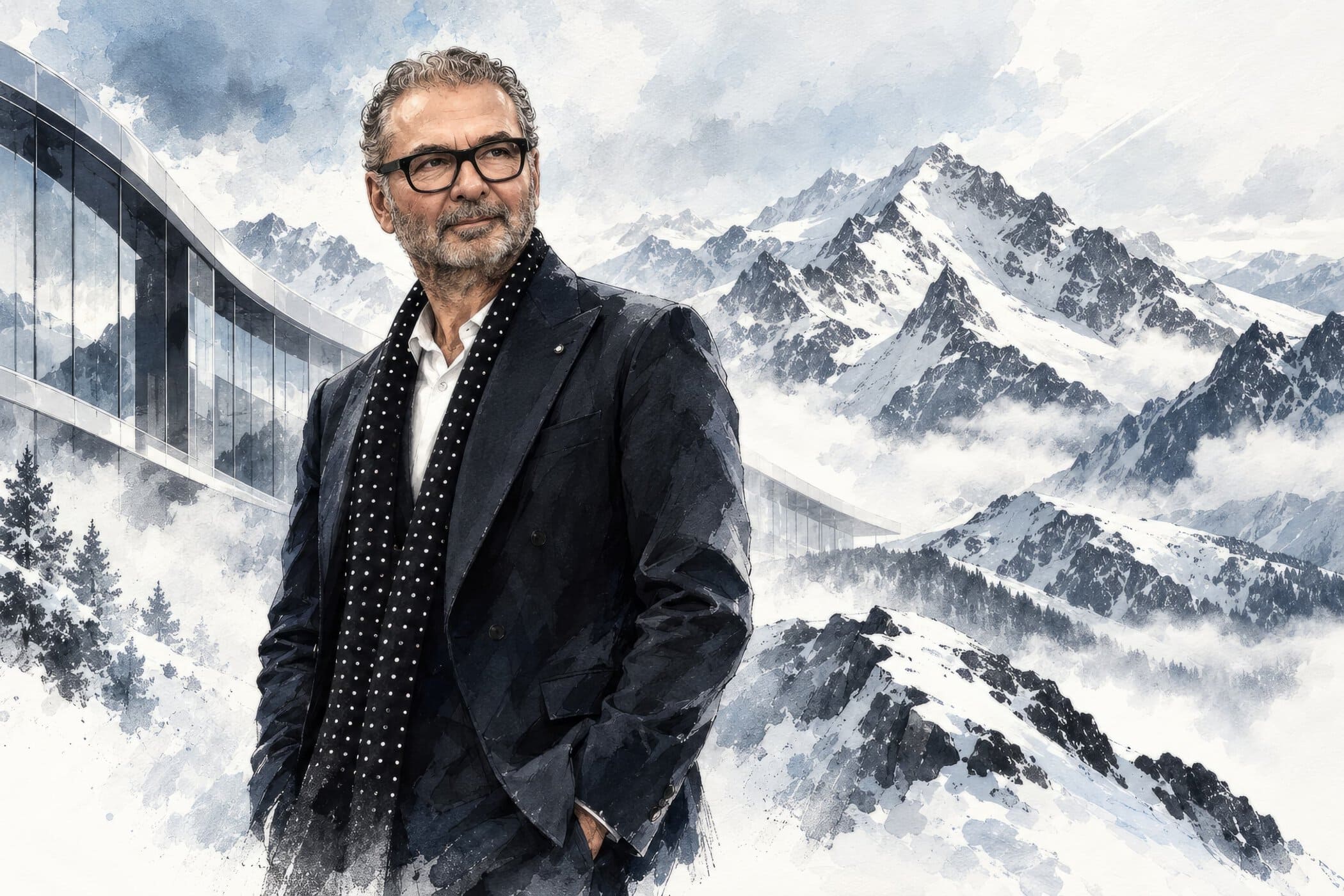
“In the third quarter, our industry continued to navigate an extremely complex environment,” said Remo Ruffini, Executive Chairman of Moncler Group. “In times like these, it is important to remain rigorous, grounded and, above all, focused on our brand strategy, guided by our long-term vision.”
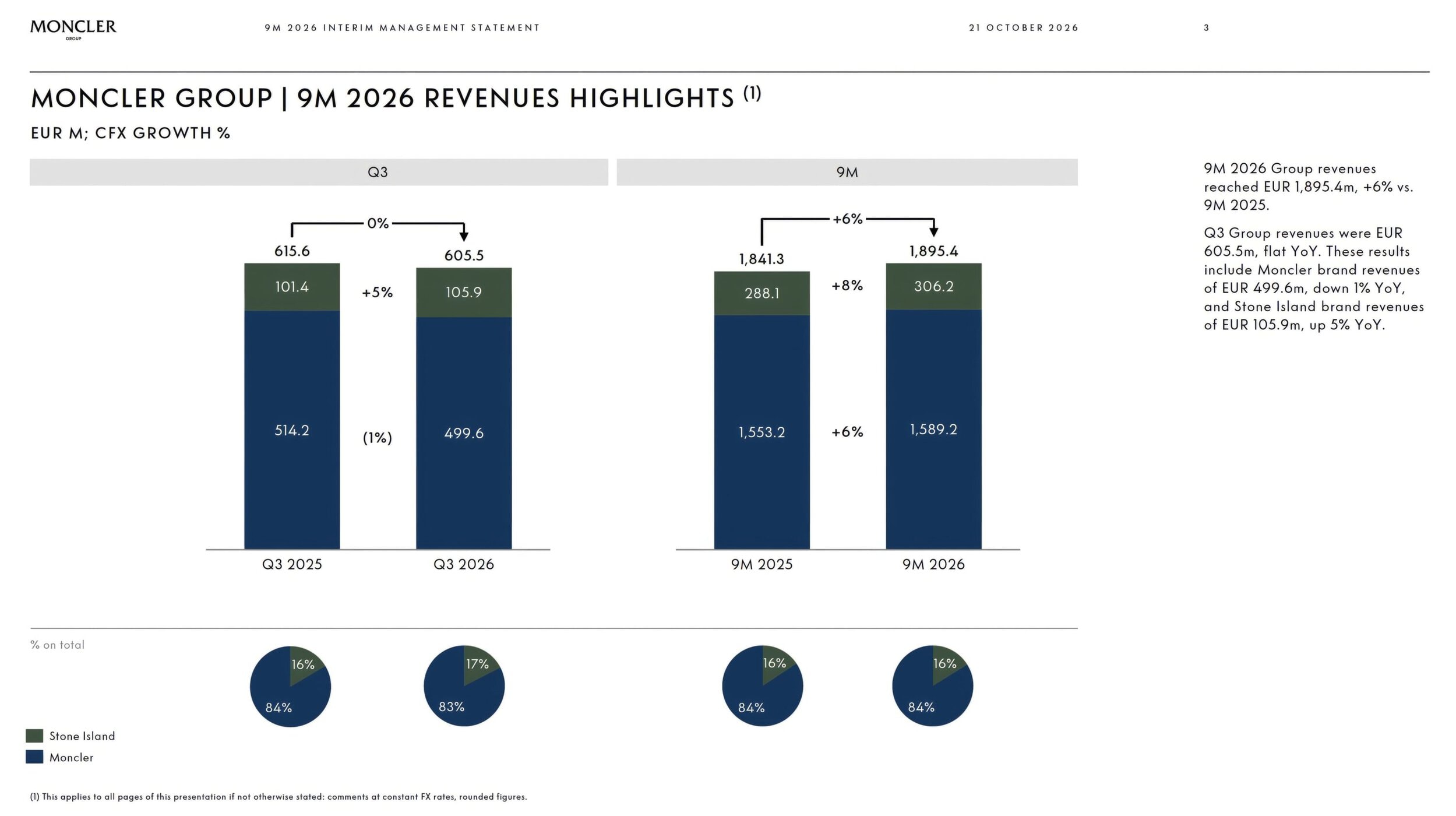
The group’s nine-month revenue increased 3% at reported exchange rates, reflecting the impact of currency movements on its international business.
Moncler Faces a Challenging European Market
The Moncler brand generated €1.59 billion in revenue during the first nine months, an increase of 6% at constant exchange rates and 2% at reported rates.
Third-quarter revenue totaled €499.6 million, declining 1% at constant exchange rates as softer demand in Europe offset growth elsewhere.
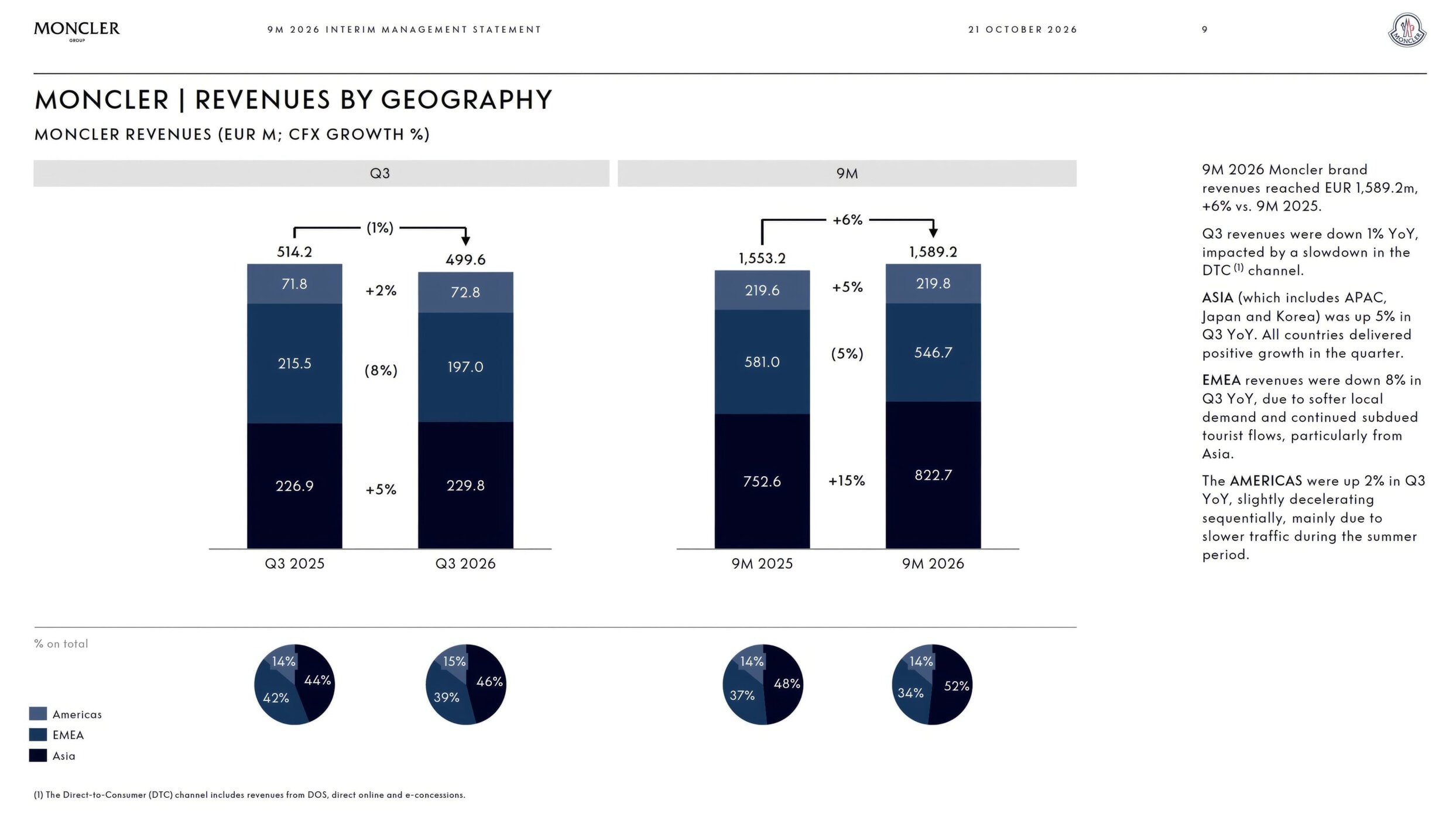
The brand’s Direct-to-Consumer business fell 2% during the quarter, reflecting slower store traffic and reduced tourist spending, particularly across Europe, the Middle East and Africa.
EMEA was the weakest region, with third-quarter sales declining 8% at constant exchange rates. For the first nine months, revenue in the region fell 5% at constant exchange rates to €546.7 million.
Unseasonably warm temperatures proved particularly challenging for a business closely associated with winter outerwear.
Luciano Santel, Group Chief Corporate and Supply Officer, noted during the company’s earnings call that July and August were unusually hot, while September temperatures remained higher than the previous year, affecting demand for heavier winter products.
The conditions encouraged customers to purchase lighter transitional pieces rather than full winter outerwear, influencing the product mix during a commercially important period.
Moncler is responding by broadening its seasonal offering, increasing the availability of lighter products and extending their presence across more stores.
The strategy reflects an effort to make the brand more relevant throughout the year without abandoning the winter and mountaineering heritage that remains central to its identity.
Asia Remains a Source of Strength
Asia continued to deliver the strongest performance for Moncler, with nine-month revenue rising 15% at constant exchange rates to €822.7 million.
Third-quarter sales increased 5% at constant exchange rates, with positive growth across the region, including Asia-Pacific, Japan and Korea.
China remained an important contributor despite softer traffic. Santel pointed to strong trading during the country’s Golden Week holiday, suggesting that consumer demand remains responsive to significant shopping occasions.
The Americas also maintained positive momentum, with third-quarter revenue increasing 2% at constant exchange rates. For the nine-month period, sales reached €219.8 million, representing 5% growth at constant exchange rates.
Wholesale revenue increased 3% over the nine-month period and 2% during the third quarter, despite the company’s ongoing efforts to streamline distribution and improve the quality of its retail partnerships.
Moncler ended September with 305 directly operated stores, seven more than at the end of June.
Among its most significant recent investments is the opening of its largest flagship worldwide on Fifth Avenue in New York, alongside a new store at The Shops at Crystals in Las Vegas and an expansion of its Champs-Élysées location in Paris.
The Fifth Avenue opening has also provided a platform for the brand’s wider cultural ambitions, supported by its global “Pioneers in Moncler” campaign.
Stone Island Maintains Growth Momentum
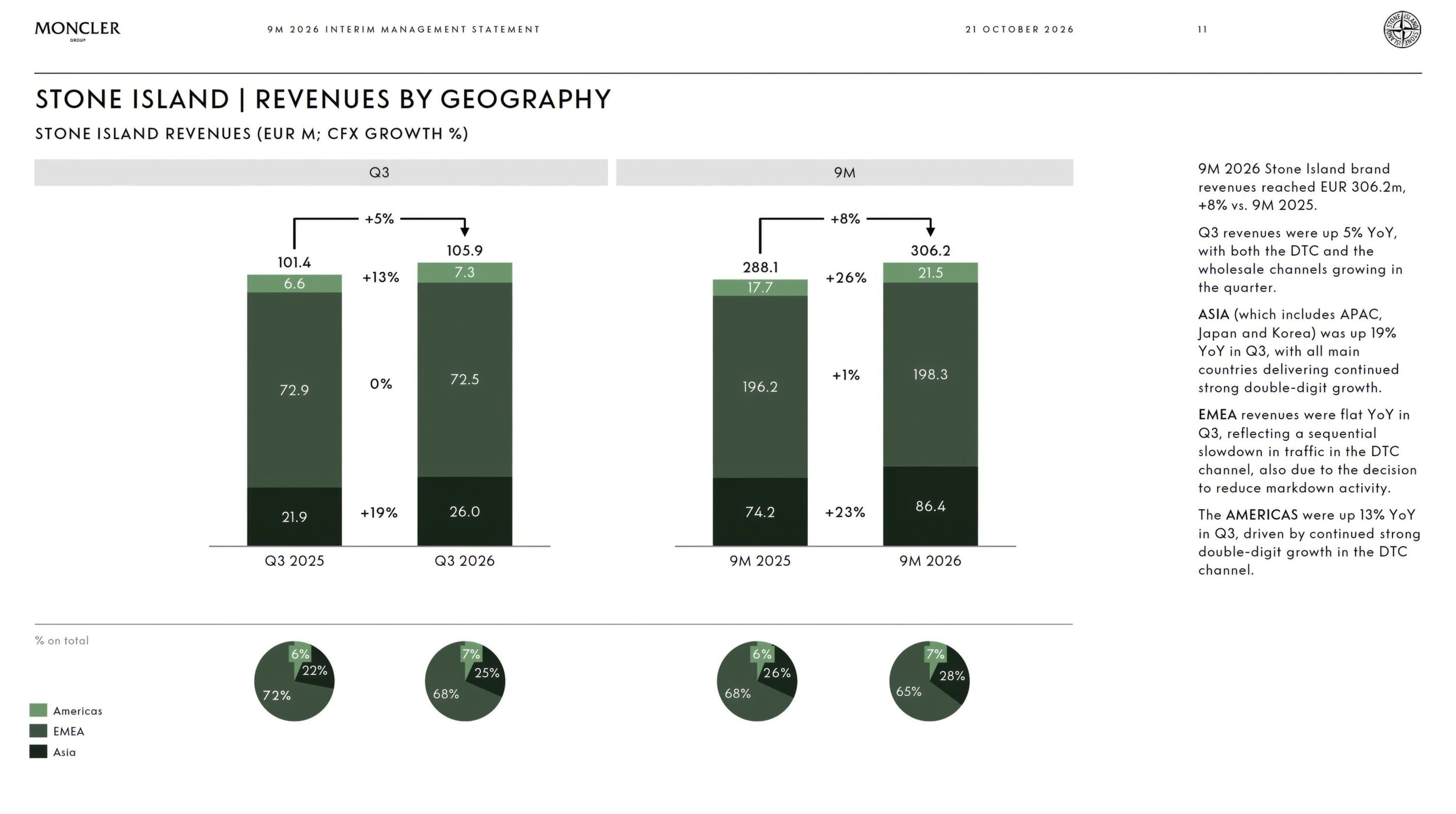
Stone Island delivered a stronger performance, generating €306.2 million in revenue during the first nine months of 2026, an increase of 8% at constant exchange rates and 6% at reported rates.
Moncler’s Direct-to-Consumer business generated €1.29 billion during the first nine months, increasing 6% at constant exchange rates. Physical stores continued to outperform online sales, reinforcing the importance of the group’s investments in its retail network.
Third-quarter sales reached €105.9 million, rising 5% at constant exchange rates, supported by continued growth in Asia and the Americas.
Asia was particularly strong, with nine-month revenue increasing 23% at constant exchange rates to €86.4 million. During the third quarter, sales in the region advanced 19%, with double-digit growth across its principal markets.
The Americas also delivered a notable performance, with nine-month revenue increasing 26% at constant exchange rates to €21.5 million. Third-quarter growth reached 13%, supported by strong Direct-to-Consumer demand.
Although the Americas remain a relatively small part of Stone Island’s overall business, the growth suggests the brand is gaining momentum beyond its established European customer base.
In Europe, the Middle East and Africa, Stone Island recorded a more subdued performance. Nine-month revenue increased 1% to €198.3 million, while third-quarter sales remained flat at constant exchange rates.
The brand’s decision to reduce markdown activity also affected traffic, although full-price sales continued to grow at a double-digit pace.
That performance is particularly relevant as Stone Island continues refining its distribution and positioning, prioritizing full-price demand rather than relying on promotional activity to drive volume.
Stone Island’s Direct-to-Consumer revenue reached €155.9 million during the first nine months, increasing 11% at constant exchange rates. Third-quarter growth in the channel was 2%, despite slower traffic in Europe.
Wholesale revenue reached €150.3 million, rising 6% at constant exchange rates over the nine-month period. Third-quarter growth accelerated to 7%, partly reflecting changes in the timing of deliveries compared with last year.
The brand ended September with 94 directly operated stores following the relocation of its Rome flagship. A larger location on Corso Matteotti in Milan is planned for the final quarter.
For Ruffini, the continued development of Stone Island remains an important component of the group’s long-term strategy. The brand has increasingly emphasized its connections with music, sport and art, reinforcing the cultural community surrounding its technical apparel and material experimentation.
Balancing Heritage With a Changing Market
The group’s results illustrate two different aspects of its business.
Moncler continues to benefit from strong brand recognition and demand across Asia, but its dependence on colder-weather products leaves it particularly exposed to changing seasonal conditions. Stone Island, meanwhile, is demonstrating broader regional momentum, although its European business is facing many of the same pressures affecting the luxury sector.
Both brands are continuing to invest in retail, product development and cultural marketing rather than relying on short-term promotional activity to stimulate demand.
For Moncler, the broader seasonal strategy is becoming increasingly important. While winter outerwear remains central to the brand’s identity and commercial strength, warmer autumn temperatures can delay purchases at precisely the moment when the company traditionally expects demand to accelerate.
Expanding its lighter-weight offering may help address that challenge, but the company must do so without weakening the distinctive positioning that has made its down jackets among the most recognizable products in luxury fashion.
Stone Island faces a different opportunity. Its strong full-price performance and accelerating growth in Asia and the Americas suggest that investments in distribution quality and brand positioning are beginning to support its international expansion.
“Knowing who we are and where we come from is what allows us to look ahead with clarity and intention,” Ruffini said. “We will keep moving forward with purpose and discipline, shaping the future of our brands with the same passion and ambition that brought us here.”
As the group enters the final quarter, the arrival of colder weather will be especially important for Moncler, whose winter collections remain a central driver of its business.
For now, the group’s nine-month growth demonstrates the continued strength of both brands, but the flat third quarter offers a reminder that even well-positioned luxury businesses are not immune to changing consumer behavior, regional uncertainty and increasingly unpredictable seasons.