The German Fashion Group Reported Falling Sales And Profits As It Prioritizes Margin Improvement And Operational Restructuring
Hugo Boss executives defended sharply lower first-quarter results as a necessary consequence of the company’s ongoing strategic reset, arguing that the business is prioritizing long-term profitability over short-term growth.
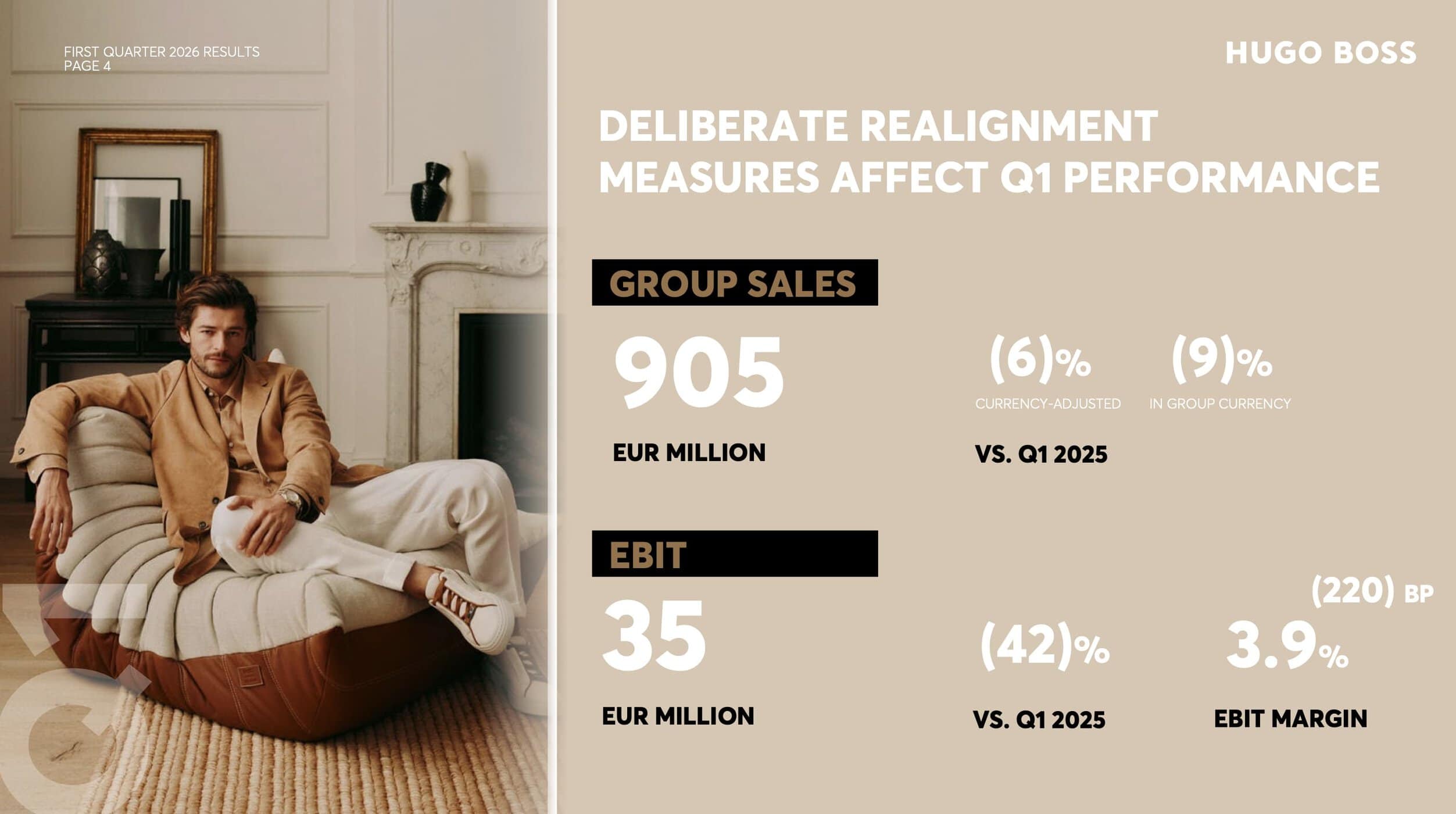
The German fashion group reported a 6 percent decline in currency-adjusted sales to €905 million in the first quarter, marking its weakest quarterly performance in roughly two years. Operating profit also came under pressure, with EBIT falling 42 percent to €35 million, down from €61 million during the same period last year.
Management framed the slowdown as an expected outcome of “Claim 5 Touchdown,” the company’s revised strategy introduced late last year after earlier growth ambitions failed to materialize despite heavy investment in marketing and brand elevation. The new plan focuses on streamlining operations, improving margins, and tightening distribution — measures executives acknowledged would weigh on revenues in the near term.
“As you can see from the announcement, the first quarter was characterized by the implementation of our strategy,” chief financial officer Yves Mueller said during the company’s earnings call. “We currently measure progress not by volume growth, but by how consistently we’re progressing in the implementation of our strategy.”
The company has repeatedly signaled that it does not expect a return to meaningful growth before 2027.
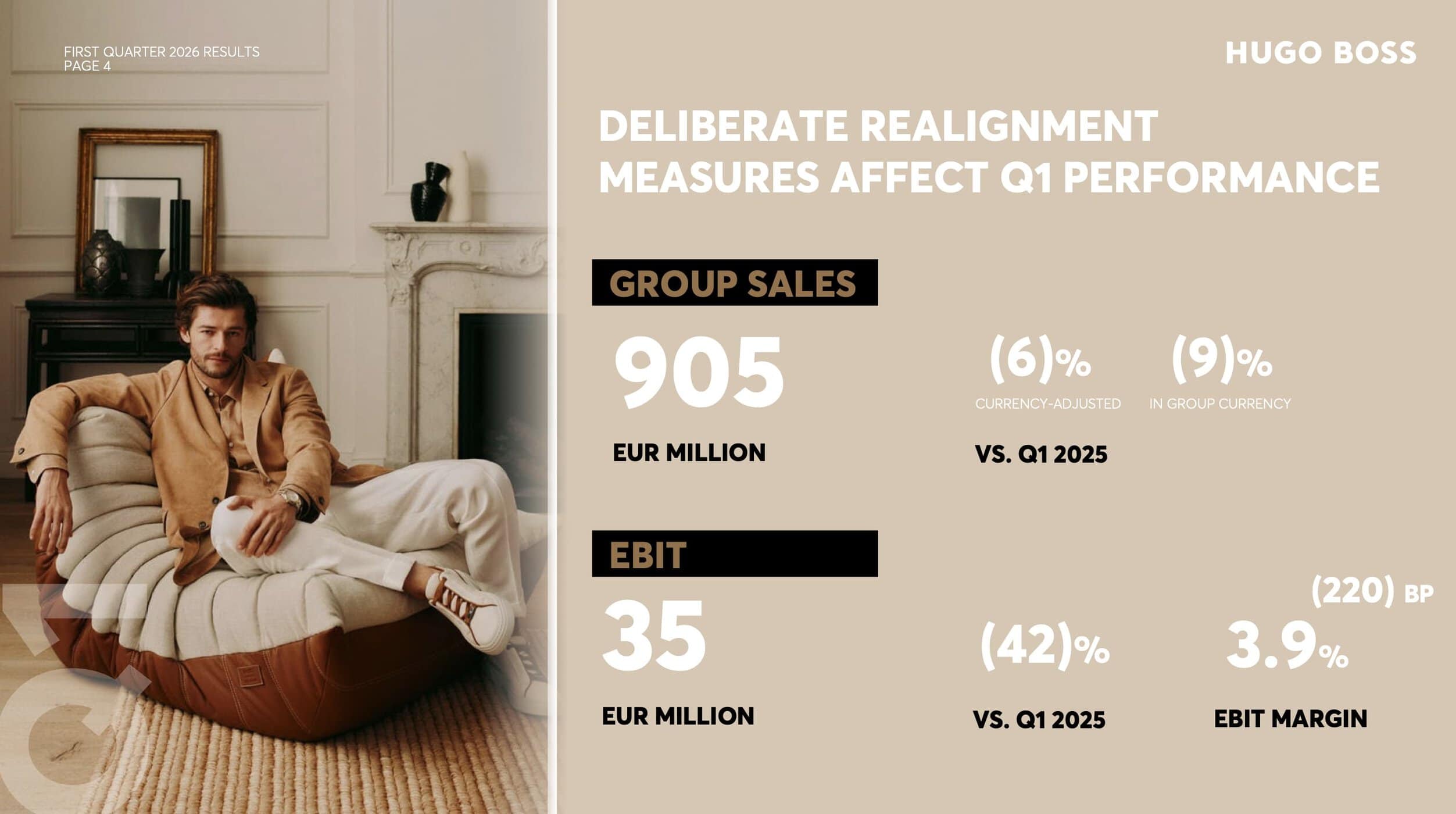
The weakest performance came from Europe, the Middle East and Africa — Hugo Boss’ largest market — where sales fell 8 percent on a currency-adjusted basis. Germany, France and the U.K. all posted similar declines. The Americas saw revenues fall 5 percent to €188 million, though management characterized the market as relatively stable given broader luxury headwinds.
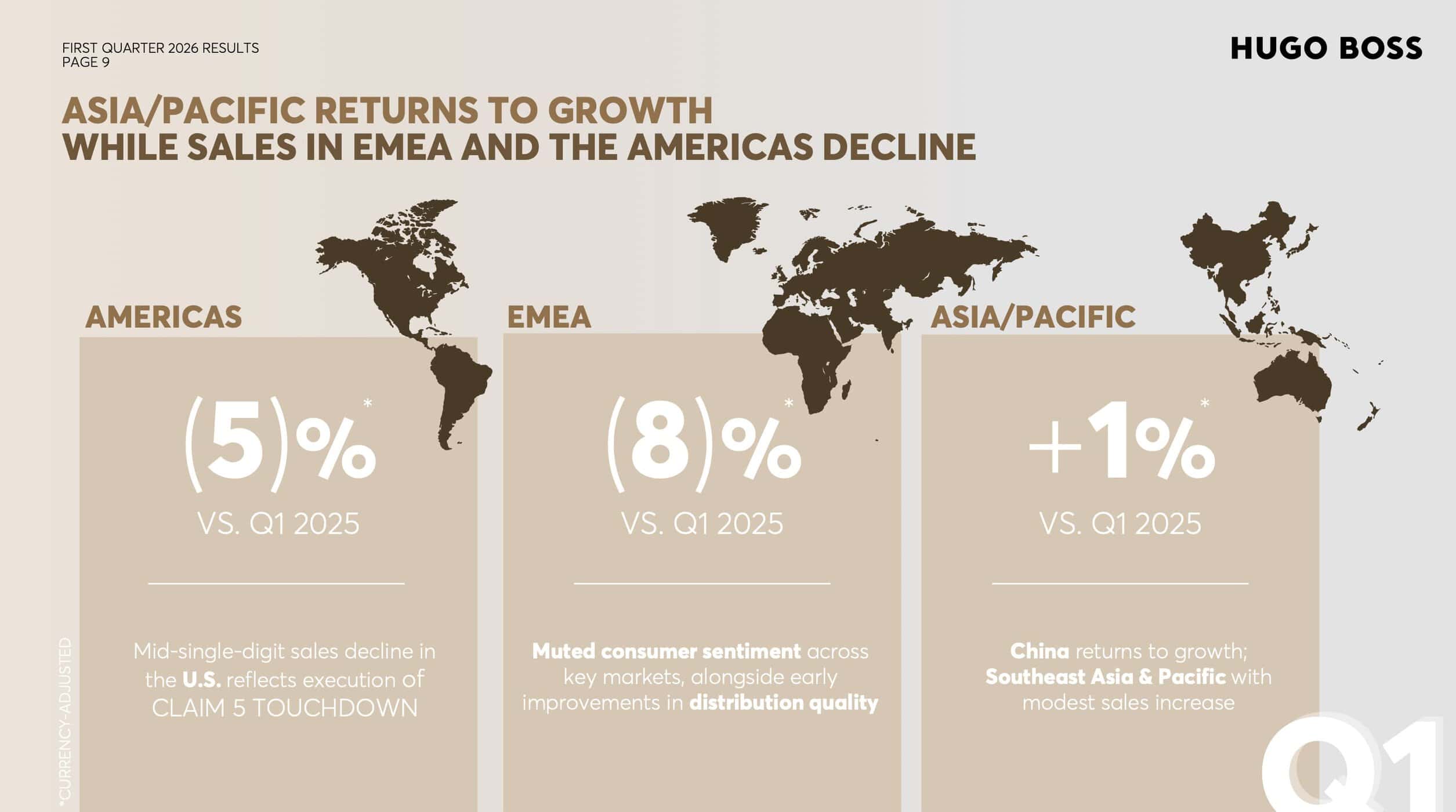
Asia-Pacific was the only region to post growth, with sales rising 1 percent to €123 million, supported by improving demand in China and continued momentum in Japan.
Mueller said the ongoing conflict in the Middle East had only a limited direct effect on results so far, estimating the impact at roughly 1 percent of first-quarter revenues. However, he cautioned that prolonged geopolitical instability could further weaken global consumer sentiment and increase inflationary and freight pressures.
The group has also accelerated operational restructuring. Hugo Boss has already closed 15 stores as part of a plan to shutter 50 locations globally by 2028, while simultaneously reducing inventory levels and tightening its wholesale network.
“We have also become more focused in selecting our strategic partners in the wholesale sector,” Mueller said, acknowledging that these measures are currently reducing both sales and profitability.

Within the portfolio, the Hugo line — the company’s more casual and trend-oriented offering — posted the sharpest decline, with sales down 21 percent. Executives said the label is undergoing a major repositioning focused on simplifying assortments and returning to “contemporary tailoring” as a core proposition.
The Boss label, which remains the company’s dominant business, proved more resilient, with sales declining 3 percent.
Hugo Boss is also preparing a renewed push into womenswear, supported by a dedicated division led by former Tory Burch executive Kerstin Dorst. The first phase of the revamped womenswear offering is expected to launch later this year, with management targeting stronger momentum by 2027.
Despite the weak quarter, the company maintained its full-year guidance, forecasting sales declines in the mid- to high-single digits and operating profit between €300 million and €350 million.
For now, Hugo Boss appears willing to absorb short-term pain as it reshapes the business around a leaner, more focused model — betting that operational discipline and brand clarity will ultimately restore sustainable growth.