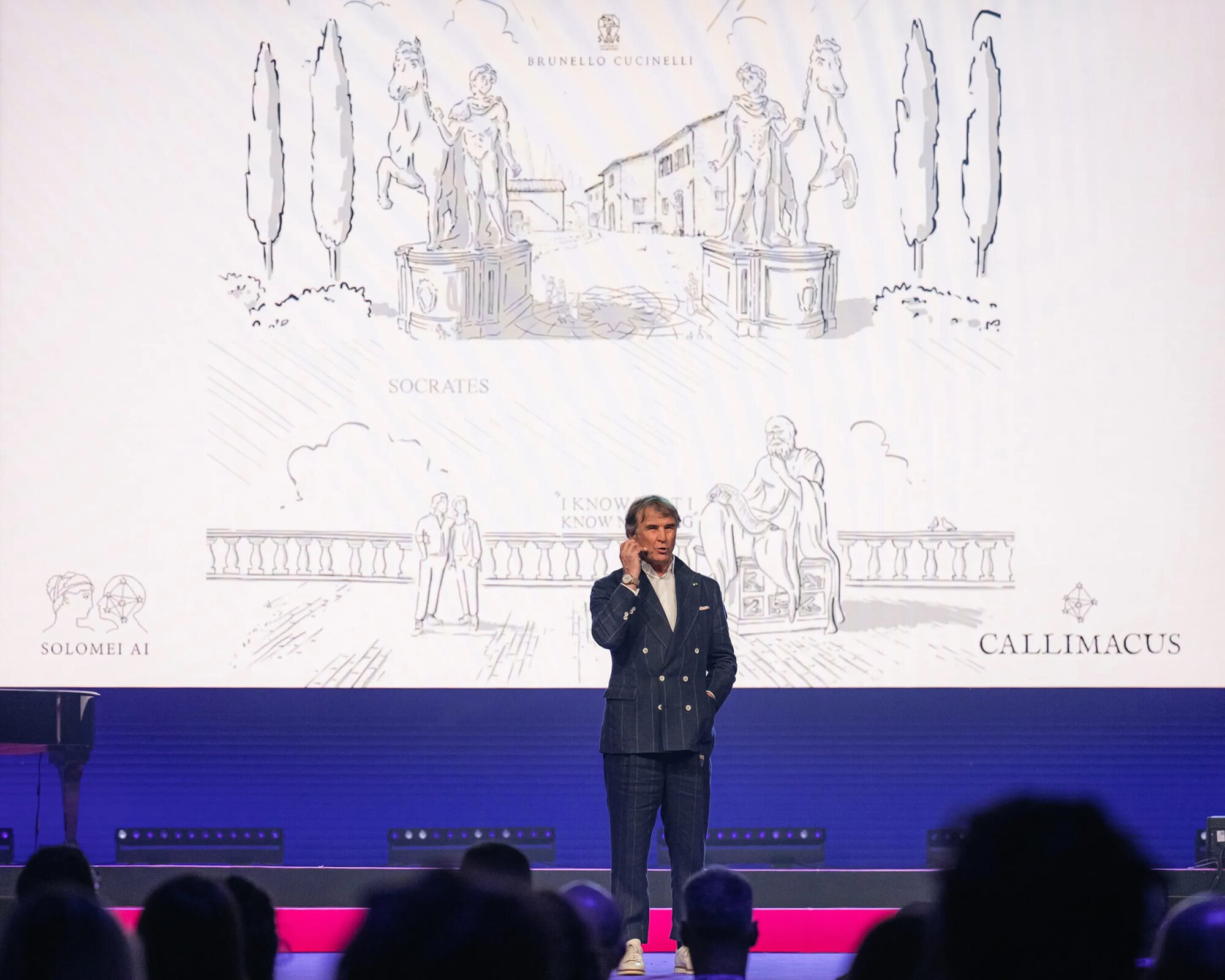
The investment expands the reach of Cucinelli’s in-house AI research unit, betting that a philosophy-driven approach to personalization can scale beyond one luxury house
Key takeaways
- Salesforce is funding the expansion of Callimacus, an AI platform developed by Cucinelli’s Solomei AI research center since 2024.
- Callimacus uses a system of AI agents to interpret visitor intent in real time and assemble a personalized, pageless digital experience without third-party cookies.
- The collaboration originated three years ago and formalizes an existing relationship between Cucinelli and Benioff.
- The platform is positioned to expand commercially across Europe and North America following the investment.

Salesforce is investing in Callimacus, the AI platform built by Brunello Cucinelli‘s in-house research center, Solomei AI, in a deal aimed at expanding the platform’s engineering capacity and accelerating its commercial growth across Europe and North America. Cucinelli, who serves as chairman of Solomei AI, described the collaboration as an outgrowth of a three-year dialogue between himself, Salesforce chief executive officer Marc Benioff, and a group of mathematicians, philosophers and technologists.
The platform takes its name from Callimachus, the ancient Greek poet and scholar credited with cataloging the vast holdings of the Library of Alexandria. The reference frames the AI system’s function in explicitly editorial terms, positioning it as an organizer and interpreter of information rather than a simple search or recommendation tool, a framing consistent with Cucinelli’s broader description of the project as a form of humanistic technology.
Unlike most AI personalization tools built for speed and scale first, Callimacus was conceived around a specific editorial premise: that a website should behave less like a fixed catalog and more like an attentive interlocutor, responding to intent rather than presenting a static hierarchy of pages. The system’s agents each carry distinct functions, from parsing behavioral signals to verifying tone and content consistency. This architecture reads more like an editorial newsroom than a typical recommendation engine. Cucinelli’s team has also been candid that the platform does not run on a proprietary foundation model, instead orchestrating existing models chosen for speed and cost efficiency, which suggests the differentiation Cucinelli is selling is not computational novelty but a curatorial framework layered on top of commodity AI.
That distinction may be what makes the Salesforce deal notable within a luxury landscape increasingly crowded with AI personalization claims. Where competitors frame their AI investments around efficiency or conversion lift, Cucinelli has built a narrative around restraint and intention, wagering that in a market saturated with automated customization, the philosophy behind the system is the more durable brand asset than the technology itself.