Saint Laurent and Bottega Veneta Show Momentum as Luca de Meo Advances the Group’s Turnaround
Kering reported stable third-quarter revenue as improving performance across several of its luxury houses helped offset continued weakness at Gucci, where the recovery remains the central priority for Chief Executive Officer Luca de Meo.
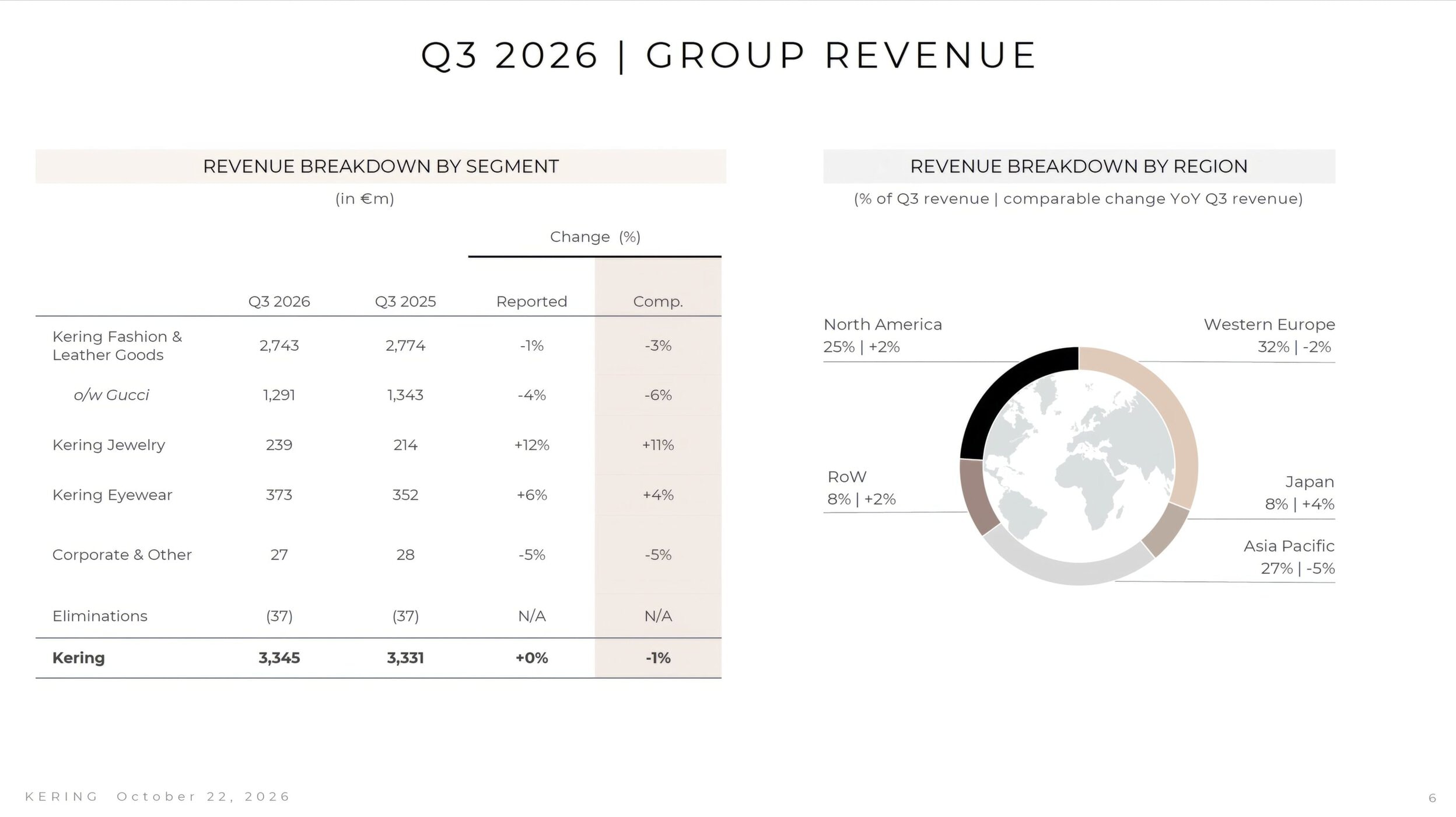
The French luxury group generated €3.35 billion in revenue for the three months ending September 30, 2026, unchanged on a reported basis and down 1% at comparable exchange rates. For the first nine months of the year, revenue totaled €10.57 billion, a decline of 2% as reported but stable on a comparable basis.
The results reflect a business undergoing significant transformation, with Kering investing in product development, strengthening its management structure and reducing its retail footprint while navigating softer luxury demand, particularly in China. Although Gucci continues to weigh on the group’s performance, Saint Laurent, Bottega Veneta and Brioni are showing more encouraging trends, alongside continued growth in jewelry and eyewear.
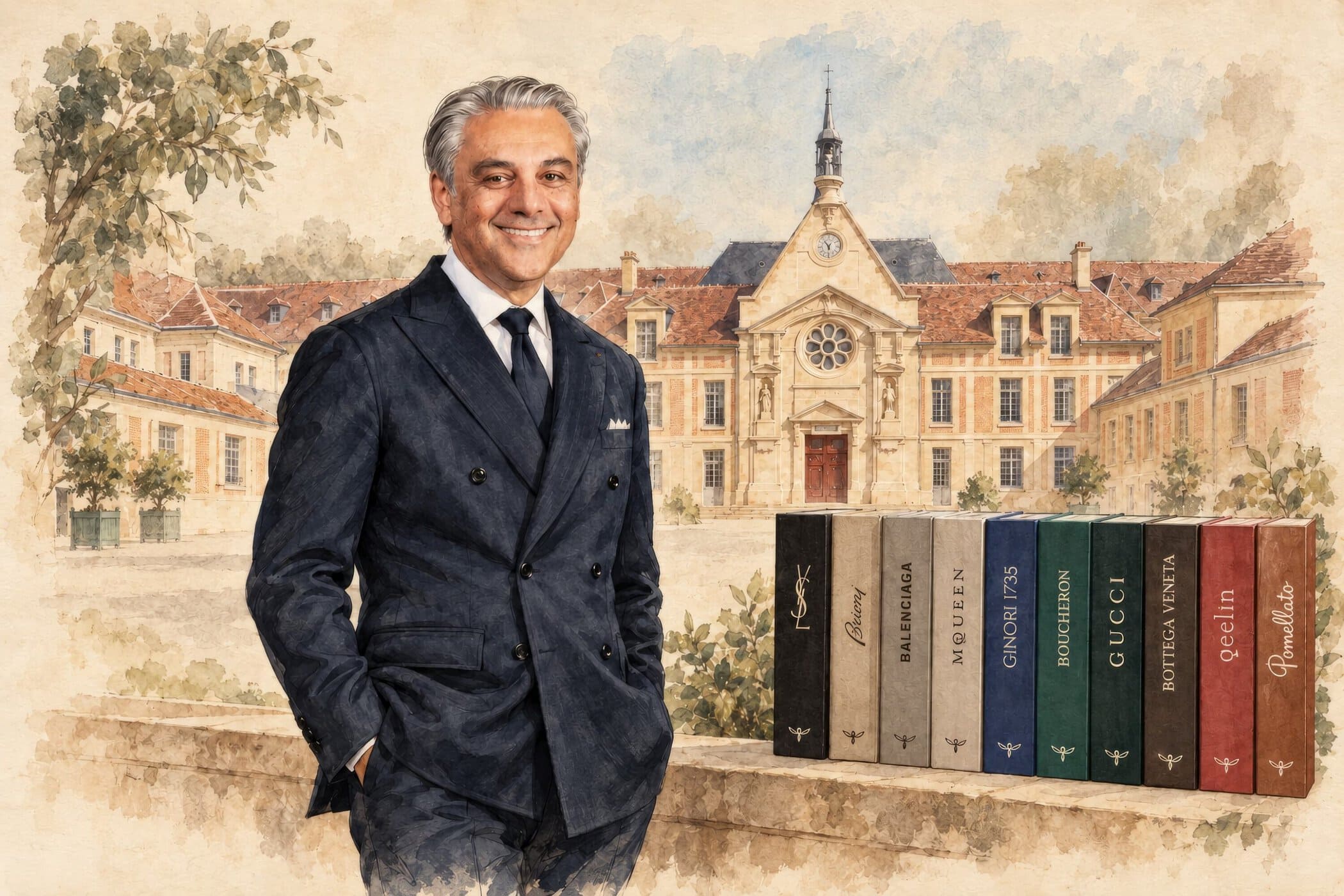
“Third-quarter revenue reflects the phasing we anticipated, in a softer macroeconomic environment. The recovery of Gucci remains our defining priority. We are steadily strengthening desirability and advancing our product development at pace,” said de Meo in the company’s earnings announcement.
Gucci’s Recovery Remains the Central Challenge
Gucci generated €1.29 billion in third-quarter revenue, declining 4% on a reported basis and 6% at comparable exchange rates. The performance marked a slowdown from the second quarter, when comparable revenue declined 2%, reflecting more difficult year-earlier comparisons and a less pronounced impact from the introduction of new collections.
The house’s directly operated retail network recorded a 9% comparable decline, with weaker store traffic remaining the principal obstacle. Mainland China and Japan were particularly challenging, while North America proved more resilient.
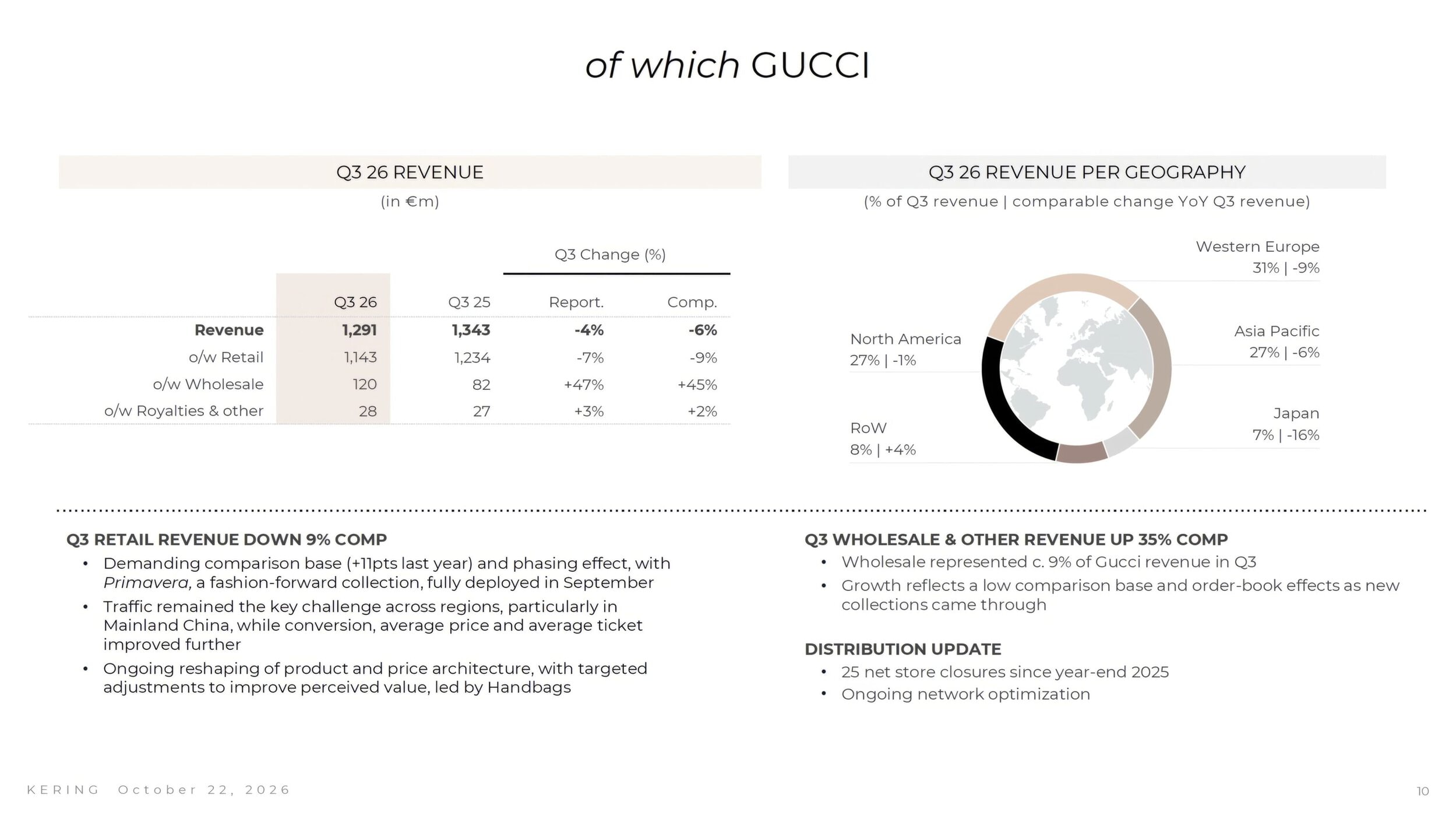
There were nevertheless some encouraging developments. Kering reported improvements in conversion rates, average selling prices and average transaction values, suggesting that customers entering Gucci stores are responding more positively to the product offering. Wholesale revenue increased 45% on a comparable basis, although the company attributed much of that growth to a low comparison base and the timing of orders for new collections.
The challenge for Gucci is now to translate the creative direction established by Demna into sustained consumer demand. His first collections have begun reaching stores, with the Primavera offering fully deployed during September, but the commercial impact remains at an early stage.
Kering is refining Gucci’s product architecture, with particular attention to handbags, where it is expanding the assortment and adjusting pricing to strengthen perceived value. Ready-to-wear and footwear remain important areas of development, alongside improvements in product quality and the speed at which new designs reach the market.
The company is also reviewing Gucci’s retail network and customer experience, combining store renovations with greater emphasis on client relationships and sales team development. Gucci recorded 25 net store closures during the first nine months of the year.
The changes reflect the scale of the task facing Demna and Gucci’s management. The house must rebuild the desirability that once made it the industry’s strongest growth engine while developing a product offering capable of attracting customers beyond the initial excitement surrounding a new creative direction.
Saint Laurent and Bottega Veneta Provide Encouraging Momentum
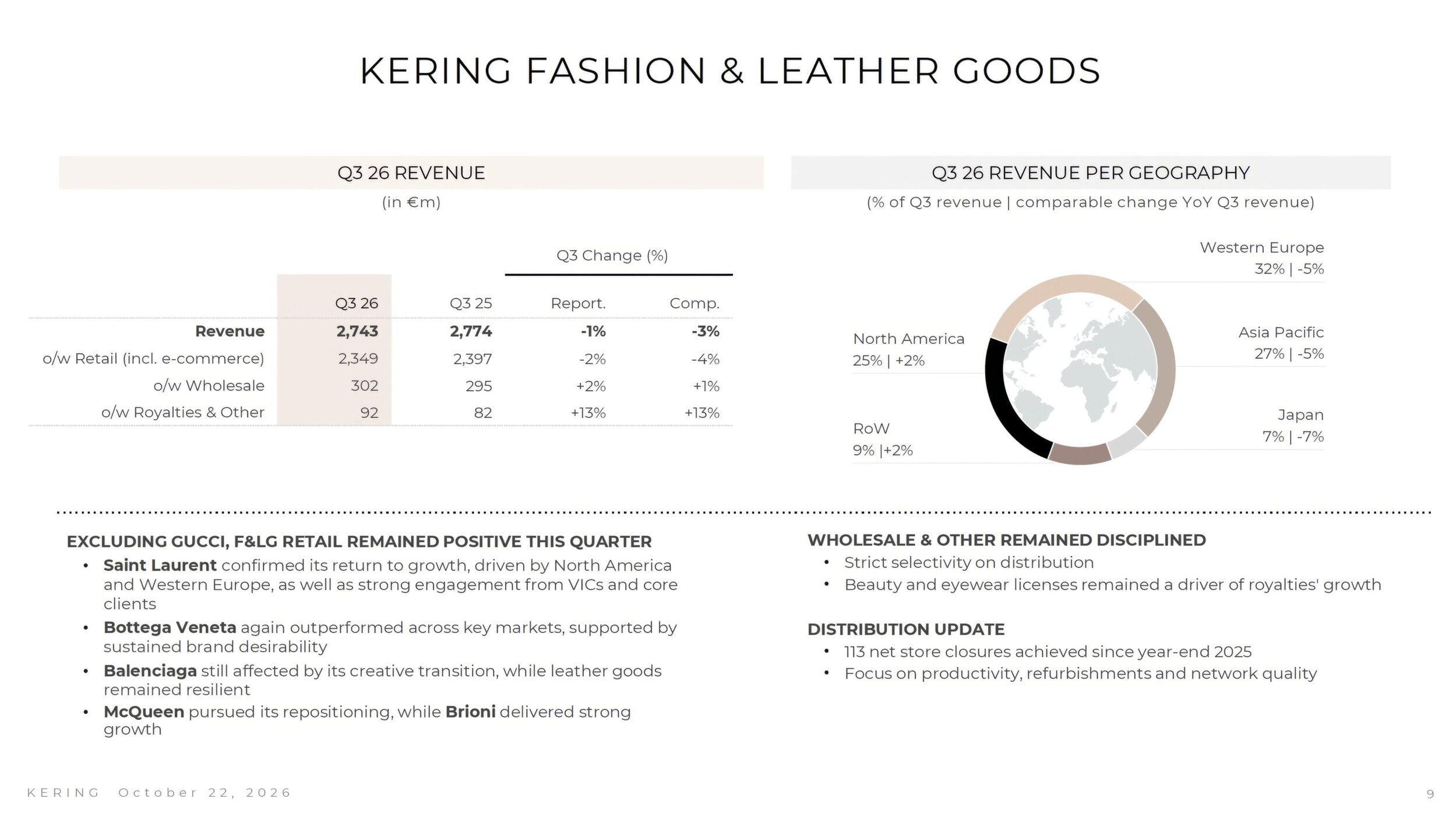
Outside Gucci, Kering’s fashion and leather goods portfolio delivered a more positive performance. Comparable retail sales across the division excluding Gucci increased 2% during the quarter, supported by Saint Laurent, Bottega Veneta and Brioni.
Saint Laurent continued its return to growth, benefiting from sustained demand in North America and Western Europe. The house also reported strong engagement from its most important clients and its broader established customer base, indicating continued interest in its product offering despite a challenging market.
The results arrive at a significant moment for Saint Laurent following the departure of Creative Director Anthony Vaccarello, announced on October 9 after a decade at the house. His tenure established a highly recognizable visual identity and helped expand Saint Laurent’s commercial reach. Kering has yet to announce his successor, making the preservation of that momentum an important consideration as the brand prepares for its next creative chapter.
Bottega Veneta continued to outperform across key markets, supported by demand for leather goods and the introduction of new products. The house is also developing its ready-to-wear business, with Kering pointing to strong engagement among its highest-spending clients.
The performance provides an encouraging foundation for Romain Spitzer, who assumed the role of Chief Executive Officer on September 1. Under Creative Director Louise Trotter, Bottega Veneta has continued to emphasize craftsmanship, material innovation and a distinctive approach to modern luxury.
Balenciaga’s performance remained mixed as the house navigates its creative transition under Pierpaolo Piccioli. Leather goods continued to demonstrate resilience, while ready-to-wear and footwear faced greater challenges. The company is working to develop the brand’s product offering as Piccioli’s vision becomes more established.
Alexander McQueen is also undergoing a period of change. Kering confirmed the departure of Creative Director Seán McGirr on October 16, with a successor yet to be announced. The house continues to refine its positioning around British tailoring while improving its product assortment and distribution network.
Brioni, meanwhile, maintained strong growth, supported by its bespoke offering and personalized relationships with clients. Its performance reinforces the continuing appeal of specialized craftsmanship and individual service within the luxury market.
Jewelry and Eyewear Continue to Grow
Kering’s jewelry business delivered one of the group’s strongest performances during the quarter, generating €239 million in revenue, an increase of 12% as reported and 11% on a comparable basis.
Boucheron maintained positive momentum, supported by demand for its Quatre and Serpent Bohème collections, particularly in Japan and South Korea. Pomellato also performed well in Japan, benefiting from continued interest in its Nudo, Iconica and Together collections.
Results at DoDo and Qeelin were more mixed, although both houses continued developing their product offerings. Jewelry retail revenue increased 18% on a comparable basis, highlighting the division’s strength at a time when demand for fashion and leather goods remains less consistent.
Kering Eyewear generated €373 million in third-quarter revenue, rising 6% as reported and 4% on a comparable basis. The division benefited from growth across international markets, supported by product launches and continued development of its brand portfolio.
For the first nine months, jewelry revenue increased 14% to €760 million, while eyewear rose 5% to €1.34 billion. Both divisions are becoming increasingly important contributors to Kering’s broader business.
China and Retail Traffic Remain Key Obstacles
Regional performance remained uneven during the quarter, with weaker demand in Asia continuing to affect the group’s fashion businesses.
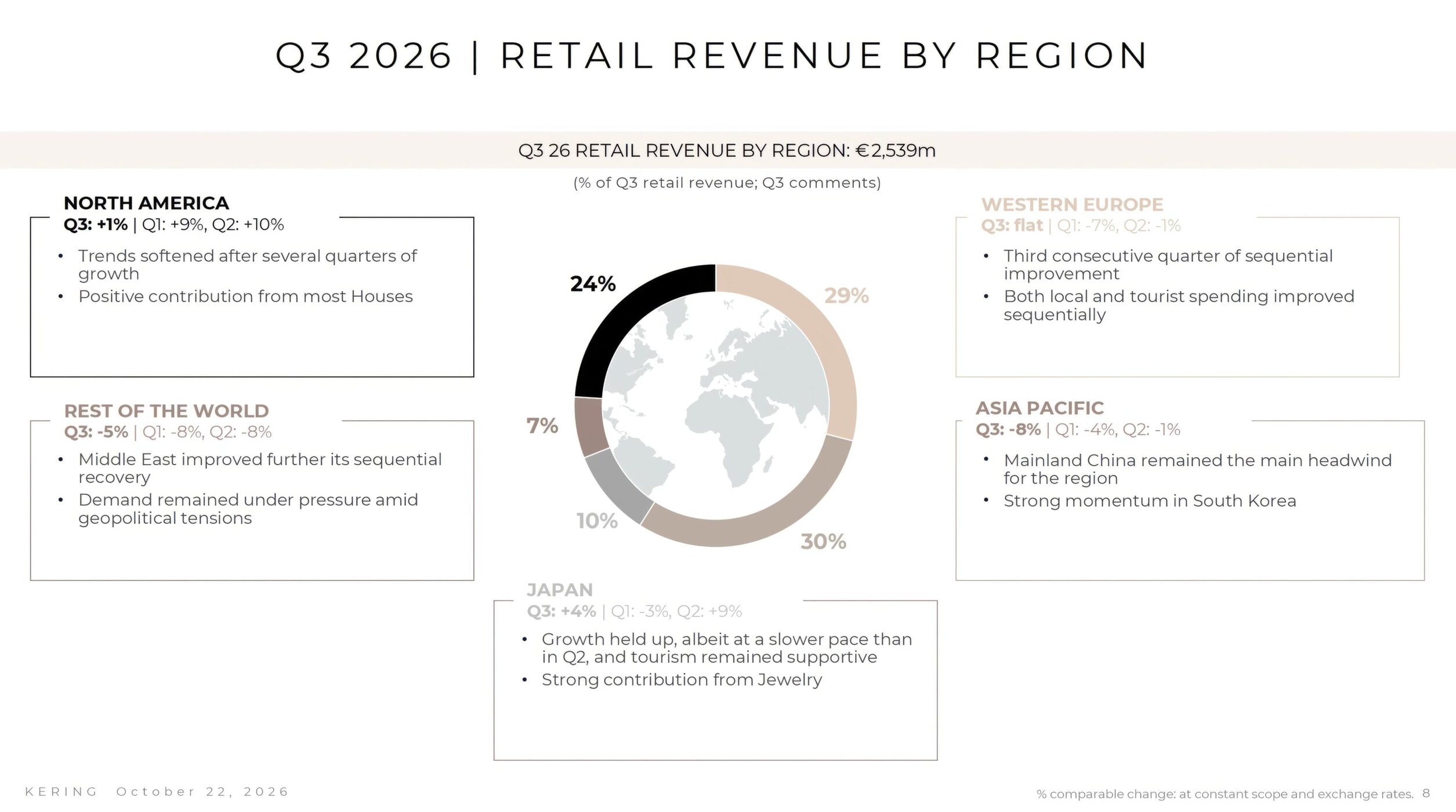
Asia Pacific revenue declined 5% on a comparable basis, while retail sales in the region fell 8%. Mainland China remained the principal source of weakness, particularly for Gucci, although South Korea continued to demonstrate positive momentum.
North America recorded comparable revenue growth of 2%, supported by contributions from several houses, although retail growth moderated following stronger performances earlier in the year. Western Europe declined 2% overall, despite sequential improvements in local and tourist spending.
Japan remained comparatively resilient, with revenue increasing 4%, supported in part by the jewelry business and continued tourist demand.
Across the group, directly operated retail revenue declined 3% on a comparable basis, while wholesale and other revenue increased 3%. Kering noted that store traffic remained the principal constraint, even as conversion rates and average transaction values showed improvement.
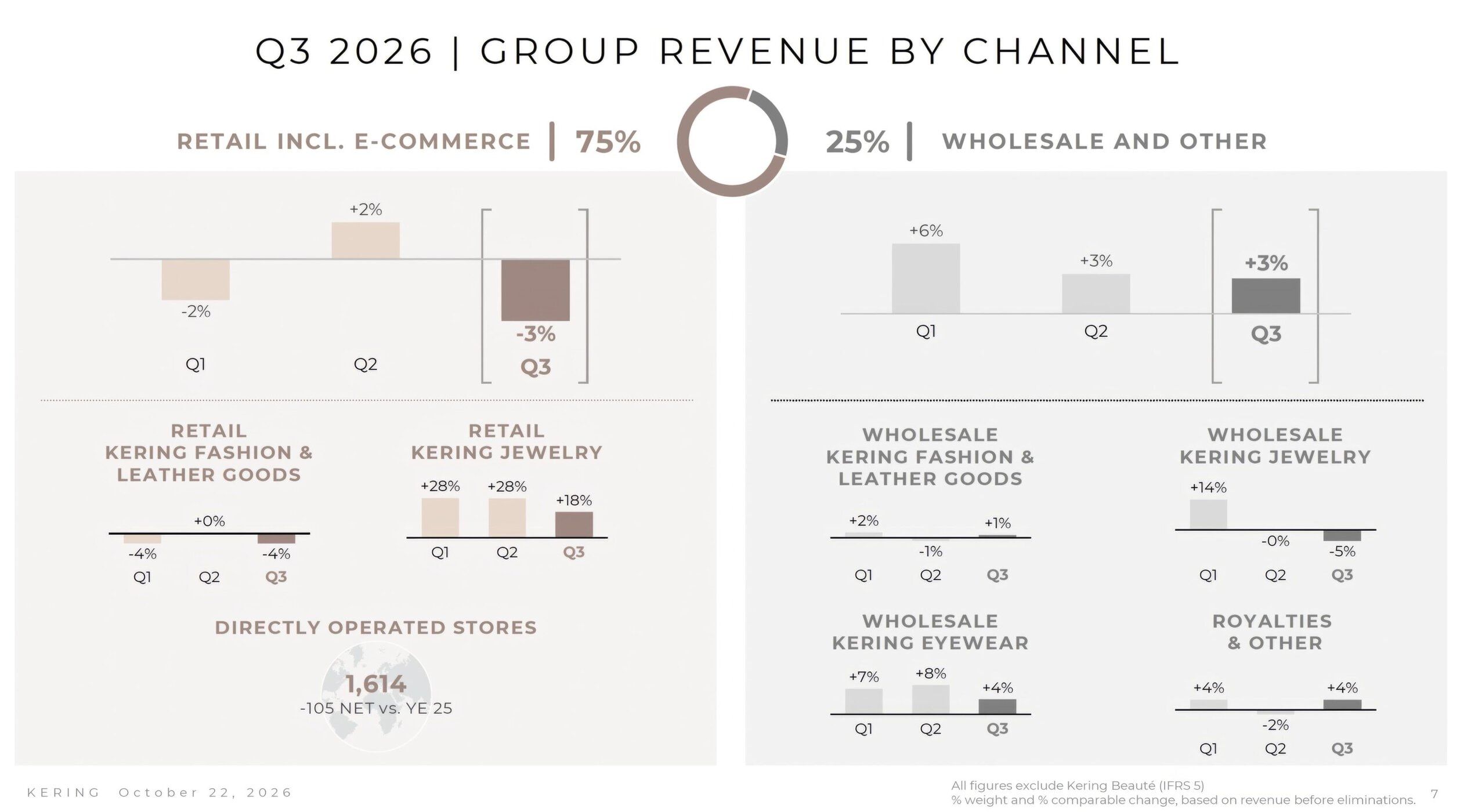
The distinction is important to the group’s recovery strategy. Kering is seeing evidence of stronger customer response to its products, but it has yet to generate the consistent traffic needed to return its largest fashion business to sustained growth.
De Meo Accelerates Kering’s Transformation
Since taking leadership of Kering, de Meo has made the rebuilding of Gucci and the improvement of operational efficiency central to the group’s strategy.
The company is reorganizing its approach to product development, merchandising and retail, seeking to improve quality, simplify assortments and bring new products to market more quickly. It is also strengthening decision-making in China, with greater local responsibility for product selection, marketing and commercial initiatives.
Retail network optimization is another major component of the restructuring. Kering completed 105 net store closures during the first nine months of 2026, exceeding its original full-year target of 100. The company now plans at least 125 net closures by year-end, following 75 net closures in 2025.
The group is also building greater coordination across its businesses, particularly in manufacturing, customer relationships and technology, while continuing to invest in the individual identities of its houses.
The strategy extends to craftsmanship and talent development. Kering’s Accademia per le Eccellenze has begun its first full academic year, involving more than 1,500 students across seven partner schools in Italy, reflecting the group’s commitment to developing the technical skills needed to support its fashion businesses.
For 2026, Kering reaffirmed its objective of improving recurring operating margins compared with the previous year, supported by efficiency measures while maintaining investment in its brands.
“The transformation of Kering is a multi-season undertaking, but the improvements we are seeing across the Group, notably in desirability and key operating indicators, reinforce our confidence in the direction we have set, and the determination of our teams to deliver it,” de Meo said.
Kering’s third-quarter results show a group making progress in several areas, although its recovery remains dependent on Gucci. The encouraging performances at Saint Laurent, Bottega Veneta, Brioni and the jewelry division demonstrate the strength of its wider portfolio, while the creative transitions at several major houses introduce another period of change.
For de Meo, the coming seasons will be an important test of whether improvements in product development and retail execution can translate into stronger sales. Gucci’s new creative direction is taking shape, but its commercial recovery will require time as the group works to restore consumer demand and establish a more consistent foundation for growth.