The third-quarter decline puts renewed scrutiny on creative renewal, regional demand and the businesses sustaining LVMH’s growth.
LVMH’s fashion recovery lost momentum in the third quarter of 2026, renewing pressure on the group’s largest business as weaker Chinese demand weighed on sales. Group revenue reached €18.5 billion, with organic growth slowing to 1% from 3% in the second quarter. Fashion and Leather Goods declined 5% organically after briefly returning to growth.
The results arrive at a consequential point for LVMH’s creative strategy. New directions at Dior, Celine, Fendi, Givenchy and Loewe are moving through collections and into stores, with management identifying encouraging responses to several products. The commercial outcomes remain uneven, while jewelry, Sephora and wines and spirits help sustain group growth.
The accompanying investor presentation adds an important qualification: fashion’s second-quarter improvement benefited from a substantially weaker prior-year comparison. The latest figures therefore put the durability of the recovery, alongside the effectiveness of individual brand initiatives, at the center of the discussion.
Key Takeaways
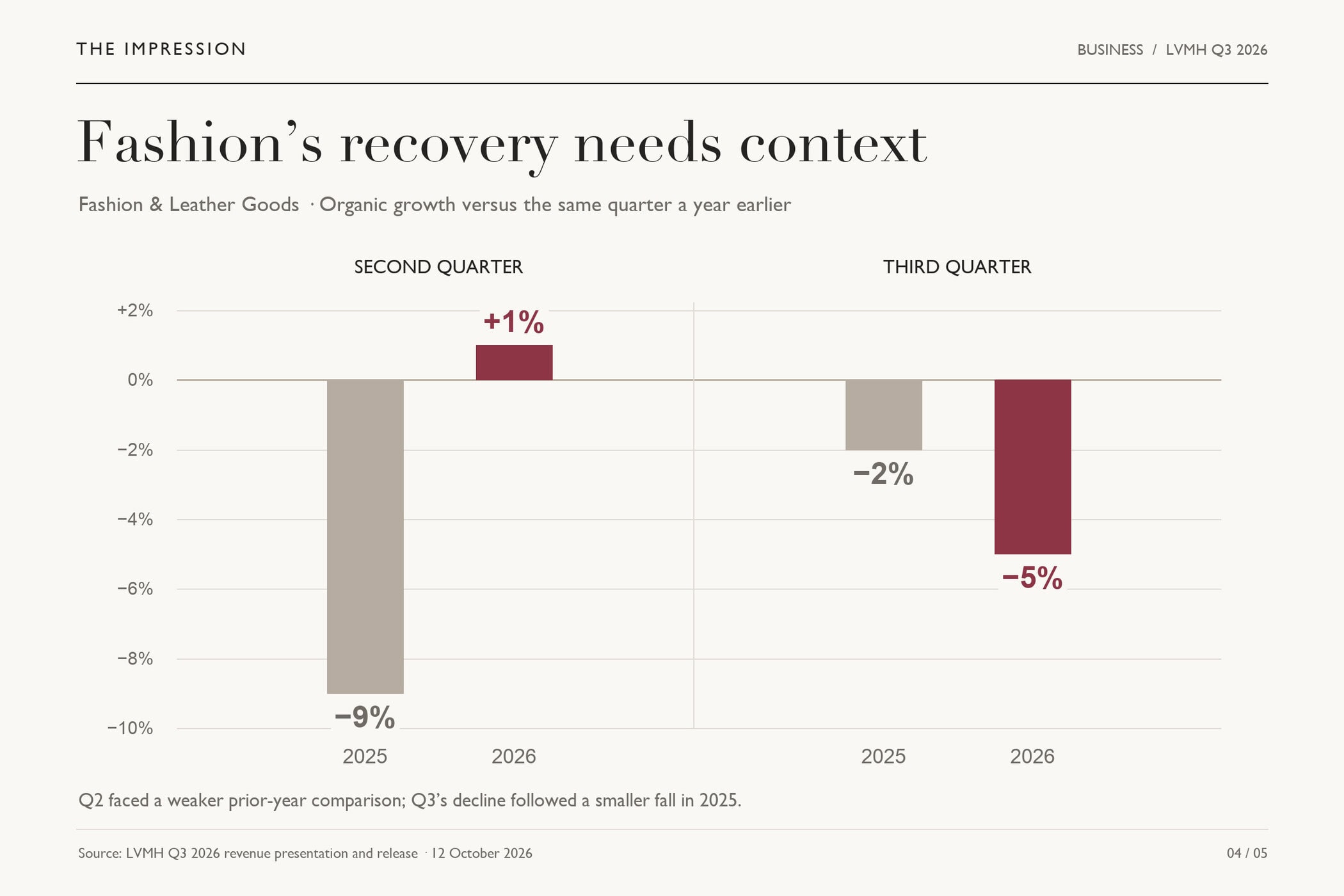
- Fashion’s recovery remains tentative. Second-quarter organic growth of 1% followed a 9% decline a year earlier. Third-quarter sales fell 5%, following a 2% decline in the corresponding 2025 quarter.
- Asia’s reversal is the clearest regional warning. Organic growth in Asia excluding Japan moved from 7% in the first quarter to 4% in the second and −5% in the third.
- Creative renewal is producing identifiable points of strength. LVMH highlighted growth at Dior Couture over nine months, momentum for Michael Rider’s Celine collections and specific product successes across other houses.
- Selective Retailing delivered the strongest quarterly growth. The division increased 8% organically against a prior-year quarter that had already grown 7%.
- Reported figures reflect different pressures across divisions. Currency movements and asset disposals explain the gap between Selective Retailing’s organic growth and its reported revenue decline.
- Fashion’s earnings contribution raises the stakes. Its disproportionate share of group operating profit makes the eventual margin impact of weaker sales a central question.
The Financial Picture
LVMH generated €57.148 billion in revenue over the first nine months of 2026, compared with €58.090 billion a year earlier. Revenue declined 2% as reported and increased 2% organically.
Currency movements reduced nine-month growth by three percentage points, while changes in consolidation scope subtracted another point. In the third quarter, a positive two-point currency effect offset a negative two-point scope effect.
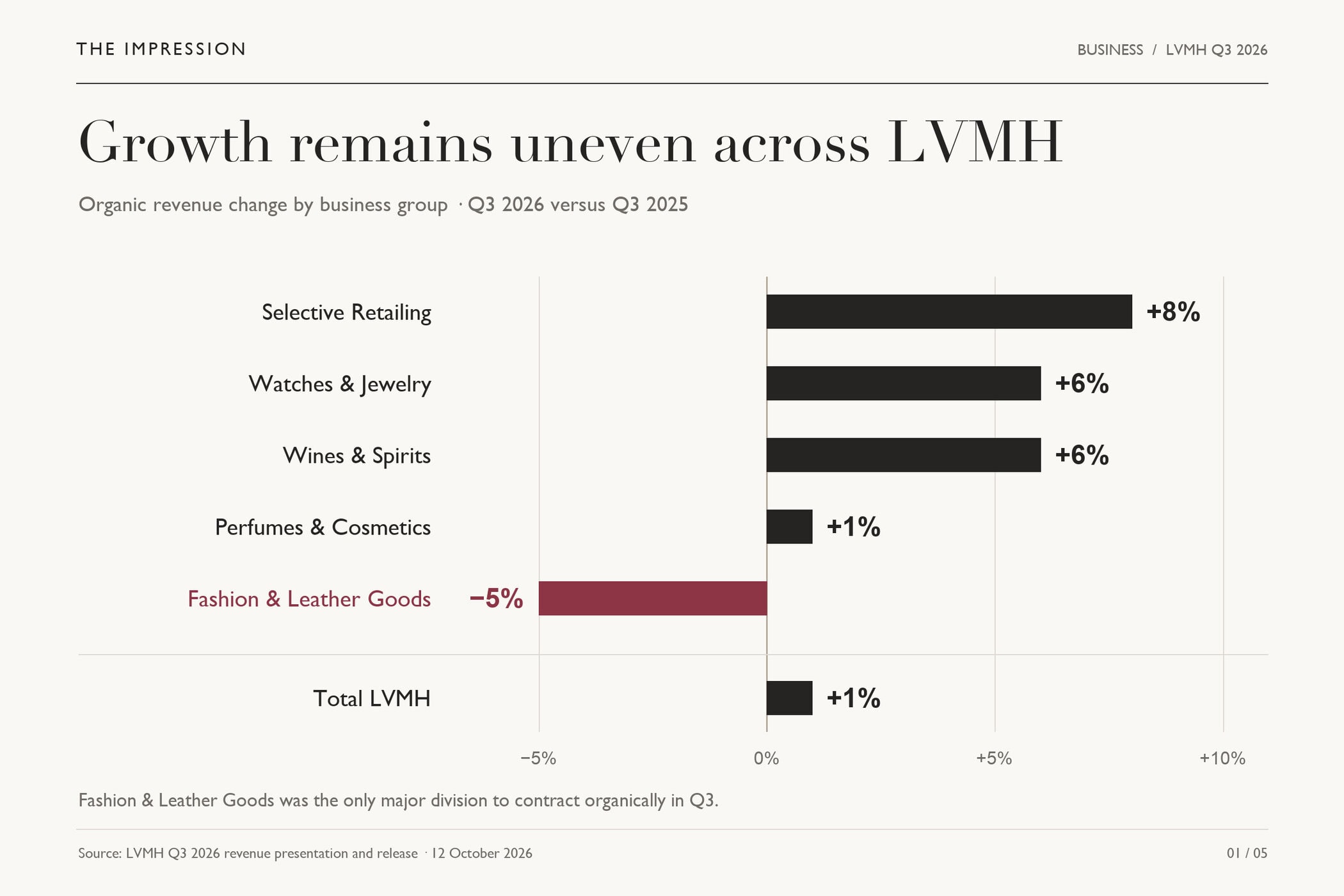
Group totals include other activities and eliminations. Organic growth excludes changes in exchange rates and consolidation scope. Comparisons are against the corresponding period in 2025.
Fashion also fell short of market expectations. Visible Alpha consensus forecasts cited by Reuters anticipated a 1.8% organic decline in the division and 1.3% growth at group level. Actual results were −5% and +1%, respectively.
Fashion’s Recovery Needs Historical Context
Fashion and Leather Goods generated €8.245 billion in third-quarter revenue. Its nine-month sales of €26.391 billion represented approximately 46% of LVMH’s total.
The movement from 1% organic growth in the second quarter to a 5% decline in the third spans materially different prior-year comparisons. In the second quarter of 2025, fashion sales had fallen 9%. By the third quarter of that year, the decline had moderated to 2%.
That history makes the brief return to growth a more tentative signal of recovery. The latest decline also compounds weakness in the corresponding prior-year period.
Fashion’s financial importance extends beyond its share of revenue. In the first half of 2026, the division generated €6.195 billion in profit from recurring operations, equivalent to approximately 71% of the group’s €8.691 billion total. Its operating margin was approximately 34%, compared with 22.5% for LVMH overall, calculated from the company’s published figures.
Consequently, growth in other divisions provides only a partial answer to fashion’s weakness. Their different profit margins mean that additional revenue elsewhere does not translate into an equivalent earnings contribution.
The third-quarter update provides no new operating-profit figures. The margin consequences of the slowdown remain to be established.
Asia Reverses as Europe Improves
The presentation shows how sharply regional conditions diverged during the year.
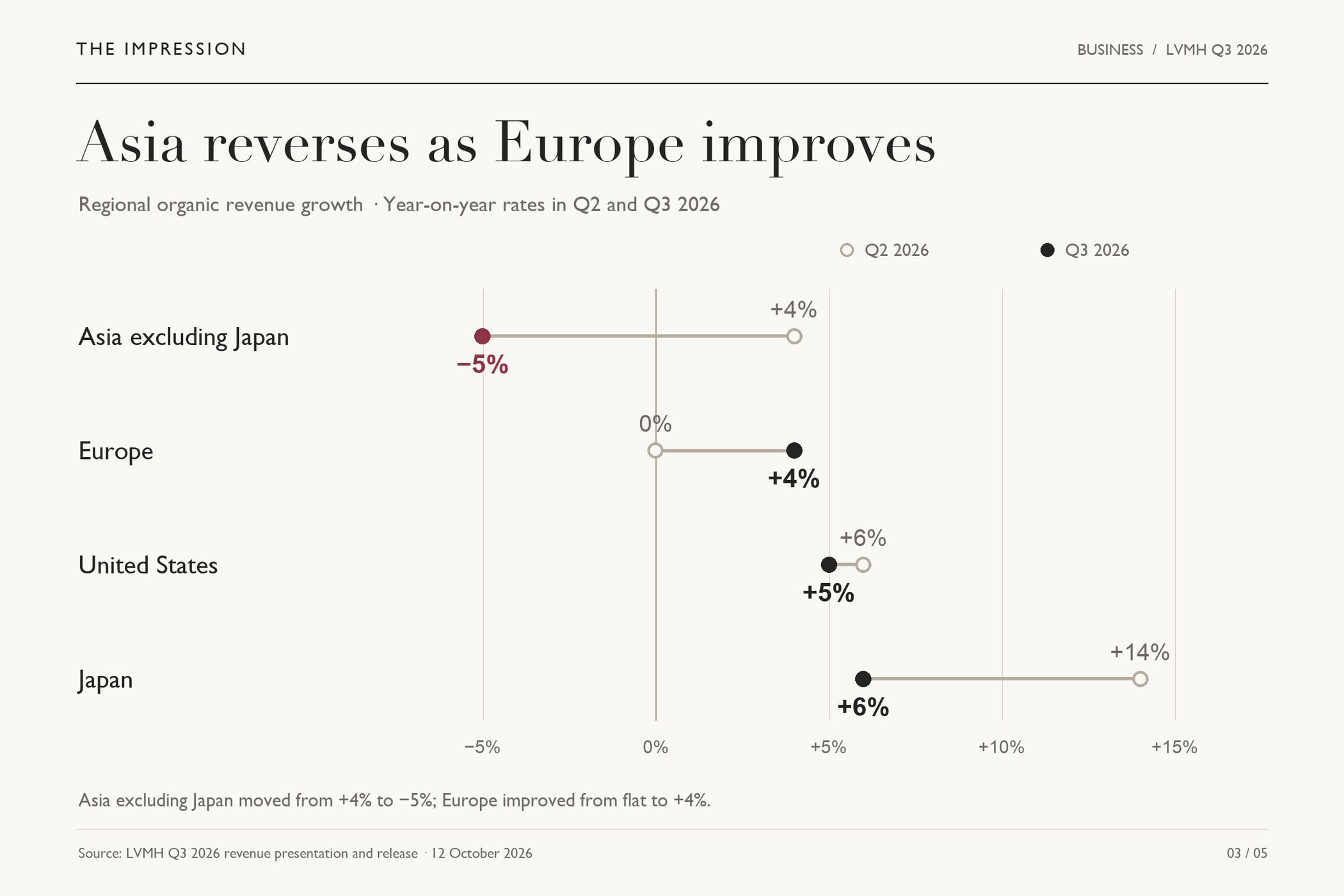
Figures represent group revenue by region and compare with the corresponding periods in 2025.
Asia excluding Japan remained positive over nine months, although the third-quarter reversal interrupted the improvement seen earlier in the year. Europe returned to quarterly growth, bringing its nine-month performance to flat.
Japan’s growth also requires context: its 6% third-quarter increase followed a 13% decline in the corresponding 2025 quarter. The rebound is measured against a depressed base.
LVMH’s geographic exposure remains broadly balanced. Asia excluding Japan accounted for 27% of nine-month revenue, the United States 25%, and Europe including France 26%.
On the earnings call, chief financial officer Cécile Cabanis said fashion demand among Chinese customers declined by a mid-teens percentage, while spending by American clients increased at a mid-single-digit rate.
Customer nationality and regional revenue describe different dimensions of demand. For executives allocating store investment and marketing budgets, that distinction matters because shoppers contribute to sales across multiple markets.
Louis Vuitton also faced consumer backlash in China following a copyright dispute with tea chain Molly Tea over a floral logo, Reuters reported. The company’s revenue materials provided no quantified financial impact from the dispute.
Creative Renewal Produces Uneven Commercial Results
The presentation gives a more specific account of the fashion houses’ progress, identifying both brand performance and the products receiving a response.
Christian Dior Couture offers the clearest evidence of progress within the wider decline. LVMH reported growth over the first nine months and highlighted the performance of women’s bags and ready-to-wear under Jonathan Anderson.
Cabanis said Dior was flat in the third quarter and positive over nine months, with double-digit growth among American customers over the nine-month period.
Dior also expanded its retail presence, opening a House of Dior flagship on Milan’s Via Monte Napoleone in September after an Osaka opening in May. The combination connects its new creative direction with the physical presentation of the brand.
Louis Vuitton is developing established signatures alongside newer products. The house marked the Monogram’s 130th anniversary through its bags and the Monogram Emblème jacquard weave. Management highlighted recently launched bags, collections by Nicolas Ghesquière and Pharrell Williams, and momentum at recent store openings.
The presentation also confirms a temporary logistics problem during the quarter. Cabanis quantified its impact at slightly more than one percentage point of Louis Vuitton’s quarterly organic growth.
That operational disruption adds context to Vuitton’s performance. The broader commercial challenge remains sustaining demand across heritage products, new designs and customer groups.
The other houses provide a more varied picture of renewal.
- Celine: LVMH described accelerating momentum for Michael Rider’s collections and highlighted activity around silk.
- Loewe: Management identified growing success for the Amazona 180 and the launch of the Whisker bag.
- Fendi: The presentation highlighted Maria Grazia Chiuri’s first collections and the performance of the new Baguette.
- Givenchy: Sarah Burton’s ready-to-wear was identified as a source of positive performance.
- Loro Piana: The house recorded growth and supported its collection with an immersive Milan presentation and a new knitwear center in Ghemme.
- Rimowa and Berluti: LVMH described strong growth at Rimowa, alongside new Classic Titanium and Grid suitcases, and a solid performance at Berluti.
These disclosures offer useful evidence of product traction. LVMH provides limited individual brand financial data, so the success of a collection or bag should be read within the division’s overall contraction.
The strategic pattern is nevertheless clear: new creative leadership is working through established house identities, while product development gives those identities fresh commercial expression.
Retail Strategy Extends Beyond Flagship Openings
LVMH continues to invest in how customers encounter its brands.
Louis Vuitton’s experiential locations, including LV The Place Seoul, connect retail with its travel heritage. Dior’s new flagships support its creative transition. Tiffany continues renovating its stores, while Loro Piana’s knitwear investment strengthens the production capabilities behind its positioning.
The presentation also adds initiatives focused on distribution and customer retention. Sephora highlighted an M&S partnership in the United Kingdom, alongside entry into Belgium and Croatia. Le Bon Marché introduced a new loyalty program while maintaining its calendar of artistic and cultural events.
Together, these developments show several approaches to growth: entering markets, developing partnerships, improving stores and encouraging customers to return. Assessing their effectiveness will require evidence of productivity and repeat purchasing alongside the visibility of the projects themselves.
Jewelry Remains Strong, With Slower Quarterly Growth
Watches and Jewelry generated €7.725 billion in nine-month revenue, increasing 8% organically and 4% as reported. Currency movements reduced growth by four percentage points.
Third-quarter organic growth moderated to 6% from 11% in the second quarter. The comparison also became more demanding: the division was flat in the second quarter of 2025 and grew 2% in the third.
LVMH attributed the division’s strength primarily to jewelry. Tiffany continued developing its established collections and renovating its store network. Its Blue Book 2026: Hidden Garden high jewelry collection was accompanied by an exhibition of Jean Schlumberger’s archive at MAD Paris.
Bulgari reported record revenue for its Eclettica high jewelry collection, alongside a successful Vimini launch and continued activity around its established designs. Chaumet introduced A Journey Through Nature and its first Bee de Chaumet high jewelry set in traceable gold.
The broader portfolio continued using cultural and sporting partnerships to build visibility, including Hublot’s collaboration with Jeff Koons and TAG Heuer’s presence at the Spanish Formula 1 Grand Prix in Madrid.
For brand leaders, the emphasis combines recognizable products, craftsmanship and cultural engagement. The slower quarterly growth rate adds a reason to monitor how consistently those strategies sustain demand.
Sephora Supports Growth Against a Stronger Comparison
Selective Retailing increased 8% organically in the third quarter, following growth of 4% and 6% in the first two quarters.
Its latest performance is particularly notable because the division had already grown 7% in the third quarter of 2025. Growth therefore accelerated against a stronger prior-year comparison.
Sephora remained a principal source of momentum. LVMH reported strength across key regions and established and emerging brands, supported by exclusive launches including Rhode and Chinese beauty labels.
The mix illustrates the commercial value of curation: established brands provide familiarity, while emerging names and exclusive products create reasons to visit. Market expansion and the UK partnership add further avenues to reach customers.
The division’s nine-month reported revenue fell 1% to €12.476 billion despite 6% organic growth. The presentation explains the difference precisely: changes in consolidation scope reduced growth by four percentage points, and currencies subtracted three.
That breakdown gives a clearer view of the underlying performance as DFS asset disposals change the division’s composition.
Beauty Returns to Modest Growth
Perfumes and Cosmetics increased 1% organically in the third quarter after declining 1% in the second. Nine-month revenue was flat organically and down 2% as reported, at €5.922 billion.
Parfums Christian Dior benefited from fragrances including J’adore Intense, Addict and Sauvage Extrait, alongside Forever and Backstage makeup and Prestige skincare.
Guerlain highlighted Rouge G lipstick and Orchidée Impériale skincare, while Parfums Givenchy continued developing L’Interdit. Maison Francis Kurkdjian expanded its Oud collection, and Loewe Perfumes added to its Crafted collection.
The performance reflects continued investment in established franchises and product extensions. Sephora’s faster growth also demonstrates the distinction between the economics of a multibrand retailer and the performance of LVMH’s owned beauty portfolio.
Wines and Spirits Broaden the Recovery
Wines and Spirits increased 6% organically in the third quarter and 5% over nine months, reaching €4.027 billion in nine-month revenue.
The presentation separates the nine-month performance into 6% organic growth for Champagne and Wines and 4% for Cognac and Spirits.
Champagne continued recovering, particularly in Europe. Hennessy recorded positive momentum in China and introduced ready-to-serve cocktails in the United States. Rosé wines and the Chandon Spritz range provided further product activity.
Hennessy’s performance in China adds nuance to the regional picture. Different categories are experiencing different demand patterns within the same market.
Portfolio Changes and the Fourth-Quarter Priorities
LVMH completed the sale of Marc Jacobs to WHP Global on September 1 and reported the sale of most of DFS’s businesses.
The presentation helps distinguish their effects from underlying demand. Fashion and Leather Goods’ nine-month revenue decline comprised a 2% organic contraction and a two-point currency drag, with the scope effect reported as zero at the presentation’s rounding precision. Selective Retailing recorded the more substantial four-point scope reduction.
LVMH’s outlook continues to emphasize recognizable products, creative renewal, craftsmanship, targeted investment and operational efficiency. Cabanis defended balancing higher-end offerings with customer recruitment and rejected price cuts as a response to Vuitton’s slowdown.
For fashion executives, the next quarter will be revealing in four areas:
- Commercial breadth: whether success in individual collections and products translates into growth across more houses.
- Demand in China: whether the third-quarter deterioration stabilizes, and how brands sustain engagement through softer spending.
- Retail productivity: whether openings, partnerships and loyalty initiatives deliver stronger customer acquisition and repeat purchasing.
- Profitability: how continued investment and operational discipline affect earnings as fashion revenue remains under pressure.
LVMH has identifiable strengths across its portfolio and several promising product initiatives within fashion. A sustained recovery will depend on those initiatives producing broader, repeatable demand in the business that contributes most to group earnings.