
Americas Momentum And Retail Optimization Offset Wholesale Decline And Continued Weakness In China
Ferragamo is sharpening its focus on direct-to-consumer growth, core product categories and retail efficiency as it works to stabilize performance following a challenging 2025.
The Florence-based company reported a 5.7 percent decline in revenues to 976.5 million euros last year, slipping into a net loss of 3 million euros compared with a profit of 16 million euros in 2024. Despite the weaker top line, profitability improved in the second half, with management pointing to early traction from a strategic reset centered on footwear, leather goods and a more disciplined distribution model.
Speaking to analysts, executive board member Ernesto Greco said the company had “refined its strategic priorities” with the aim of reinforcing consistency across its operations. That effort has included narrowing product assortments, reducing underperforming stock keeping units and prioritizing higher-productivity retail locations.
Ferragamo’s direct-to-consumer channel remains central to that strategy, accounting for 75 percent of total sales at 752.3 million euros. While the channel declined 3.1 percent at current exchange rates, it posted a modest increase of 0.4 percent at constant currency, supported by investments in e-commerce and store upgrades. Online sales continued to show steady growth, as the company works to enhance the digital customer experience.
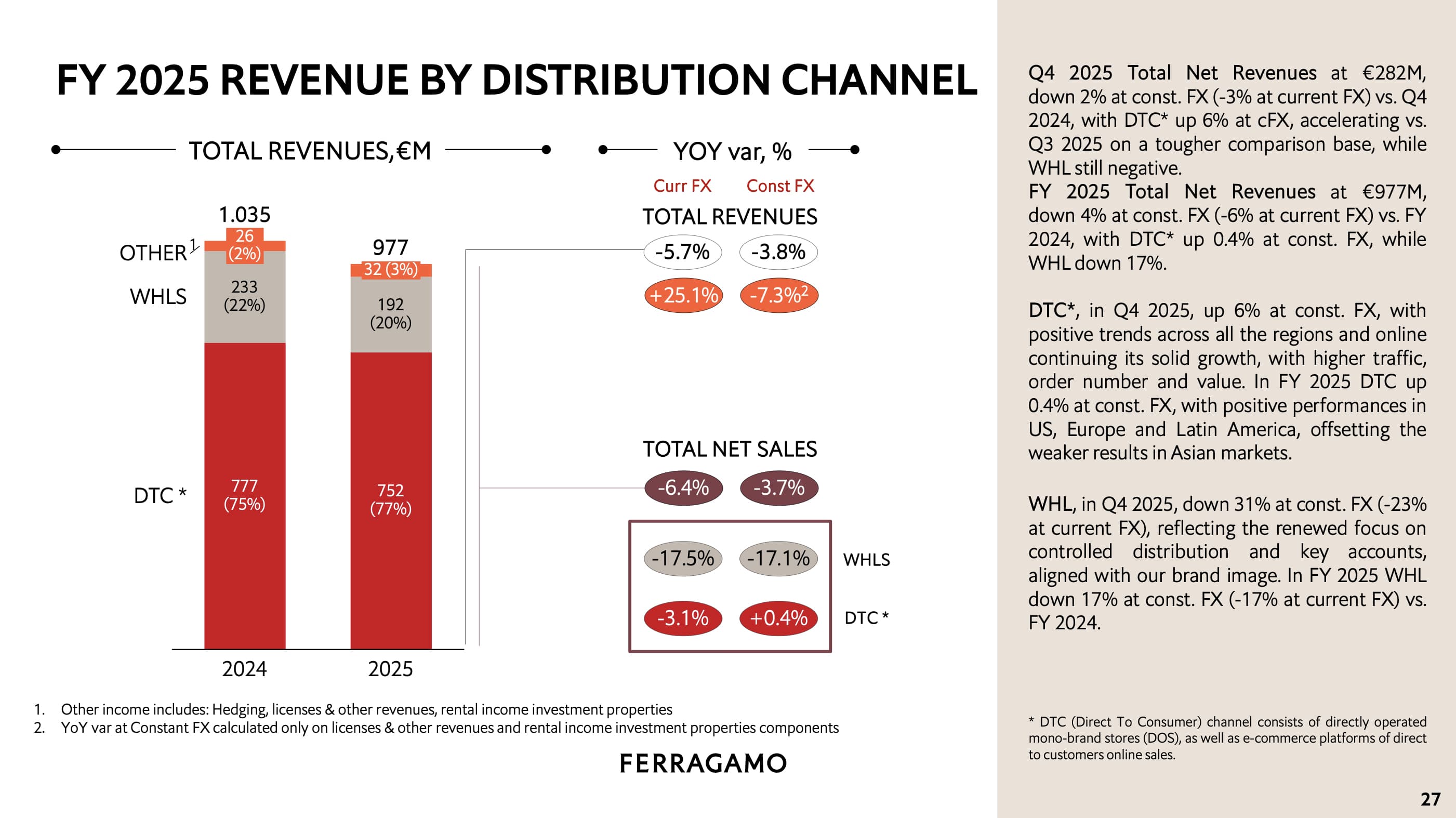
By contrast, wholesale revenues dropped 17.5 percent to 192 million euros, reflecting a more selective approach to distribution. The company has reduced exposure to lower-quality wholesale partners, including temporarily halting shipments to a major U.S. retailer earlier in the year before resuming them.
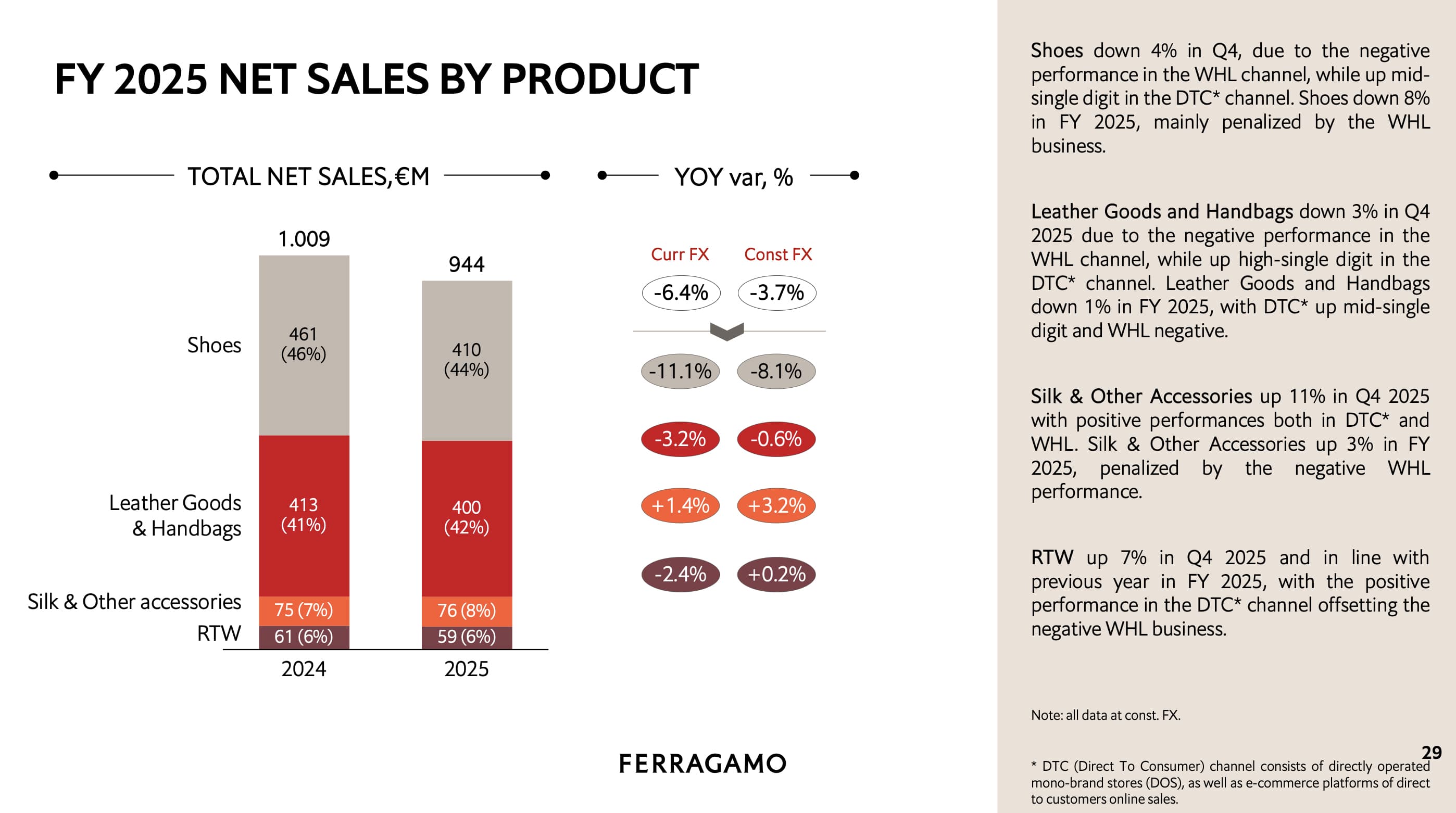
Product-wise, Ferragamo is doubling down on its historical strengths. Footwear and leather goods together accounted for more than 85 percent of revenues, with leather goods showing relative resilience, down 3.2 percent to 400 million euros, compared with an 11.1 percent decline in footwear to 409.6 million euros. Within accessories, the Hug bag has been expanded and the Soft bag has emerged as a bestseller, while silk and smaller accessories such as belts and bijoux posted modest growth.
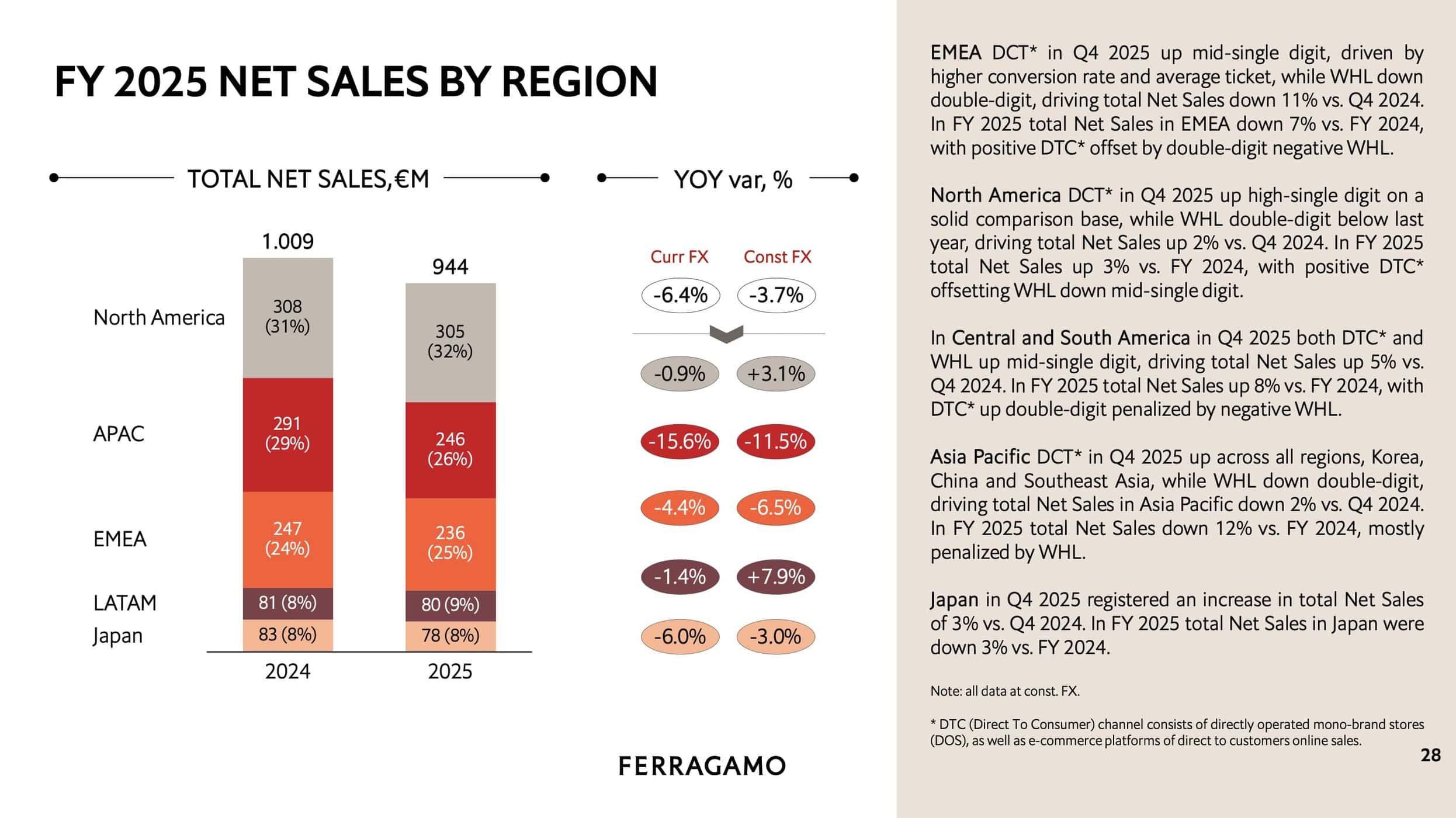
Geographically, performance remained uneven. The Americas emerged as a bright spot, with constant-currency growth of 3.1 percent in North America and high-single-digit gains in Latin America. Greco noted continued double-digit momentum in the U.S. in early 2026, prompting increased investment in the region.
Europe was broadly flat against tough comparisons, while Asia-Pacific remained under pressure, with sales down 15.6 percent for the year. China continues to weigh on results, although the company is seeing early signs of engagement from a younger customer base aged 30 to 38. South Korea delivered strong double-digit growth, partially offsetting declines in the region.
Retail optimization is another key pillar of the turnaround. Ferragamo plans to close around 70 underperforming stores between 2025 and 2026, many of them in China, while redirecting resources toward more strategic locations. Capital expenditure fell to 46 million euros from 71 million euros the previous year, reflecting a more targeted approach to investment.
The company is also continuing its search for a chief executive officer following the departure of Marco Gobbetti in March 2025. Greco confirmed that the process is underway but emphasized that the current leadership team is moving forward with urgency in the interim.
Looking ahead, Ferragamo is maintaining a cautious outlook, citing ongoing macroeconomic and geopolitical volatility. Still, management believes the shift toward a leaner retail network, tighter inventory control and a stronger focus on direct channels is laying the groundwork for more sustainable growth.
“Operating within a volatile geopolitical and macroeconomic environment… our strategy for 2026 is focused on building on the initial success of our action plan,” Greco said, pointing to the DTC channel as a key driver of that next phase.