
Strong Momentum In Greater China And The Americas Helped Restore Comparable Sales Growth As Joshua Schulman’s Reset Gains Traction
Burberry delivered its clearest sign yet that Joshua Schulman’s turnaround strategy is beginning to take hold, with the British luxury house returning to comparable sales growth in fiscal 2026 after a difficult period marked by declining demand, inventory challenges, and questions around brand positioning.
For the 52 weeks ended March 28, Burberry reported a 2 percent increase in comparable store sales, reversing a 12 percent decline a year earlier. Fourth-quarter comparable sales rose 5 percent, accelerating from 3 percent growth in the previous quarter and surpassing analyst expectations, driven largely by renewed momentum in Greater China and the Americas.
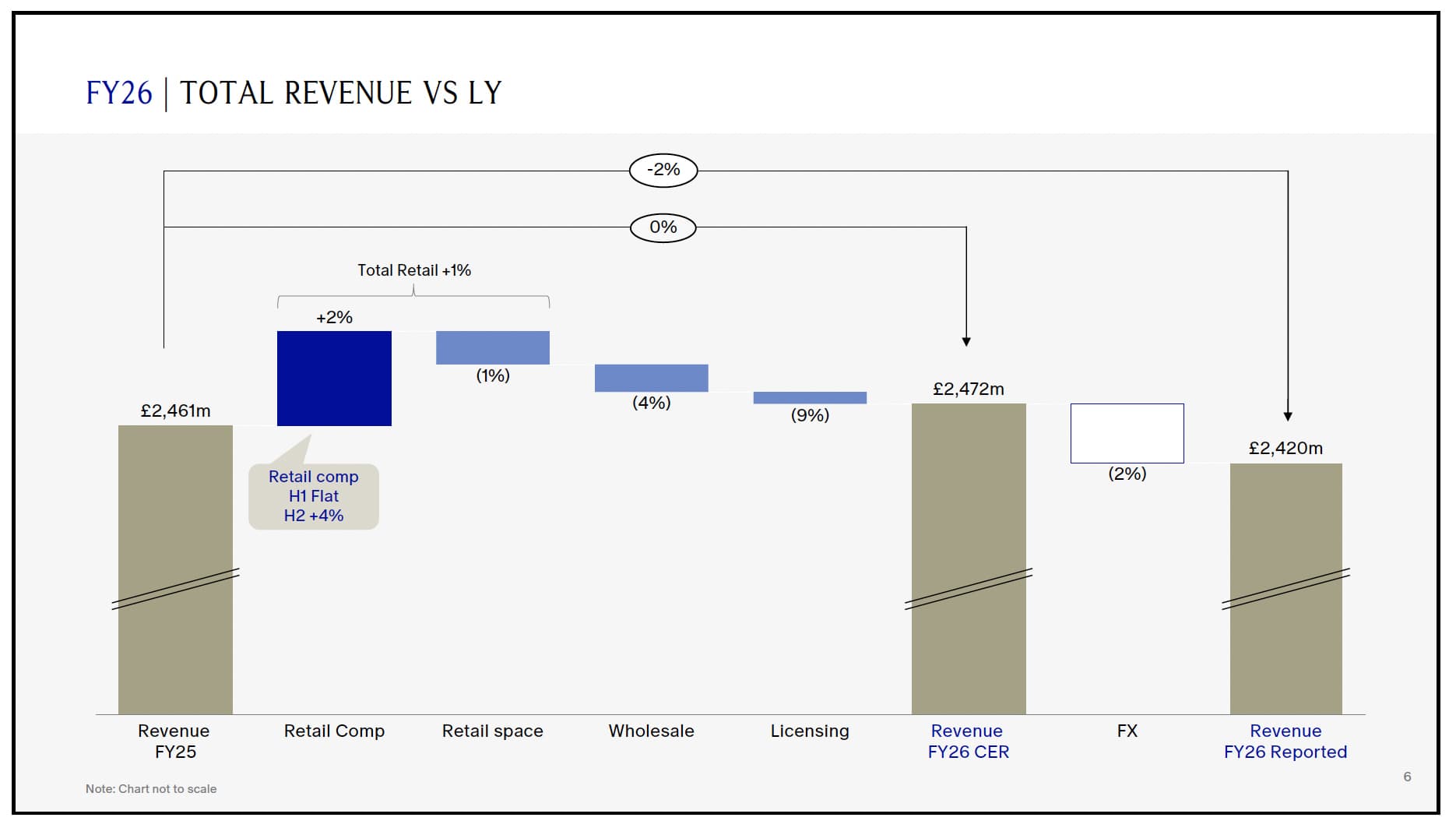
Revenue for the year totaled £2.42 billion, flat at constant exchange rates and down 2 percent at reported rates. Adjusted operating profit rose sharply to £160 million from £26 million a year earlier, while reported operating profit reached £115 million compared with a £3 million loss in fiscal 2025. Gross margin expanded to 67.9 percent, improving 530 basis points at constant exchange rates as the company benefited from higher-quality sales and tighter inventory management.
Profit for the year reached £21 million, compared with a loss of £75 million in the prior year, while free cash flow more than doubled to £141 million. Burberry also said annualized cost savings reached £80 million during fiscal 2026, with the figure expected to rise to £100 million in fiscal 2027.
The results reflect Schulman’s effort to reposition Burberry around its core strengths after years of attempting to elevate the brand further into high luxury territory. Since joining in 2024, the former Coach executive has shifted focus back toward recognizable product categories including outerwear and scarves, while recalibrating pricing, simplifying assortments, improving store productivity, and restoring a more accessible approach to merchandising.
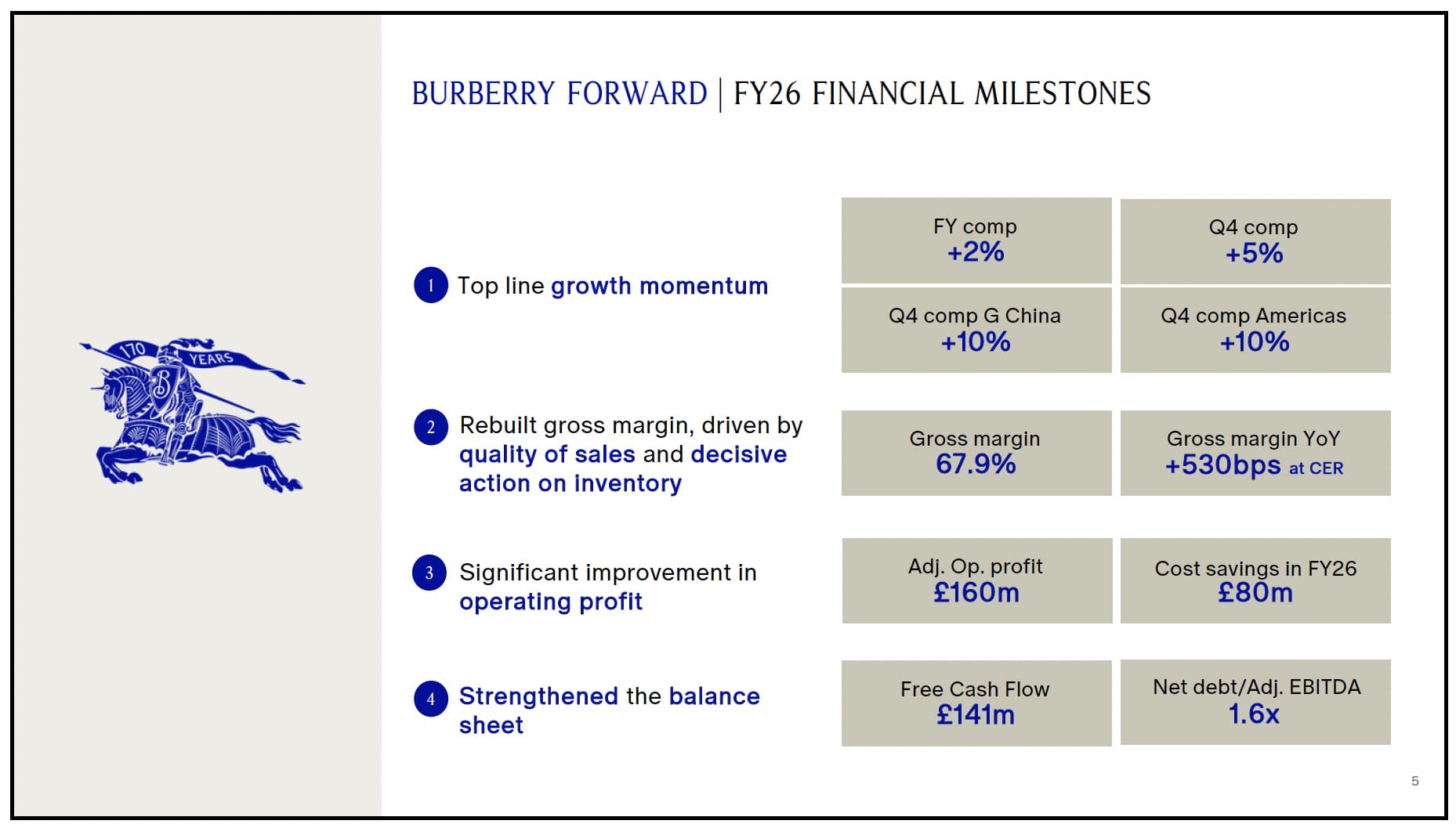
Under the strategy, dubbed “Burberry Forward,” the company has leaned into what Schulman describes as “product authority,” particularly in trench coats and scarves. Outerwear outperformed across all regions during the year, while scarves posted double-digit growth in the second half.
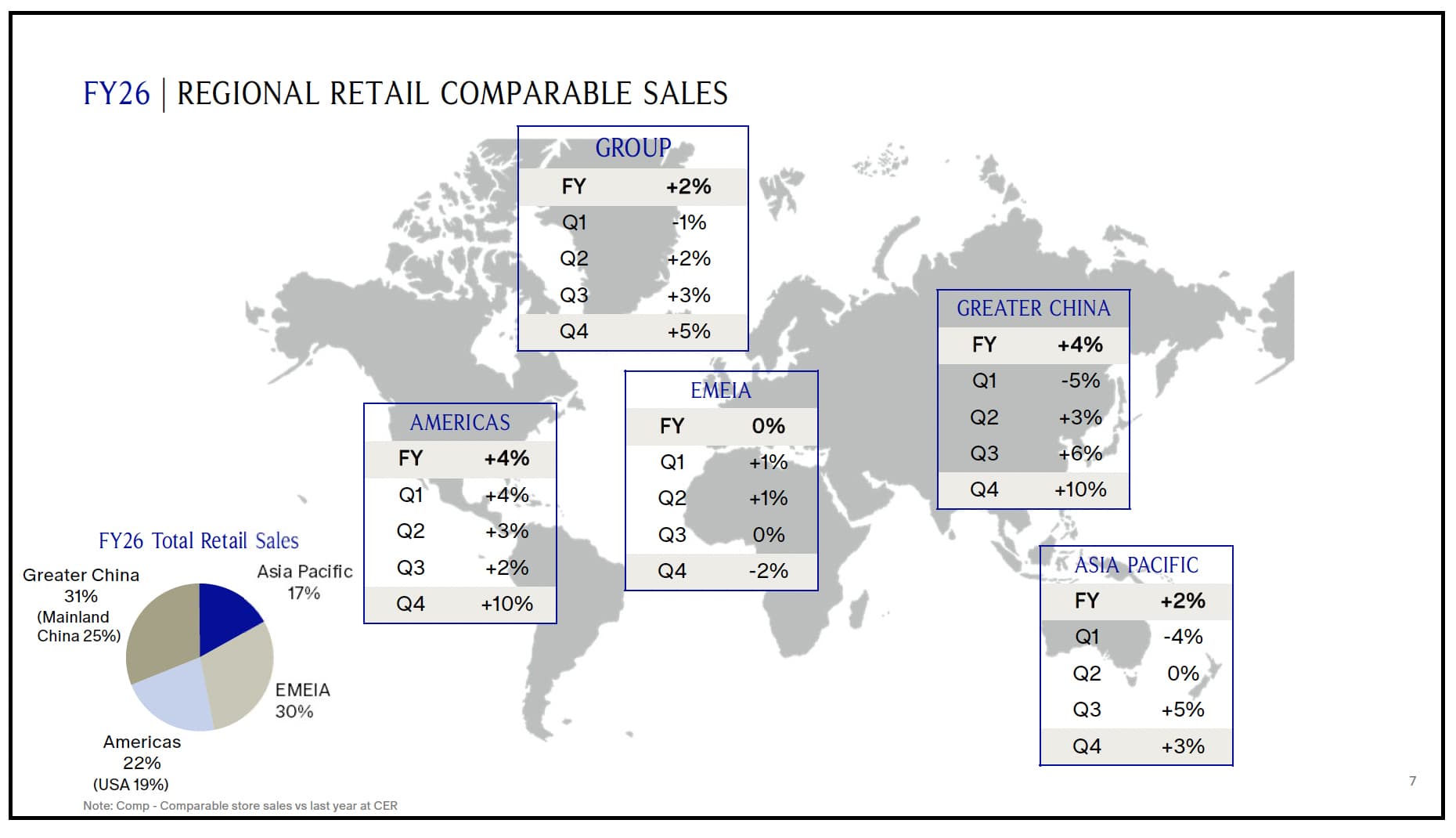
Geographically, the strongest momentum came from Greater China and the Americas, both of which grew 10 percent in the fourth quarter. Greater China finished the year up 4 percent after rebounding strongly in the second half, supported by local consumer spending and targeted marketing campaigns featuring celebrity ambassadors including actor Wu Lei. The Americas also rose 4 percent for the full year, with fourth-quarter growth accelerating to 10 percent from 2 percent in the prior quarter.
Asia Pacific increased 2 percent overall, aided by continued strength in South Korea, while EMEIA remained flat for the year and declined 2 percent in the fourth quarter as tourist activity softened amid geopolitical tensions in the Middle East. Schulman described the impact from the conflict as “quite localized,” noting the region accounts for approximately 2 percent of Burberry’s sales.
Despite the improving trajectory, investors reacted cautiously to Burberry’s outlook. Shares fell more than 5 percent in London trading after the company declined to provide detailed financial targets for fiscal 2027, instead signaling continued progress on revenue growth and margin expansion while warning that macroeconomic and geopolitical uncertainty could weigh on consumer confidence.
Wholesale revenue declined 4 percent during fiscal 2026 but is expected to return to mid-single-digit growth in the first half of fiscal 2027. Capital expenditure for the new year is projected at approximately £120 million.
Burberry also announced that William Jackson, founder of private equity firm Bridgepoint Group, will succeed Gerry Murphy as chairman in November.

“This financial year marks a meaningful inflection point for Burberry. We’ve returned to profitable comparable sales growth, with a strong fourth quarter driven by momentum in Greater China and Americas,” said Joshua Schulman, Chief Executive Officer of Burberry.
“Our strategy is working, and there are clear opportunities for further growth. As we look ahead, while mindful of the uncertain macro-economic environment, our focus is on disciplined execution of Burberry Forward. With increased brand relevance and product authority, I am more confident than ever that Burberry is firmly positioned for long-term value creation,” he added.