A House Before Its Time
Olivier Theyskens Introduces Boloria With A Debut That Argues Identity Is Built Through Memory, Not Marketing
Review of Boloria by Olivier Theyskens Spring 2027 Fashion Show
By Kenneth Richard
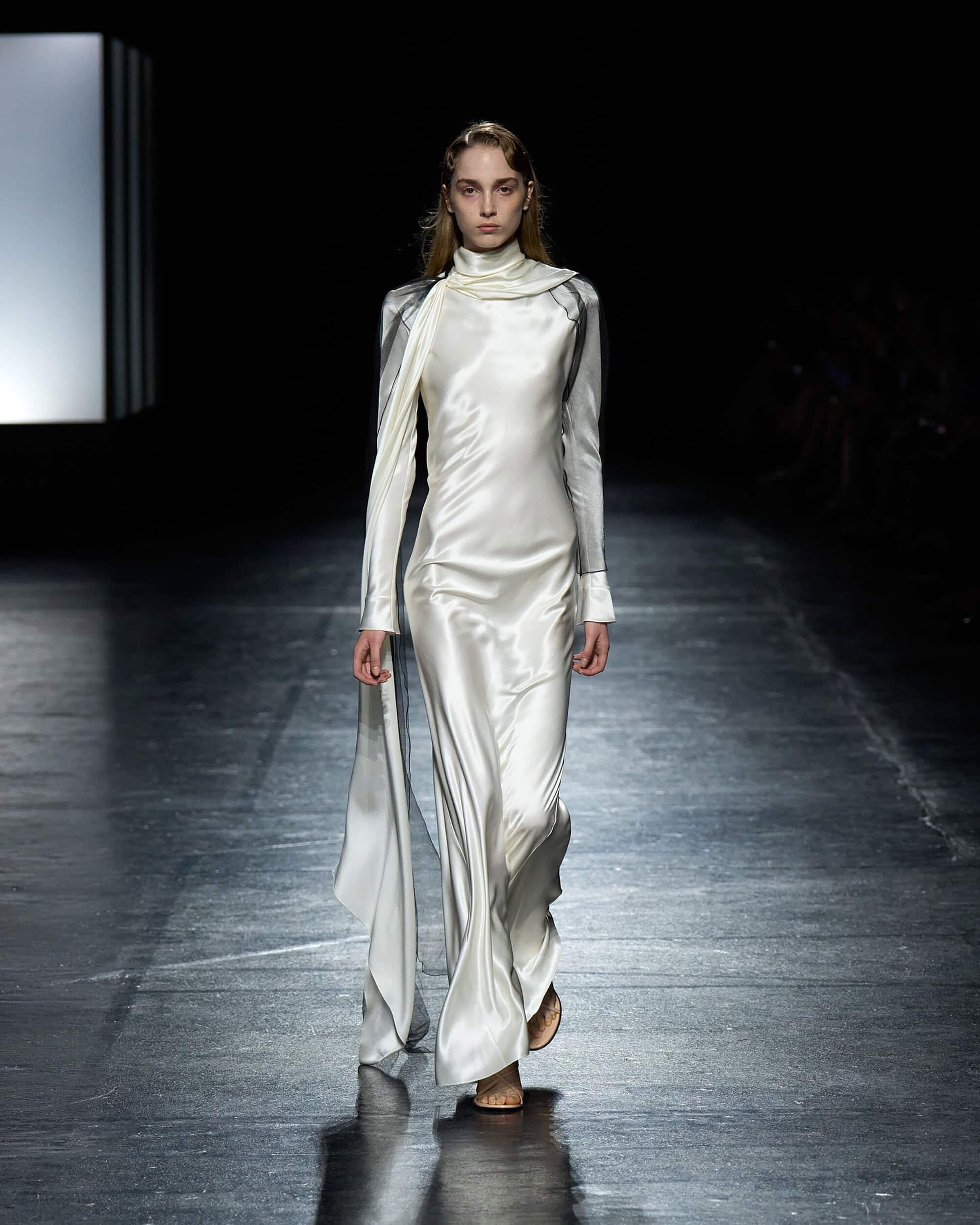
Launching a fashion house has become a strangely predictable exercise. First comes the announcement. Then the campaign. Then the celebrity endorsements. Finally, the runway arrives carrying the impossible responsibility of convincing everyone that history can begin overnight.
Olivier Theyskens rejected that sequence before the lights even came up.
Speaking backstage, Theyskens explained, “I wanted to express that the brand has a past… I wanted to create the feeling that what the house had done still existed in the present, like remnants.” It is a twisty premise for a debut collection because it asks the audience to suspend chronology altogether. Rather than inventing a mythology, Theyskens invited us to discover one already in progress.
Speaking backstage before the show, he explained that Boloria was never conceived as something new. He wanted it to feel as though it had always existed—a house with more than a century of accumulated memory whose past still lingered in the present. It is an unusual ambition because it shifts the conversation away from debut collections and toward permanence. Rather than asking fashion to witness the birth of a brand, Theyskens asked it to believe in its continuity.
That distinction mattered because the collection never relied on storytelling to manufacture emotion. There was no elaborate set demanding interpretation, no theatrical device distracting from the clothes, no attempt to overwhelm the audience with spectacle. Instead, everything—from the restrained presentation to the measured pacing of the runway—suggested confidence in something increasingly rare: that ideas are enough when they are fully realized.
In an industry often consumed by reinvention, Boloria proposed something quieter and ultimately more difficult. It suggested that originality is not always found by inventing new codes, but by giving familiar ones an entirely new emotional purpose.
THE DIRECTION
The central achievement of Boloria lies in the way Theyskens approached authorship. Rather than designing individual garments, he designed a vocabulary. Every silhouette, fabrication, and styling decision belonged to the same conversation, allowing the collection to accumulate meaning instead of chasing moments.
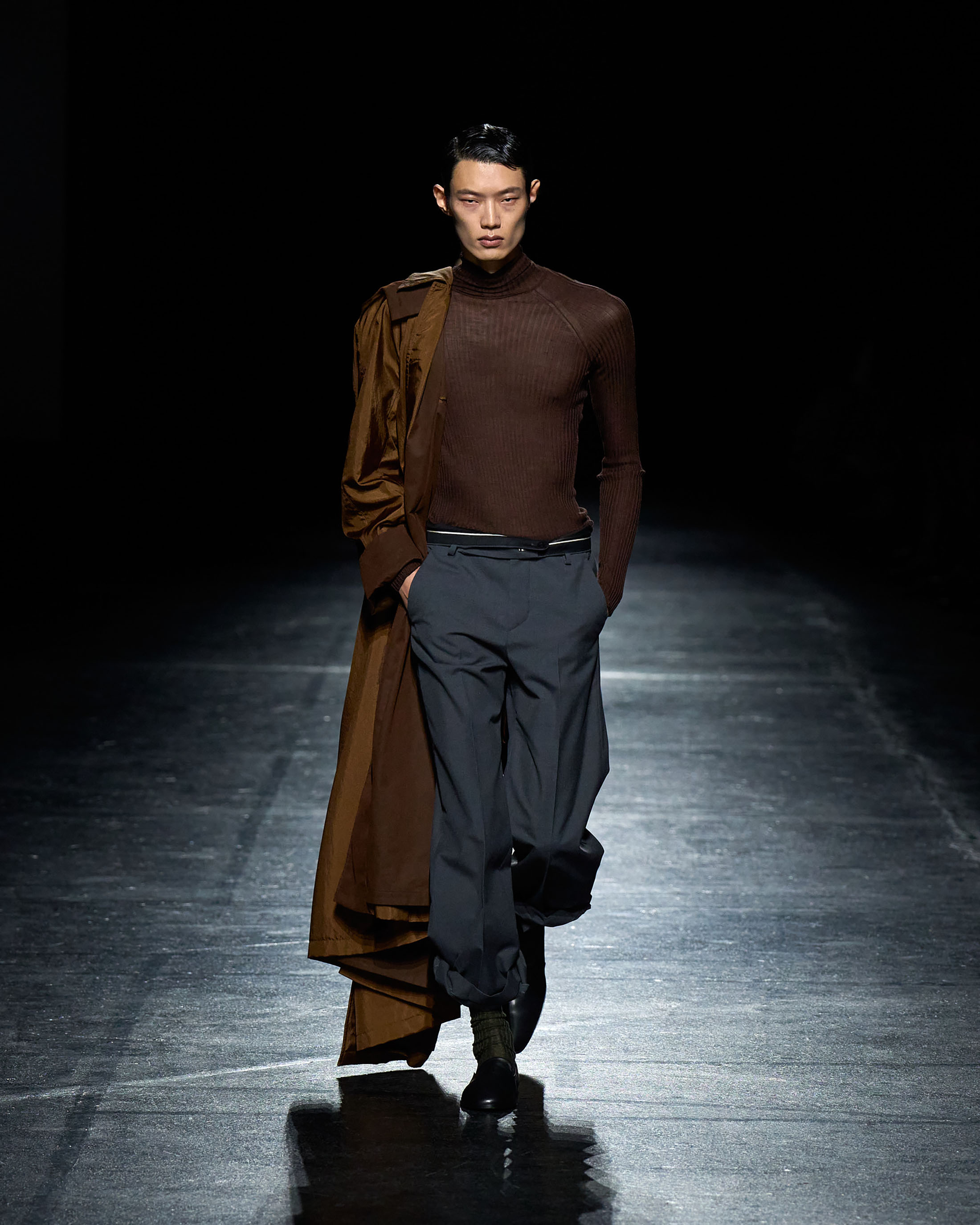
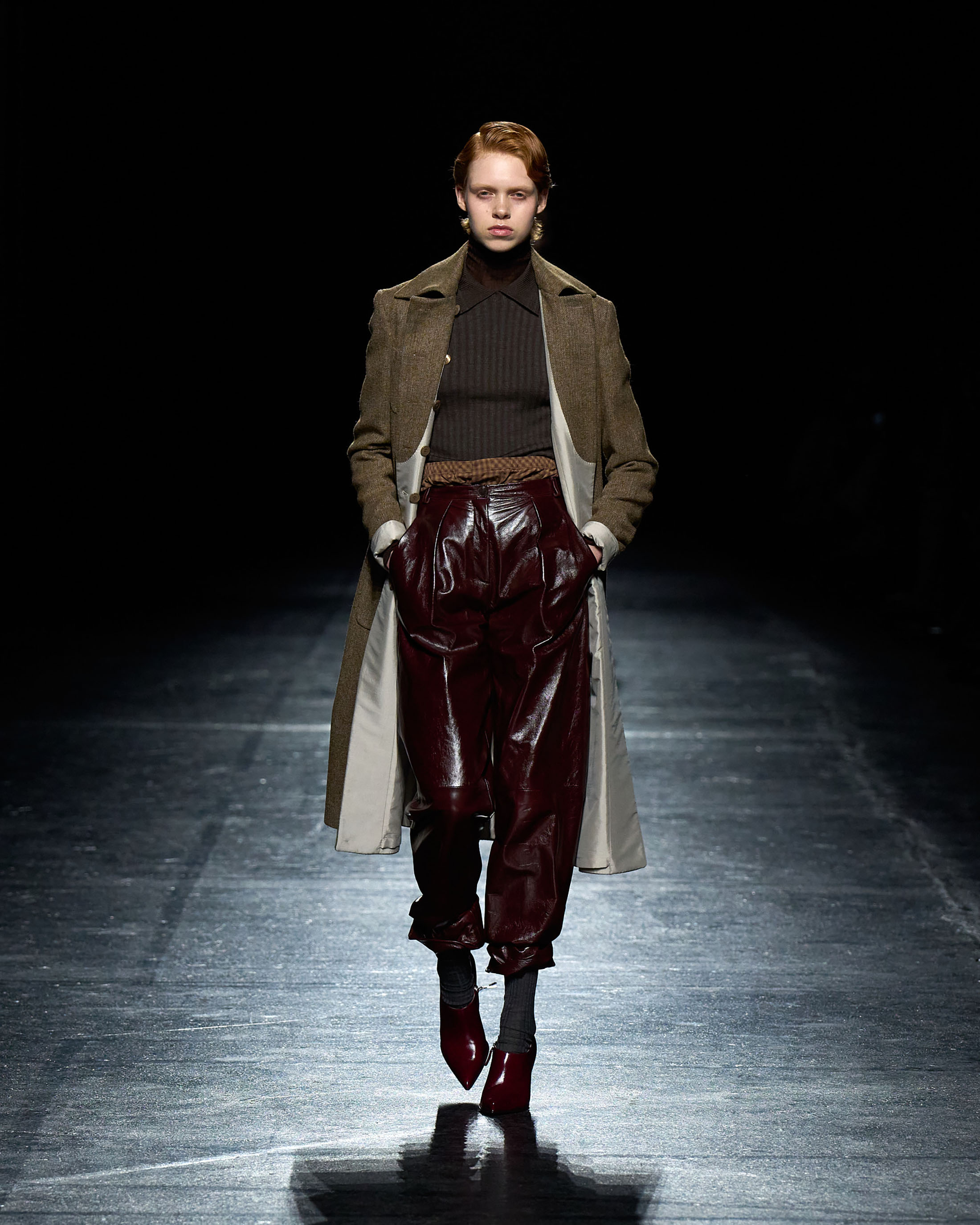
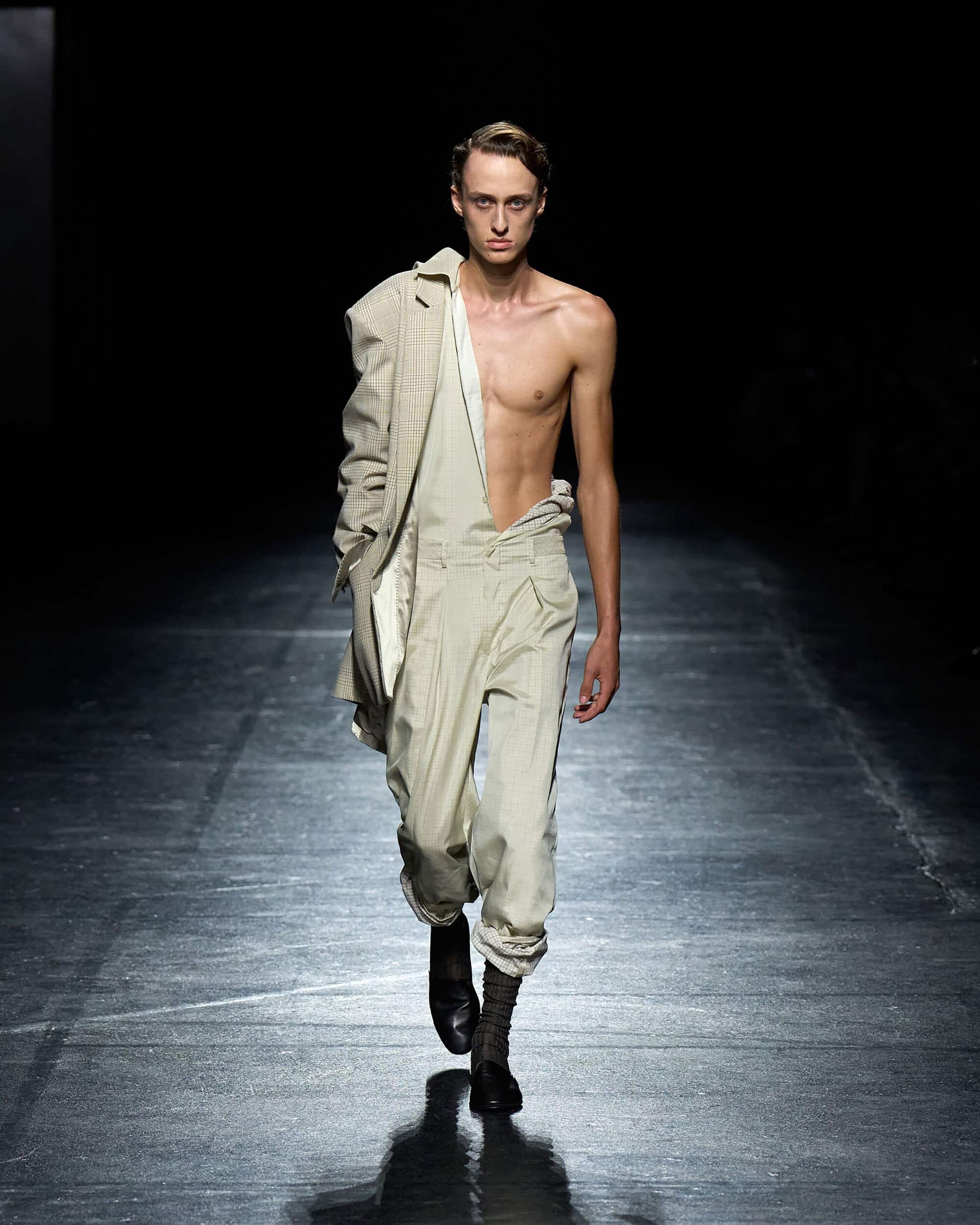
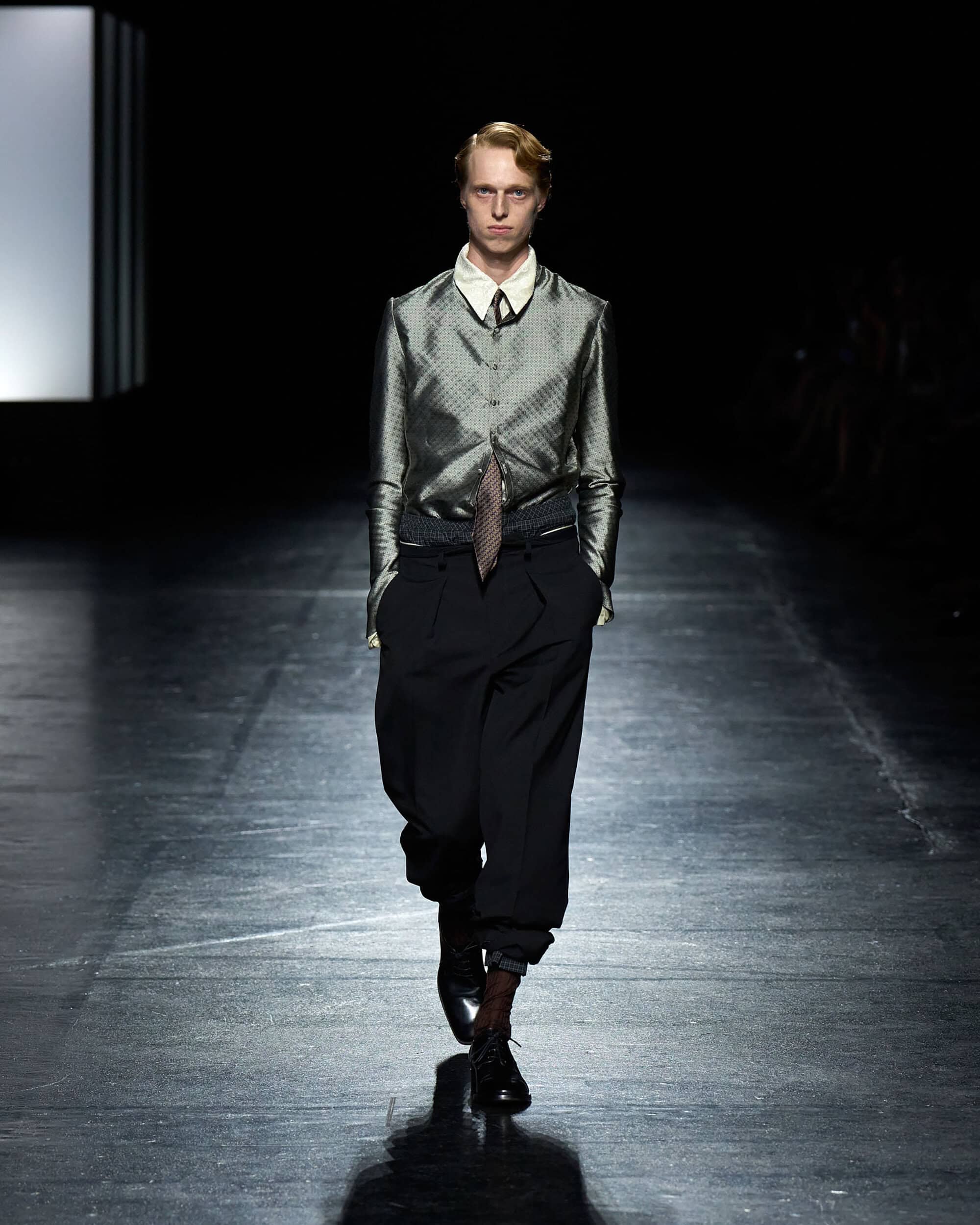
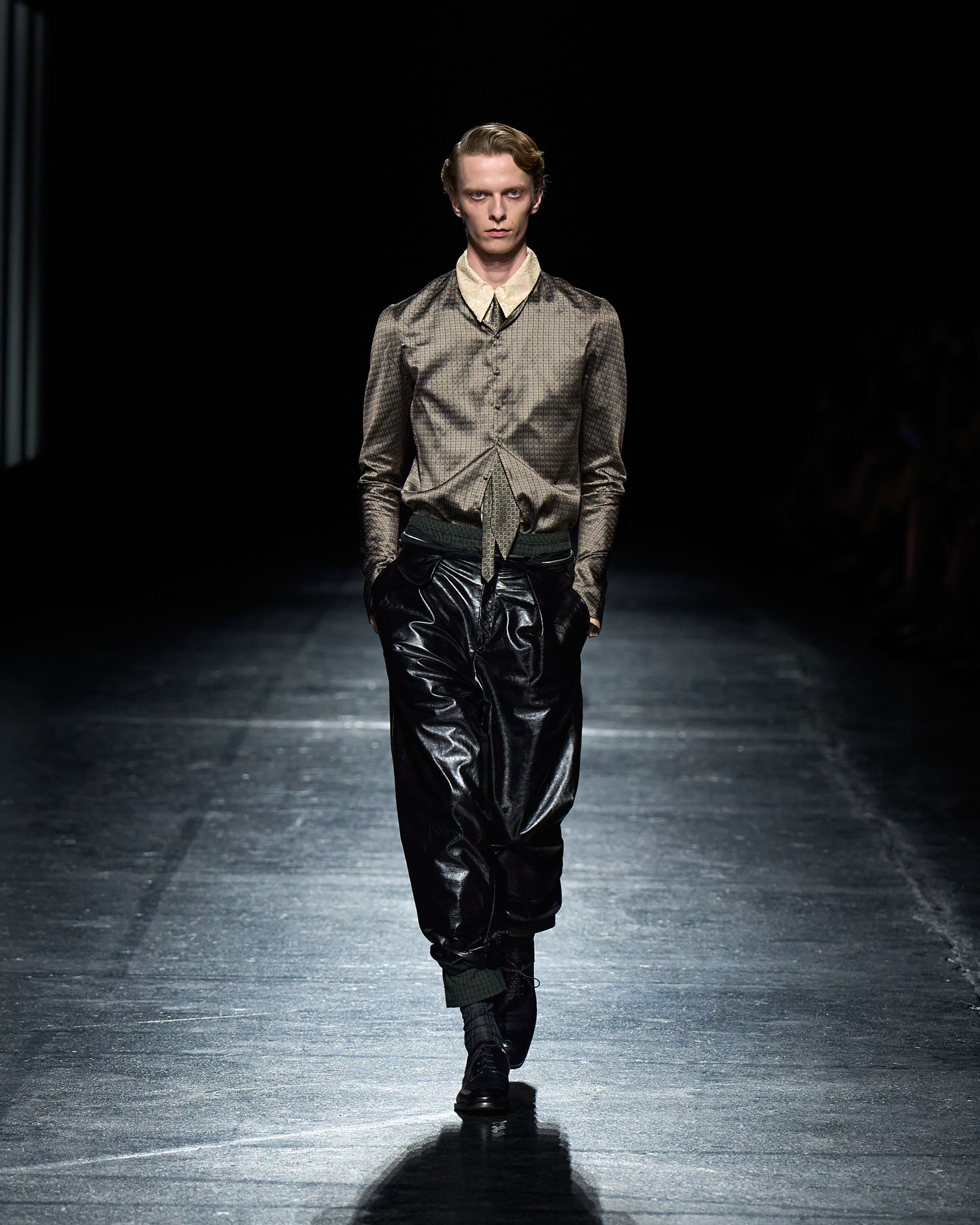
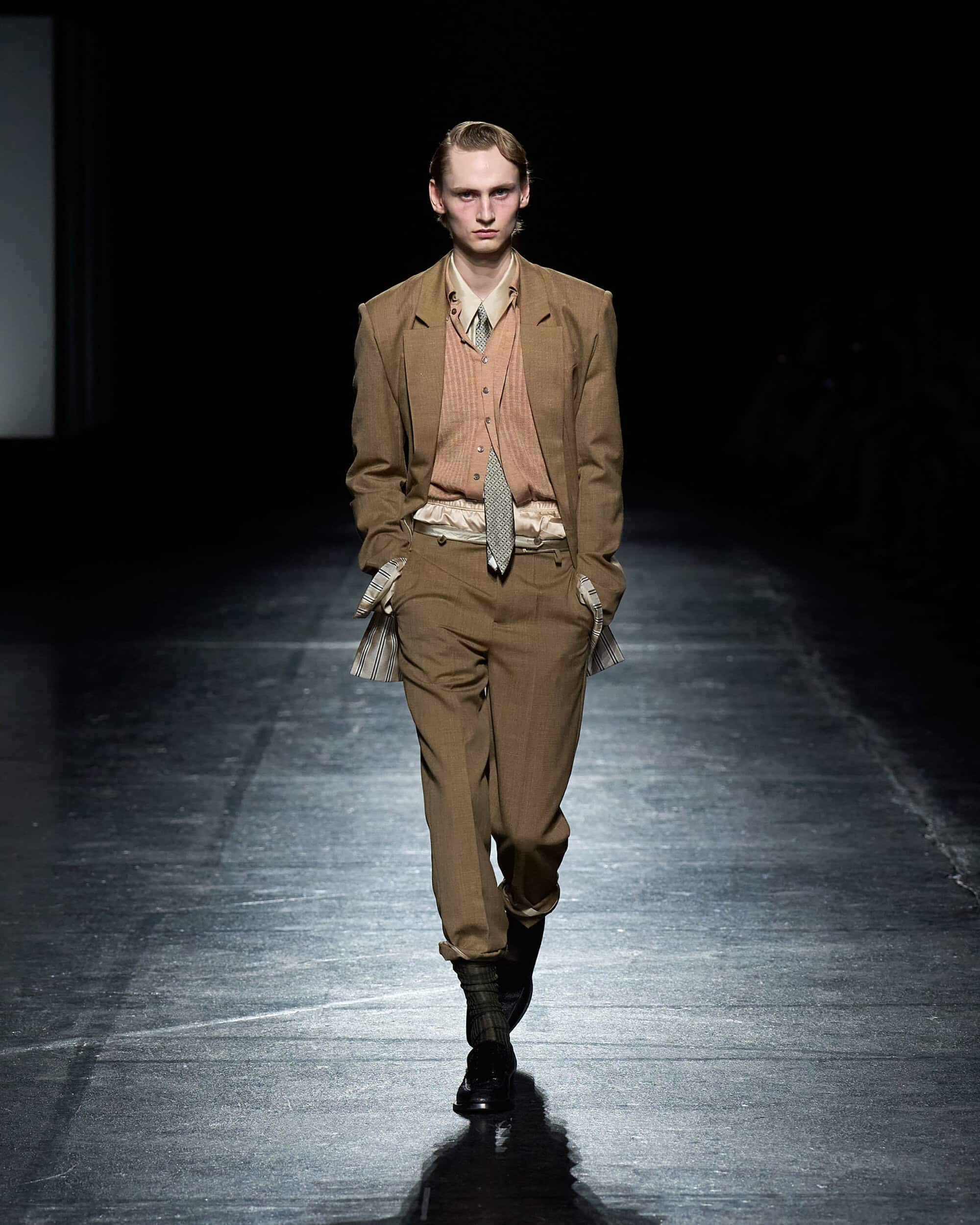
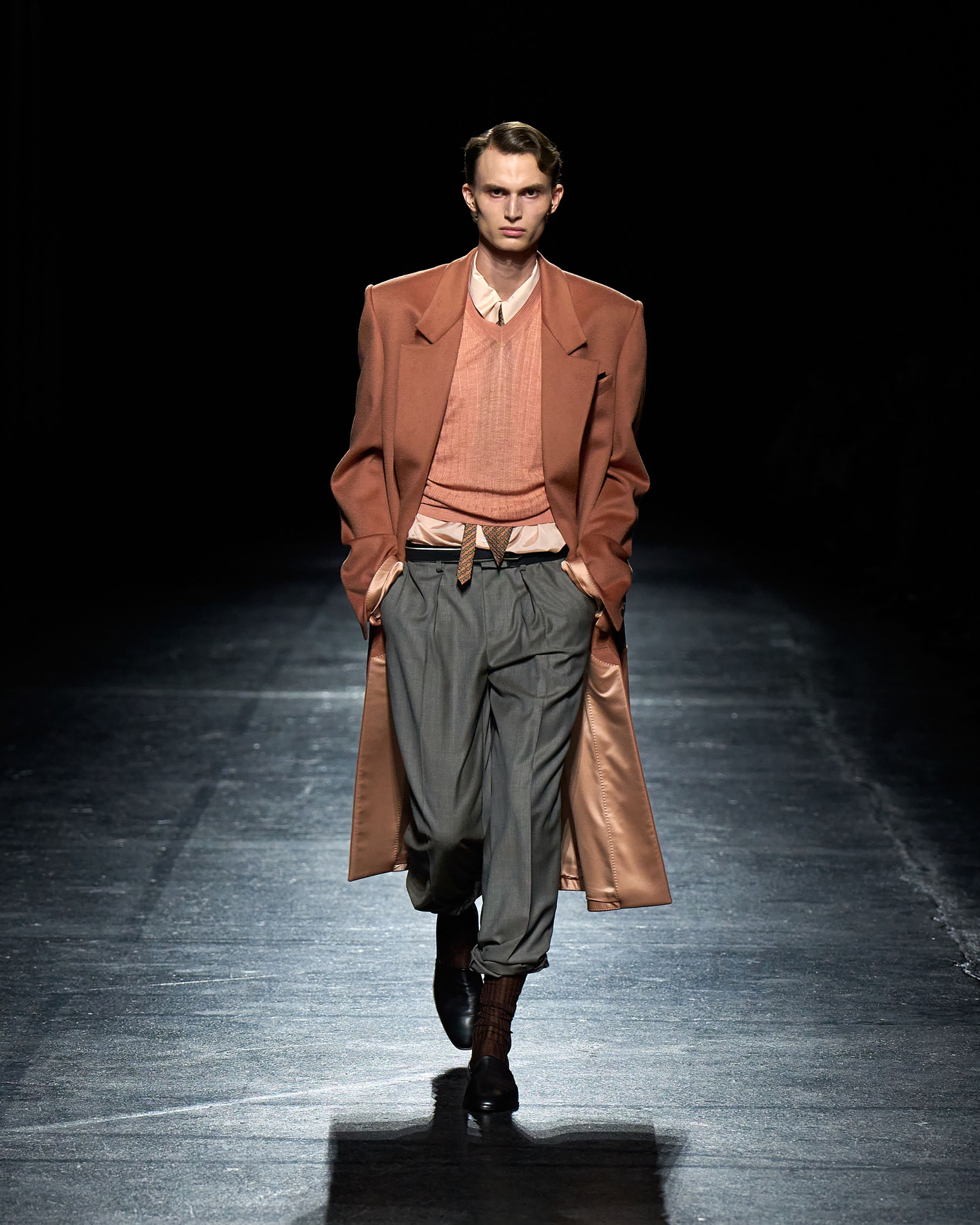
Tailoring became the foundation of that language. Jackets carried generous shoulders without collapsing into the exaggerated proportions that have dominated recent seasons. Their authority came from balance rather than volume. Trousers softened through the leg before gathering gently at the ankle, introducing movement without sacrificing precision. These were not nostalgic recreations of classic tailoring, nor ironic reinterpretations. They felt lived-in—as though they had already existed long enough to develop character.
The shirt and tie emerged as the collection’s most intelligent recurring motif. Reappearing across menswear and womenswear, they gradually lost their conventional associations and became something more symbolic. The tie evolved from business attire into ornament. Shirts shifted through lace, embroidery, delicate jacquards, and translucent fabrication while maintaining their essential structure. Instead of borrowing masculine codes for womenswear, Theyskens dissolved the distinction altogether. Everyone inhabited the same wardrobe.
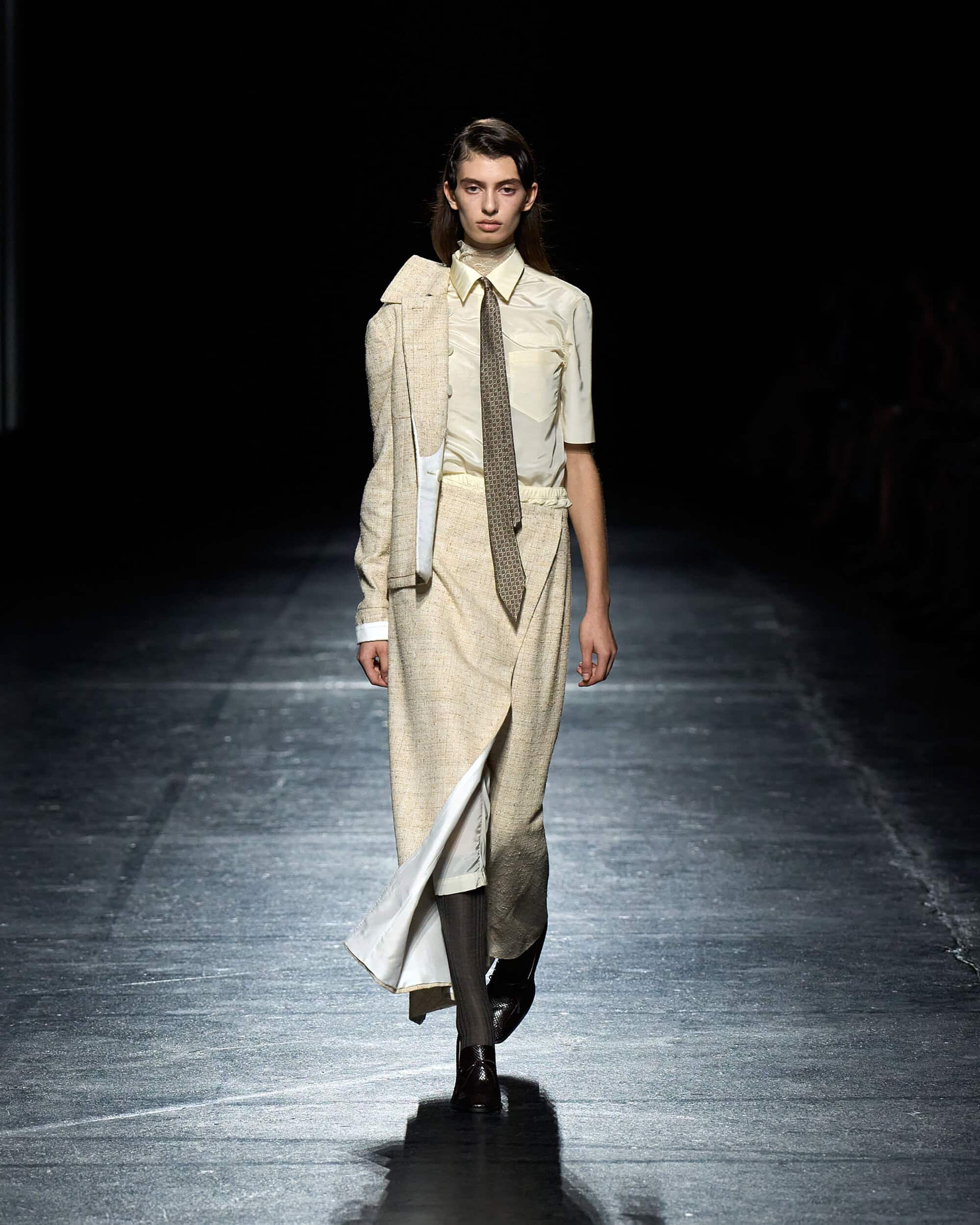
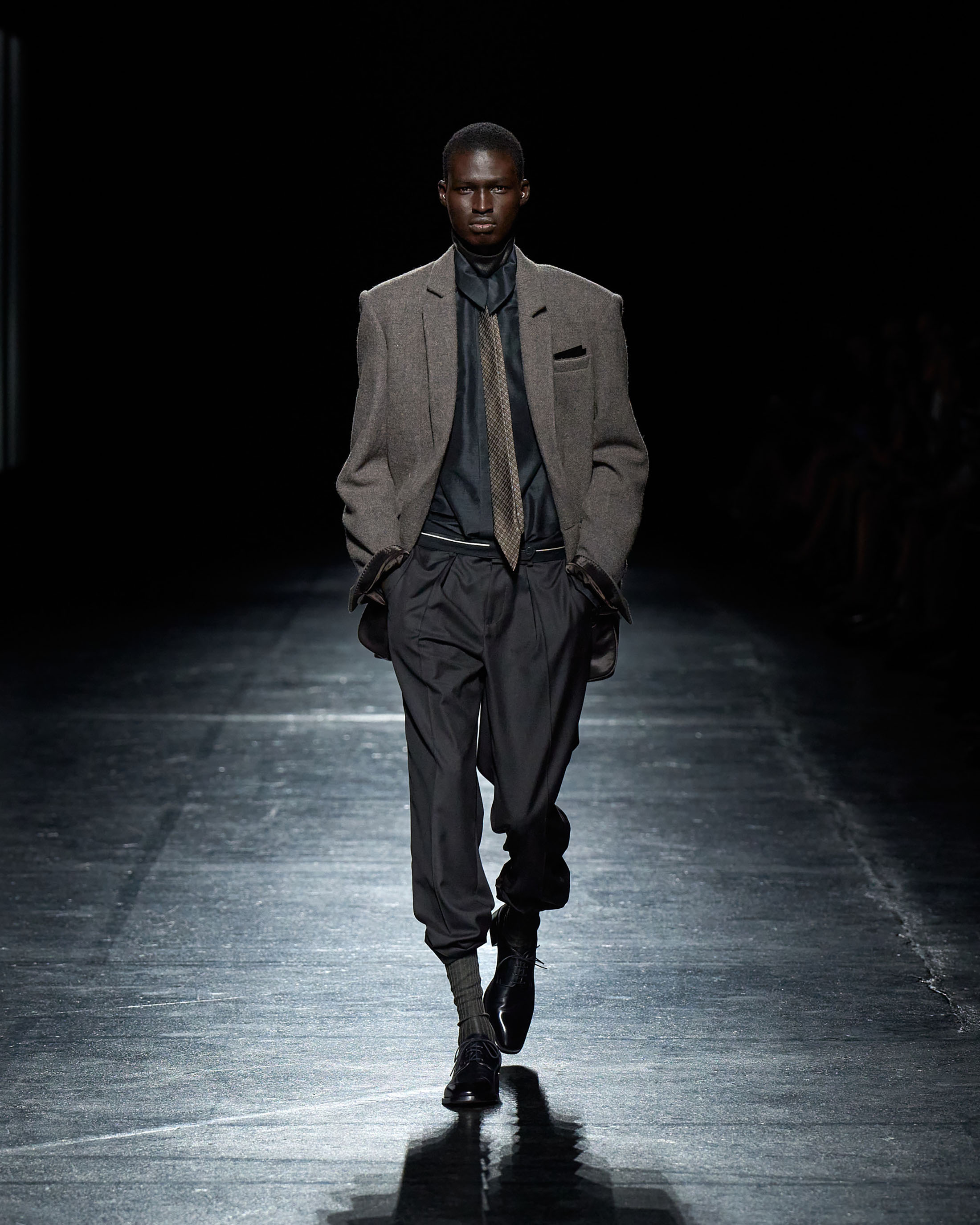
That continuity extended into fabrication. Matte suiting wool established restraint before satin, silk, leather, velvet, chiffon, and lace slowly expanded the emotional register. The progression never felt decorative for its own sake. Fabric functioned as atmosphere. Light was absorbed, reflected, softened, and diffused in carefully measured rhythm, allowing texture to replace embellishment as the collection’s primary source of richness.
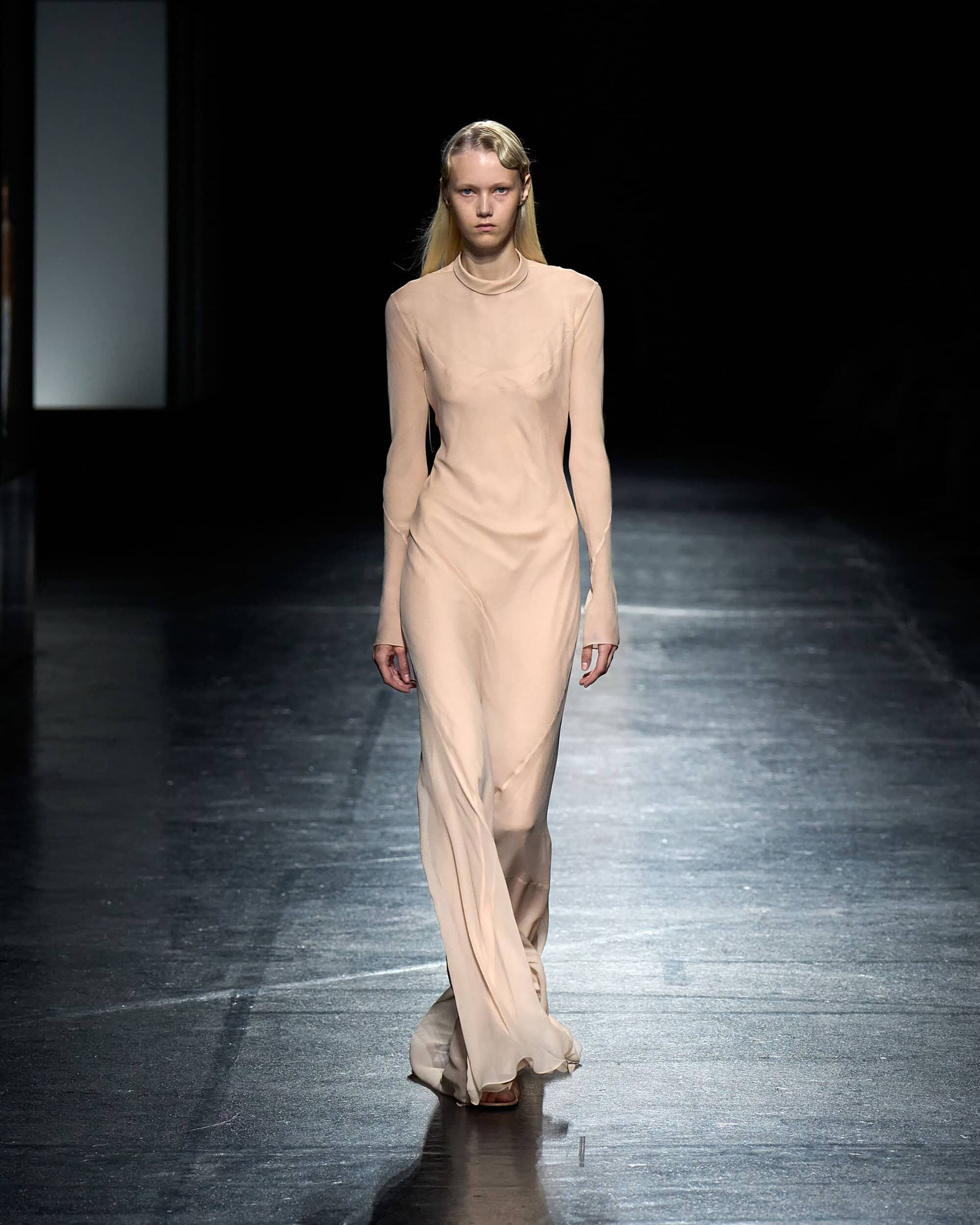
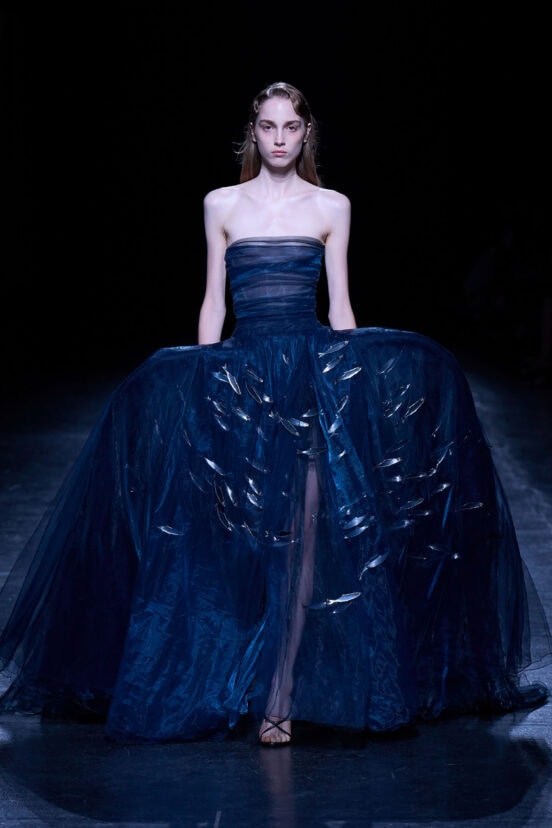
Movement became increasingly fluid as tailoring slowly yielded to eveningwear. Jackets transformed into elongated dresses. Structured shoulders survived inside liquid silhouettes. Black jersey columns drifted rather than clung, while ivory lace and luminous satin arrived late enough to feel almost revelatory after an extended meditation on charcoal, graphite, and black. The transition demonstrated remarkable confidence. Eveningwear did not interrupt the collection’s language; it simply completed it.
The styling reinforced that discipline. Hair remained understated. Makeup suggested presence rather than personality. Casting avoided obvious statements about diversity or archetypes, instead selecting individuals capable of inhabiting the collection without performing for it. Even the runway pace encouraged contemplation over spectacle. Every element supported the same thesis: identity emerges through consistency.
If the collection revealed one limitation, it was also a consequence of its greatest strength. The commitment to restraint occasionally compressed the emotional range. Boloria became so successful at sustaining its atmosphere that it rarely allowed tension to enter the narrative. A single moment of sharper disruption—whether through proportion, colour, or construction—might have heightened the collection’s dramatic architecture without compromising its coherence. Theyskens trusts subtlety, and that trust is admirable, but even the quietest symphony benefits from a crescendo.
Still, that observation feels less like criticism than anticipation. This is not a designer searching for a point of view. It is a designer deliberately limiting himself in order to establish one.
THE VIBE
I wanted it to not feel like a debut, but something that had been there the entire time. That had memory. — Olivier Theyskens
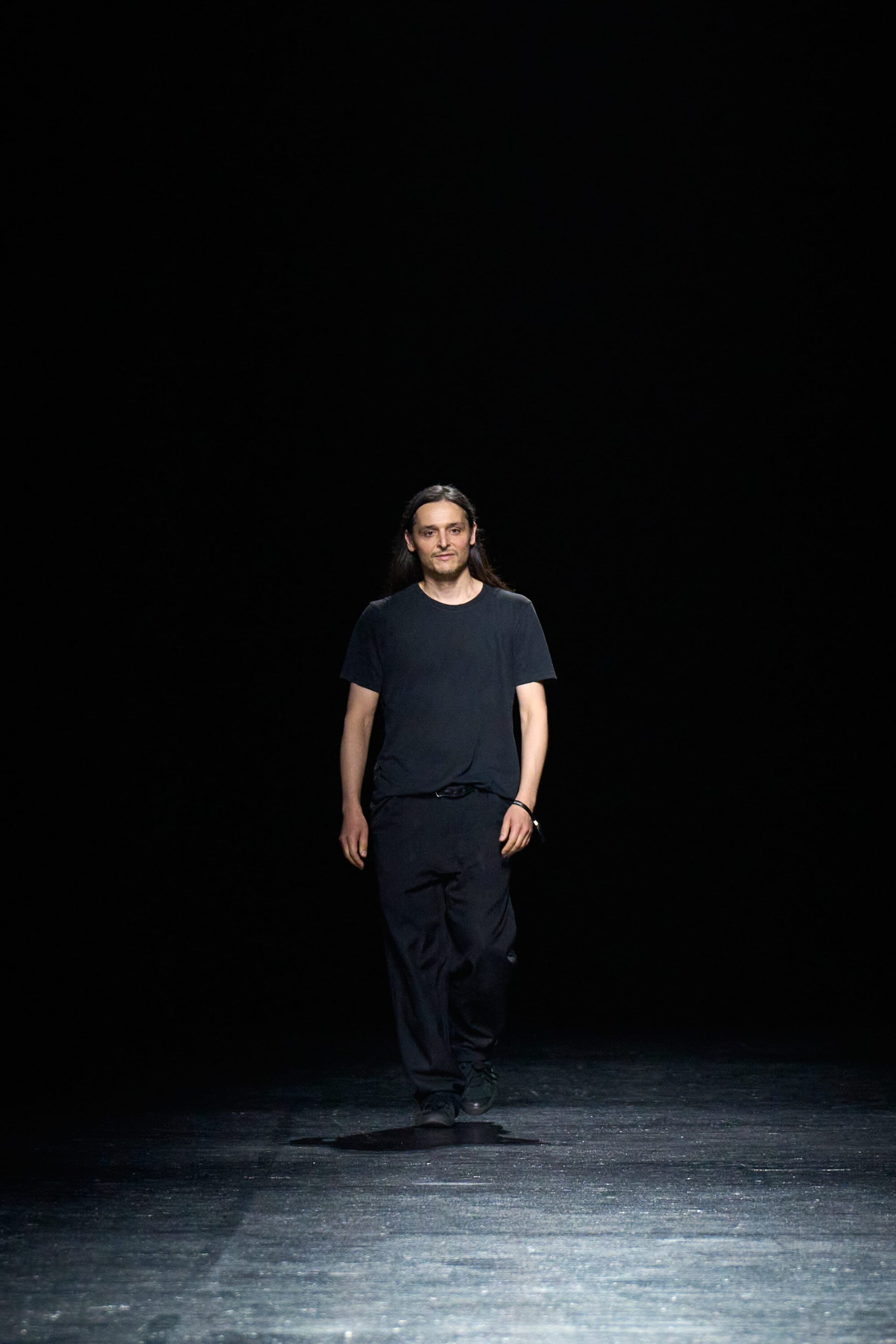
Few designers would build an entire first collection around such an idea. Fewer still could make it believable. Boloria succeeds because it doesn’t imitate history; it behaves as though history has already shaped it.
THE WRAP UP
Fashion has become remarkably efficient at launching brands and surprisingly poor at building houses. Brands are often assembled through marketing strategies, collaborations, and visibility. Houses are constructed through repeated ideas, refined season after season until they become unmistakable.
Boloria begins from that older ambition.
Theyskens has spent decades demonstrating that elegance can carry emotional complexity without theatrical excess. Here, he applies that philosophy to something larger than a collection. He is establishing a framework capable of growing rather than a debut designed simply to impress.
The philosophy becomes even clearer in something Theyskens said backstage that at first sounded almost incidental: “I like anonymous pieces in museums. Clothes where you don’t know who made them… they simply belong somewhere.” In an industry increasingly driven by signatures, logos, and instant recognition, it is a quietly radical ambition. Boloria isn’t trying to produce iconic garments overnight. It is trying to create clothes that feel as though they have earned their place through time.
That is why Boloria’s debut feels so unusual. Olivier Theyskens did not launch a brand in search of an identity. He built a house whose identity already feels settled. Fashion often celebrates reinvention as its highest virtue. Boloria reminds us that permanence may be the rarer achievement.
Where Boloria goes next will matter because the foundation is unusually complete. The challenge will not be inventing new signatures, but allowing this language to evolve without becoming too precious or too controlled. If future collections introduce greater risk while preserving this remarkable clarity of vision, Boloria could become one of the rare contemporary houses whose identity is recognized long before its logo.
For a first collection, that is an extraordinary place to begin. More importantly, it is an even more extraordinary place to continue.