A Beautiful Collection Hanging In A Studio Changes Very Little. A Beautiful Collection Hanging In A Great Store Has The Opportunity To Change A Career
Fashion has never suffered from a shortage of creativity. It has sometimes suffered from a shortage of commercial pathways for that creativity to thrive. We often ask what the next generation needs most, and our answers usually include more funding, more mentorship, more technology, better manufacturing, stronger branding, or additional investment. All of those things matter. But none of them matter for very long if extraordinary work never finds extraordinary customers.
Over the past two decades, our industry has become remarkably good at discovering and mentoring talent. We have built prizes, incubators, accelerators, educational programs, advisory networks, and investment initiatives devoted to helping young designers succeed. We teach manufacturing, merchandising, finance, operations, branding, sustainability, and communications with increasing sophistication. Yet one subject still feels strangely secondary.
How to build customers.
Not simply how to sell a garment, but how to build a business that consistently generates demand. How to attract visitors to a website and convert them into loyal clients. How to cultivate private relationships. How to negotiate a pop-up location, turn it into a profitable retail experience, approach wholesale with confidence, and eventually open stores that can sustain a business for decades. Sales is too often treated as the reward for building a brand, when in reality it is the discipline that allows a brand to survive.
That thought stayed with me throughout Berlin Fashion Week, where I had the opportunity to spend time with Scott Lipinski, Chief Executive Officer of Fashion Council Germany, and Christiane Arp, Chairwoman of the organization. What impressed me most wasn’t simply the quality of the collections, but the quality of the ecosystem surrounding them. Berlin has invested thoughtfully in grants, mentorship, international exposure, and educational initiatives that give emerging designers a genuine opportunity to succeed. It is one of the most complete support systems I have encountered, bringing together government, retailers, editors, buyers, educators, and designers around a shared ambition to help young brands build lasting businesses.
One conversation with Scott particularly stayed with me. He spoke about the importance of helping designers become commercially successful, and it struck me that perhaps commercial thinking shouldn’t arrive after the creative process. It should exist alongside it from the very beginning.
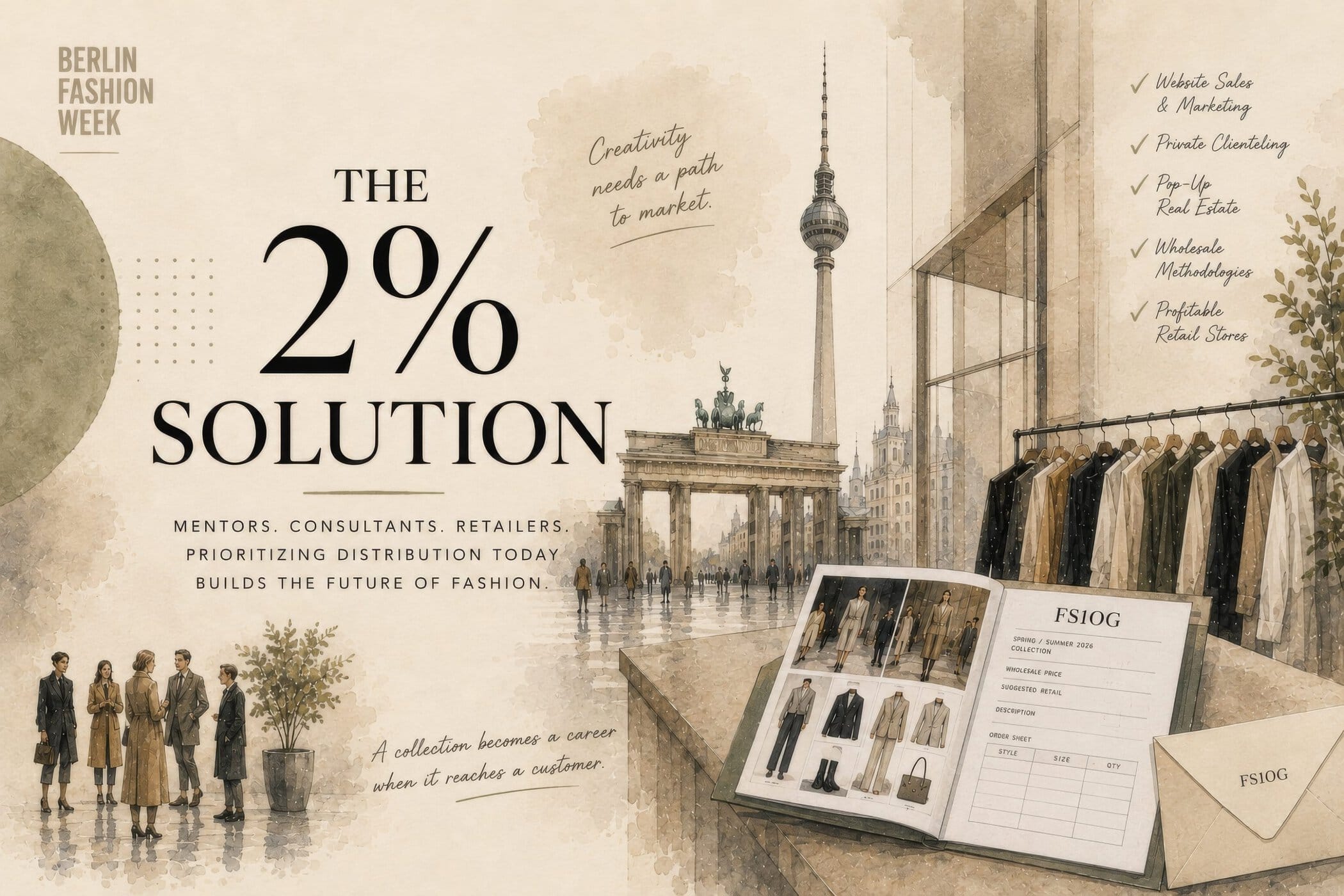
One of the smartest examples I witnessed all season came immediately after the FS1OG presentation in Berlin. As buyers and key clients left the show, they weren’t simply thanked for attending. They were handed white envelopes containing lookbook imagery on models, individual still life product photography, wholesale pricing, suggested retail pricing, detailed product descriptions, and ready-to-complete order sheets. Every tool a buyer needed was placed in their hands while the excitement of the collection was still fresh. It was thoughtful, beautifully executed, and entirely focused on turning inspiration into action.
That is innovation.
It also reinforced something I have been thinking about for some time. Mentorship programs, consultants, incubators, and advisors should begin placing customer acquisition and sales strategy at the center of their teaching rather than at the end. Young designers need to understand how to generate demand before they perfect supply. They need to learn how to build profitable e-commerce businesses rather than simply beautiful websites. They need to understand digital customer acquisition, private clienteling, wholesale strategy, retail partnerships, and how to negotiate temporary retail spaces that create both visibility and revenue. Manufacturing, finance, logistics, and operations remain essential, but they exist to support sales, not replace them.
Last week I wrote about Adrian Joffe and the remarkable role Dover Street Market has played in championing emerging designers. This week I’d like to extend that conversation to every multi-brand retailer, whether a physical boutique, department store, concept store, or online platform.
The 2% Solution is remarkably simple.
Dedicate just 2% more of your assortment each year to brands you don’t currently carry. Invest 2% more of your team’s time helping those designers understand what only retailers truly know. Which garments customers reach for first. What earns a fitting room visit. What sells immediately. What sits on the rack. How quality is perceived. How pricing feels. How merchandising changes a customer’s response. How delivery, communication, and presentation can improve.
That knowledge is every bit as valuable as capital.
Retailers possess insights that no classroom, consultant, or business school can replicate because they observe customers every single day. Sharing even a small percentage of that experience could fundamentally change the trajectory of a young designer’s business.

Imagine if we approached emerging talent this way across the entire industry. Mentors would teach customer acquisition before manufacturing schedules. Advisors would begin with go-to-market strategies before operating plans. Retailers would become active partners in developing brands rather than simply buyers of collections. The cumulative effect wouldn’t simply produce more talented designers.
It would produce more sustainable businesses.
Fashion has always depended on extraordinary creativity. The next chapter may depend on becoming equally innovative in how we help that creativity reach customers. If we can devote just 2% more of our thinking, our retail space, and our expertise to helping the next generation build businesses instead of simply collections, we won’t just strengthen young brands.
We’ll strengthen the future of fashion itself.
Warm regards,
Kenneth Richard