
Higher Zegna Margins And Double-Digit Direct-To-Consumer Growth Lift Operating Profit, While Net Income Falls On Financial Items And A Tougher Comparison
Ermenegildo Zegna Group reported higher operating profit in the first half of 2026, supported by improved profitability at its flagship Zegna brand and continued growth in direct-to-consumer sales, even as net profit declined sharply from a year earlier.
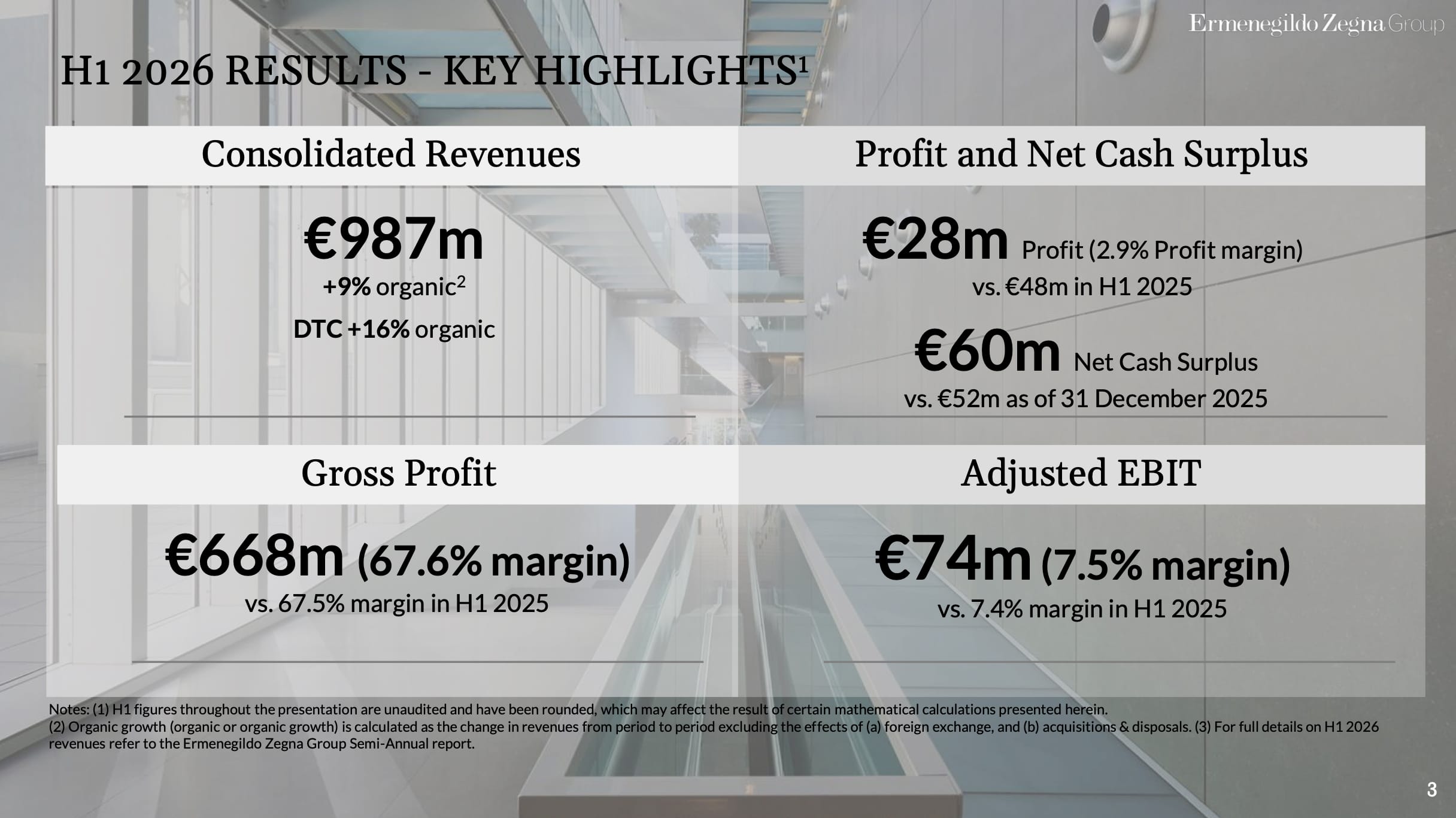
Operating profit rose 11.7 percent to 68.5 million euros from 61.3 million euros in the first half of 2025. The improvement was largely driven by Zegna, where EBIT increased to 106.9 million euros from 94.4 million euros a year earlier as the brand benefited from increased store traffic and higher revenue per square meter.
“Our first half 2026 results reflect the effectiveness of our group’s strategy, anchored in the strength of each of our brands’ identities and their direct connection to clients, as well as the continued innovation coming from our Filiera [Italian for value chain], the heart of our group’s legacy,” group executive chairman Ermenegildo “Gildo” Zegna said in a statement.
Group adjusted EBIT reached approximately 74 million euros, representing a 7.5 percent margin, compared with 7.4 percent a year earlier. Gross profit was 668 million euros, with the gross margin edging up to 67.6 percent from 67.5 percent.
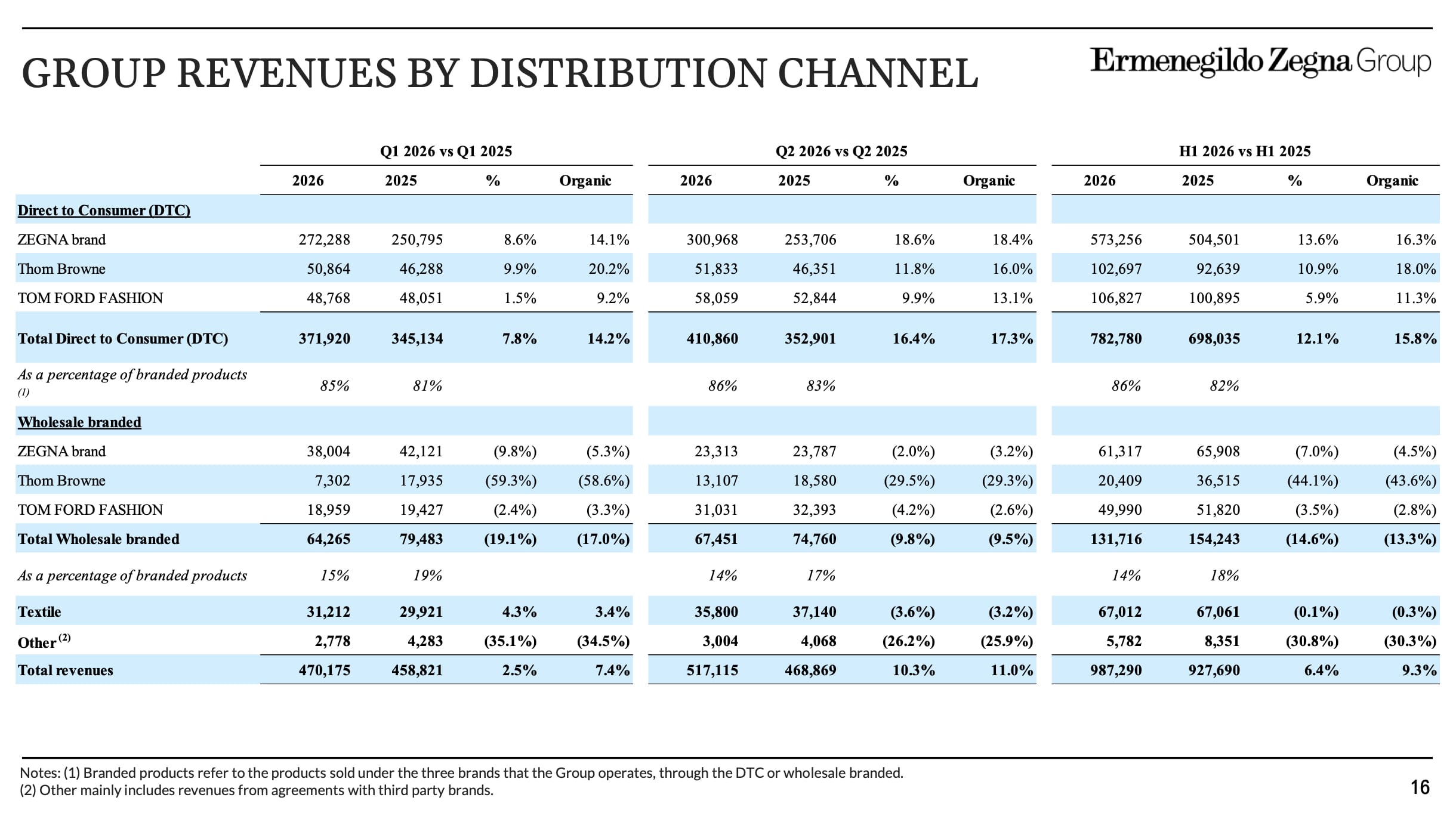
Revenue rose 6.4 percent to 987.3 million euros for the six months, while organic growth reached 9.3 percent. Direct-to-consumer remained the primary growth engine, increasing 12.1 percent to 782.8 million euros, or 15.8 percent organically. DTC represented 86 percent of branded product sales, up from 82 percent in the comparable period.
That shift was particularly evident at Zegna. The brand generated first-half revenue of 724.3 million euros, up 9.7 percent reported and 11.9 percent organically. Its DTC revenue climbed 13.6 percent to 573.3 million euros, or 16.3 percent organically, while branded wholesale declined 7 percent.
The group’s other brands showed a more mixed performance. Thom Browne’s first-half revenue declined 4.9 percent to 123.1 million euros and was nearly flat organically, reflecting a significant reduction in wholesale distribution. Its DTC business, however, increased 10.9 percent reported and 18 percent organically, while wholesale fell 44.1 percent.
Tom Ford Fashion revenue increased 2.7 percent to 156.8 million euros, or 6.4 percent organically. DTC sales advanced 5.9 percent, and 11.3 percent organically, while wholesale declined 3.5 percent. The figures reinforce a broader pattern across the portfolio: growth is increasingly being generated through directly operated retail while the group reduces its reliance on wholesale.
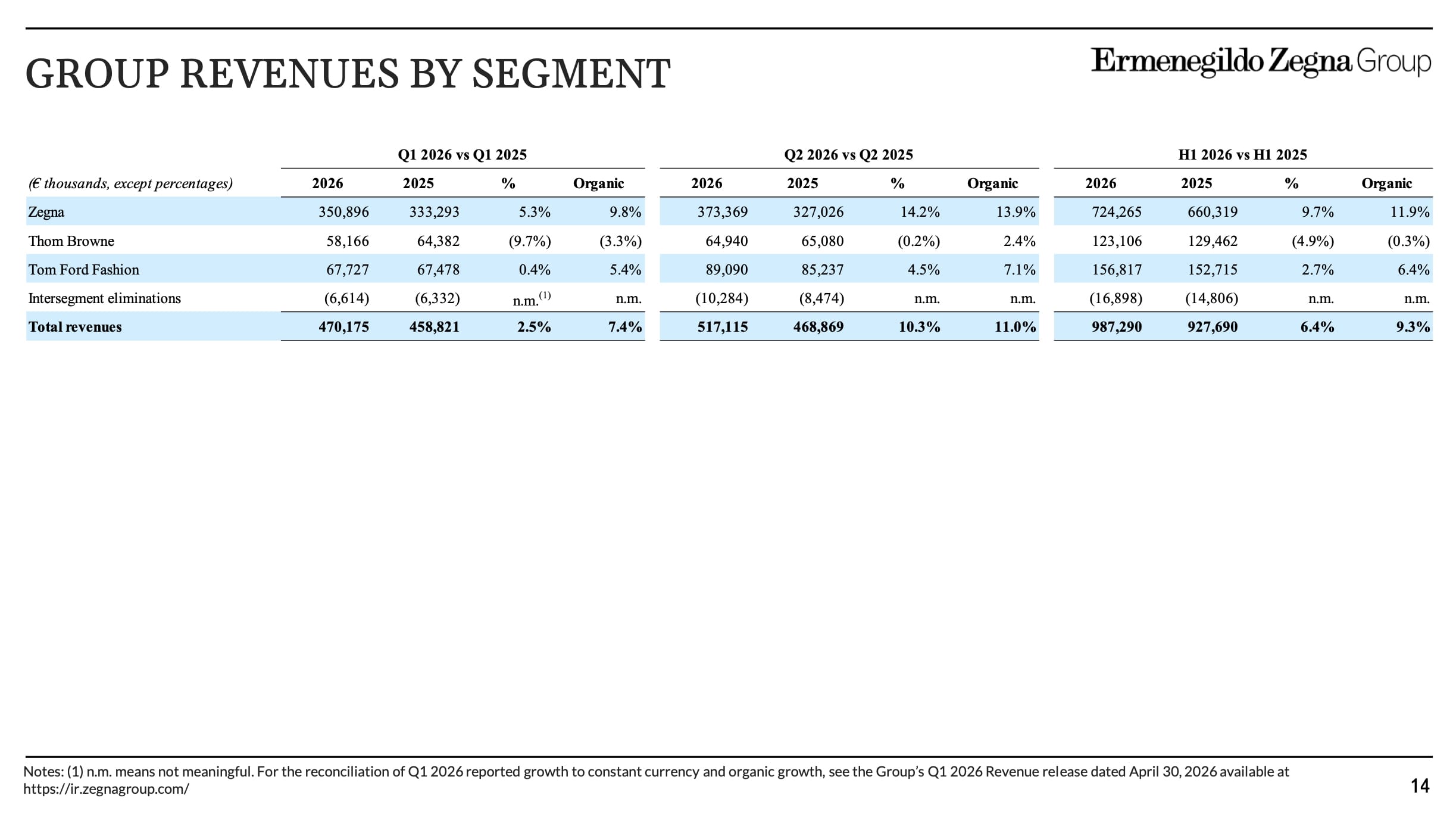
The strategy became still more visible during the second quarter. Group revenue increased 10.3 percent to 517.1 million euros, or 11 percent organically, accelerating from the first quarter. DTC revenue rose 16.4 percent, with all three brands posting double-digit increases through the channel.
Zegna led the second-quarter performance, with revenue rising 14.2 percent to 373.4 million euros and 13.9 percent organically. Its DTC business grew 18.6 percent. Thom Browne’s quarterly revenue was essentially flat at 64.9 million euros but increased 2.4 percent organically, while Tom Ford Fashion rose 4.5 percent to 89.1 million euros and 7.1 percent organically.
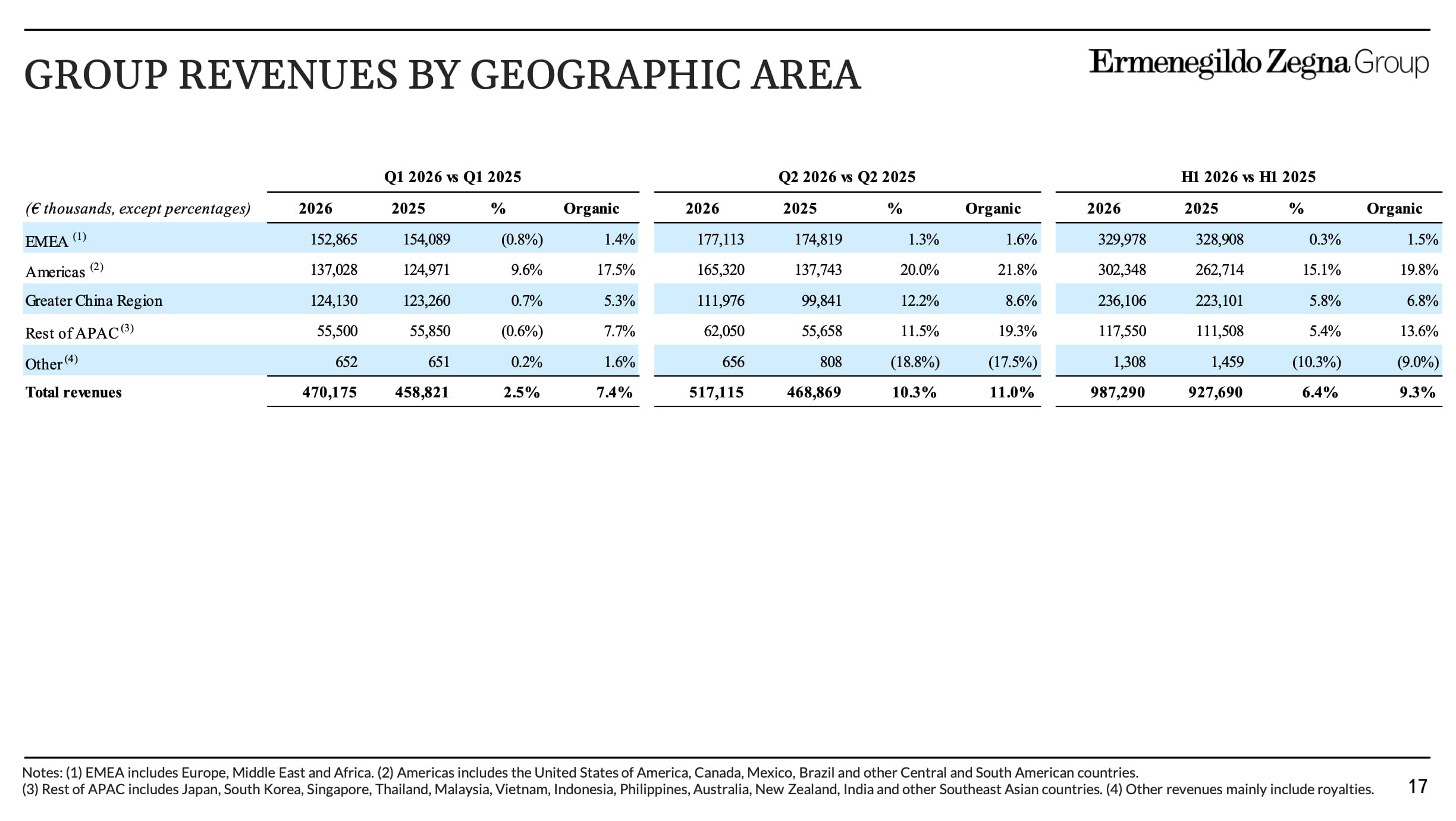
The Americas remained the group’s strongest geographic growth market during the first half, with revenue increasing 15.1 percent to 302.3 million euros and 19.8 percent organically. Greater China rose 5.8 percent to 236.1 million euros, with growth accelerating substantially during the second quarter. Revenue in the region increased 12.2 percent in Q2 compared with just 0.7 percent in the first quarter.
The rest of Asia-Pacific increased 5.4 percent for the half and 13.6 percent organically, while EMEA was broadly stable, rising 0.3 percent to 330 million euros. The geographic results highlight the importance of the Americas to current growth while suggesting improving demand in China could provide another source of momentum in the second half.
Despite stronger operating performance, group net profit declined to 28.4 million euros from 47.9 million euros a year earlier. The comparison was affected by a one-time financial gain related to the revaluation of Thom Browne liabilities that benefited the first half of 2025, as well as higher financial expenses and lower foreign-exchange gains in the current period. The effective tax rate also increased to 38.8 percent from 29.6 percent.
The group’s balance sheet remained in a net cash position, with a net cash surplus of approximately 60 million euros at the end of the first half, compared with 52 million euros at Dec. 31, 2025.
For investors, the first-half results increasingly make Zegna’s strategy a story of channel mix as much as top-line growth. Direct-to-consumer now accounts for the large majority of branded sales, while wholesale continues to contract, particularly at Thom Browne. The key questions for the second half will be whether Zegna can maintain its improved profitability, whether the acceleration in Greater China continues and whether stronger DTC growth at Thom Browne and Tom Ford Fashion can translate into broader improvements in their respective businesses.