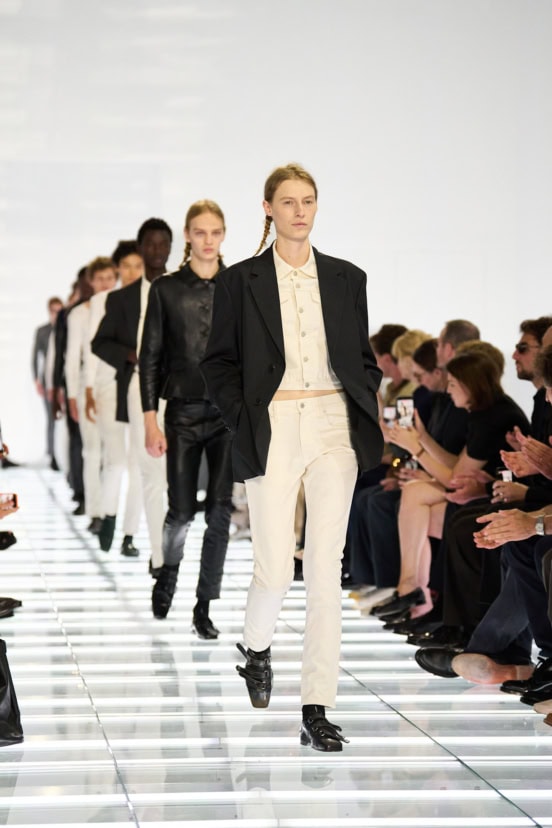
Speaking A Universal Language
Review of Prada Spring 2027 Men’s Fashion Show
By Angela Baidoo
When Prada takes us to the future, the task of attempting to guess what the co-design directors have in store is a futile exercise. Neither invitation nor set design, may give away precisely what the collections main theme will be. As the thought process and design development behind each collection that Miuccia Prada and Raf Simons work on can be as abstract, as it is intellectual or spiritual. In turns out this season there was a loose correlation between the light-sabre style invitation, glass runway (last seen for Fall 2026 when it sat atop a forest floor) and white-walled set that suggested galaxies far, far away were on the design duos minds for next spring.
The universe, or rather the universal was in fact where Prada and Simons landed. Titled Clarity the collection was their act of, not so much a reduction, but a distillation of what mattered. So far, a recurring theme for designers during Milan fashion week, and one that could quite possibly shape up to be one of the key themes for spring 2027, that along with white as a palette cleanser or the incoming of something new.
THE COLLECTION
THE VIBE
Classicism and Constraint, Anti-Excess, Universal Objects
Designers are rethinking what is necessary on the runway for spring, as Miuccia Prada and Raf Simons, who spoke to The Impression pre-show, themselves clarified “ The ambition was to do something new with ‘nothing’ – against exaggeration, against complex material. Against useless design. There is nothing that I hate more in this period than useless design – this collection expresses this concept.”
The over-riding silhouette was svelte, to say the least, but in the show notes this was proposed as a “highly-controlled silhouette” that spoke to the idea of exacting, linear proportions aligning with the theme of clarity. Favouring sharp, geometric lines, rather than organic shapes. This refocus Simons said was “a little bit anti; anti-decoration, anti-over complicated techniques, anti-exaggerated shapes, anti-anything useless.”
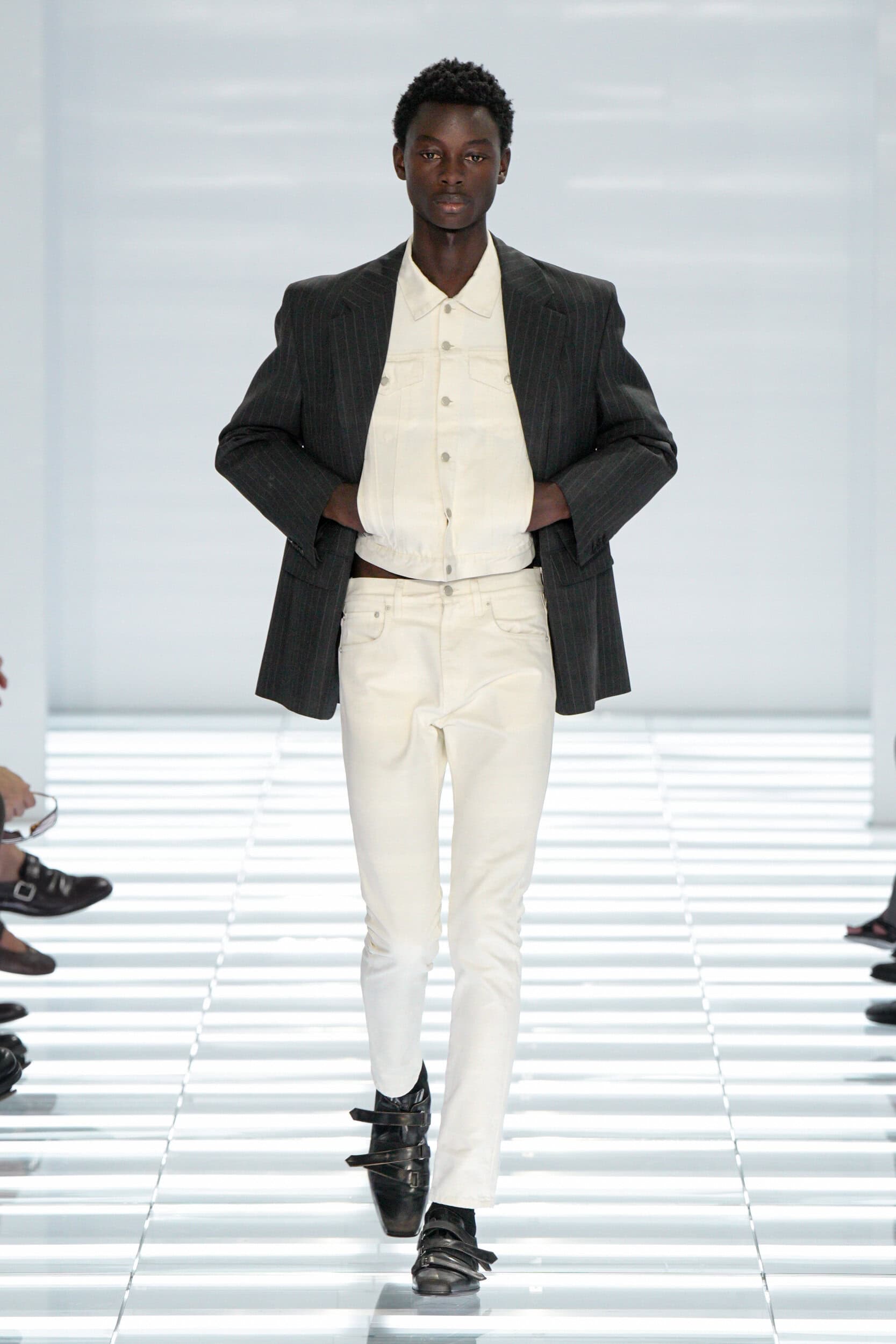
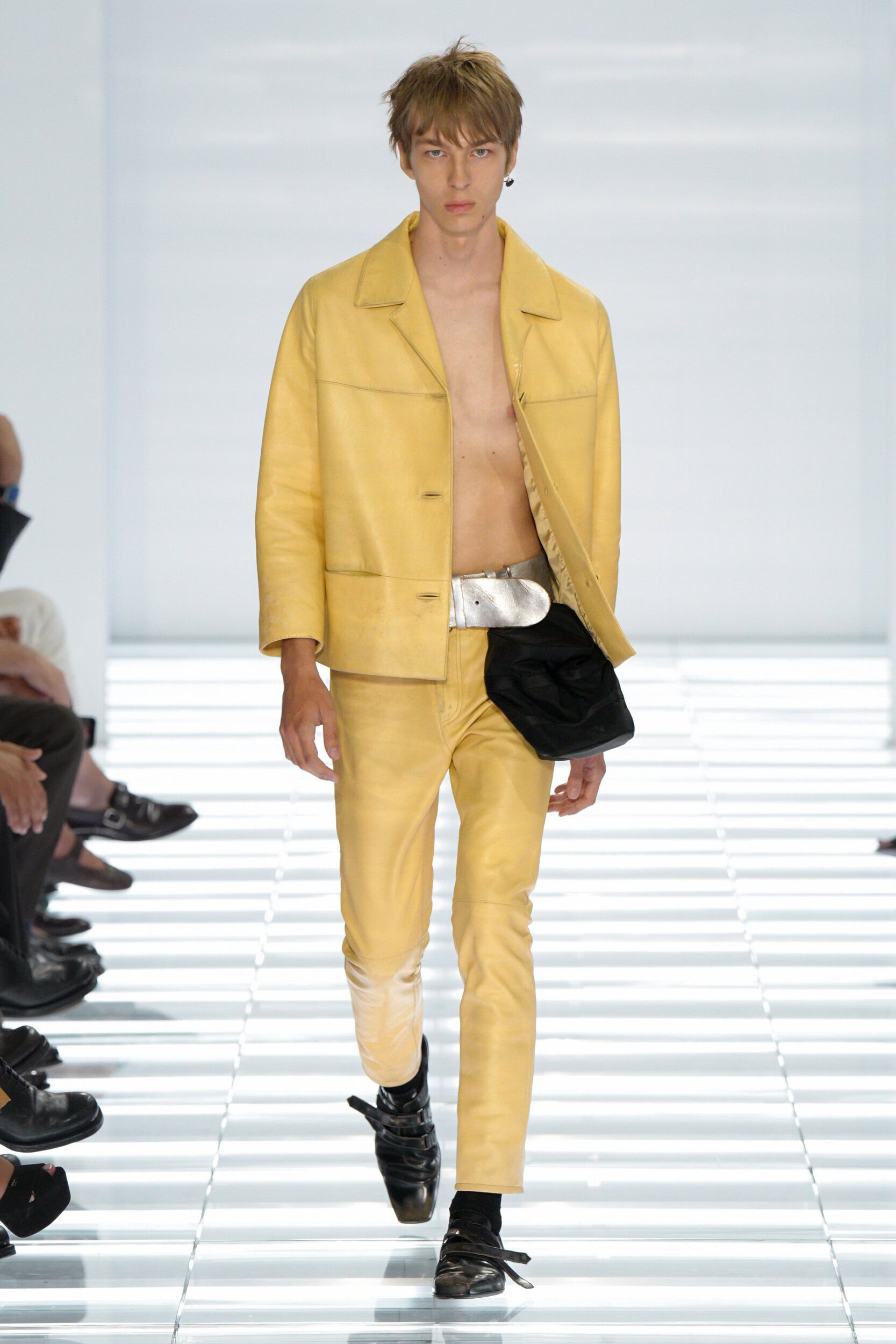
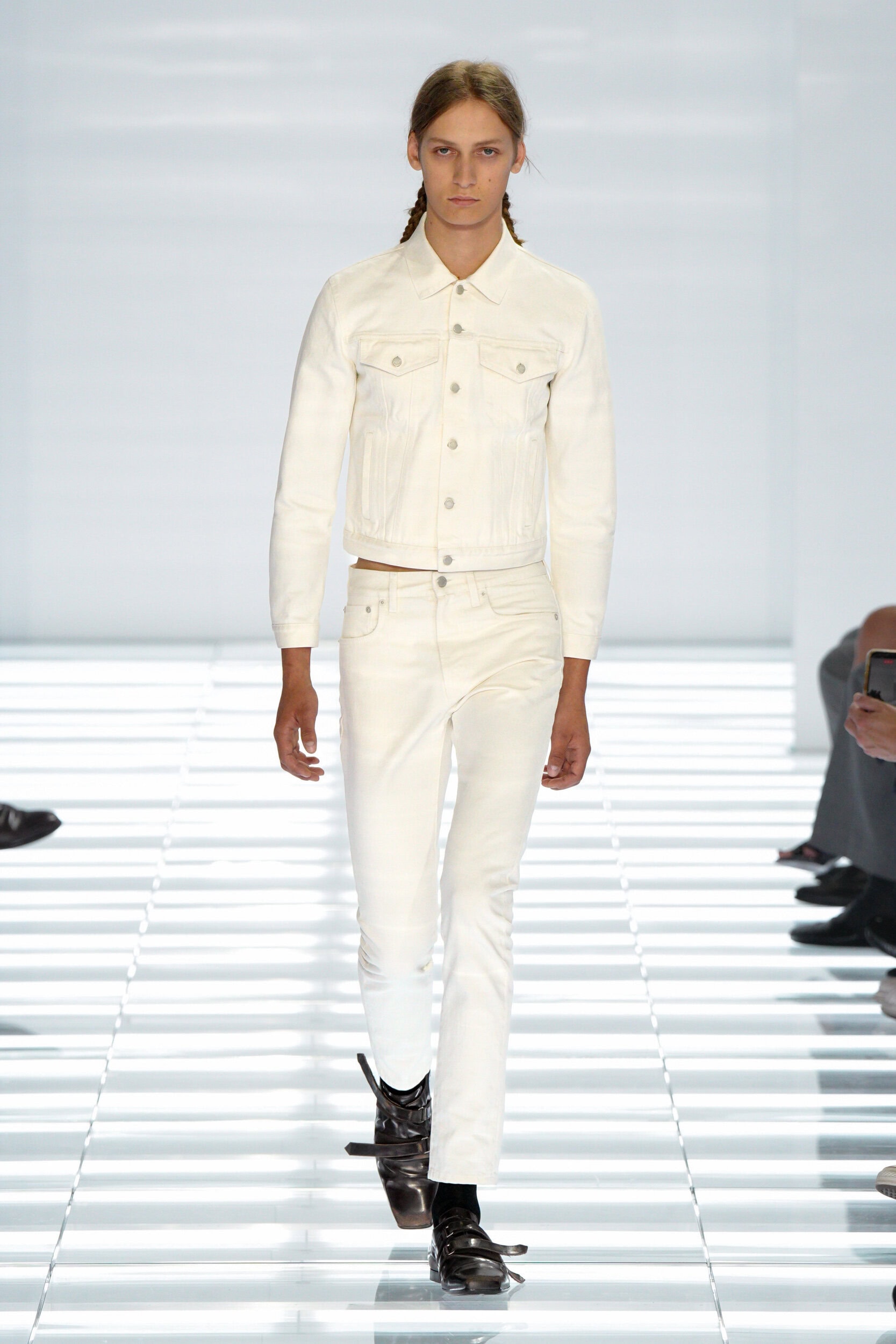
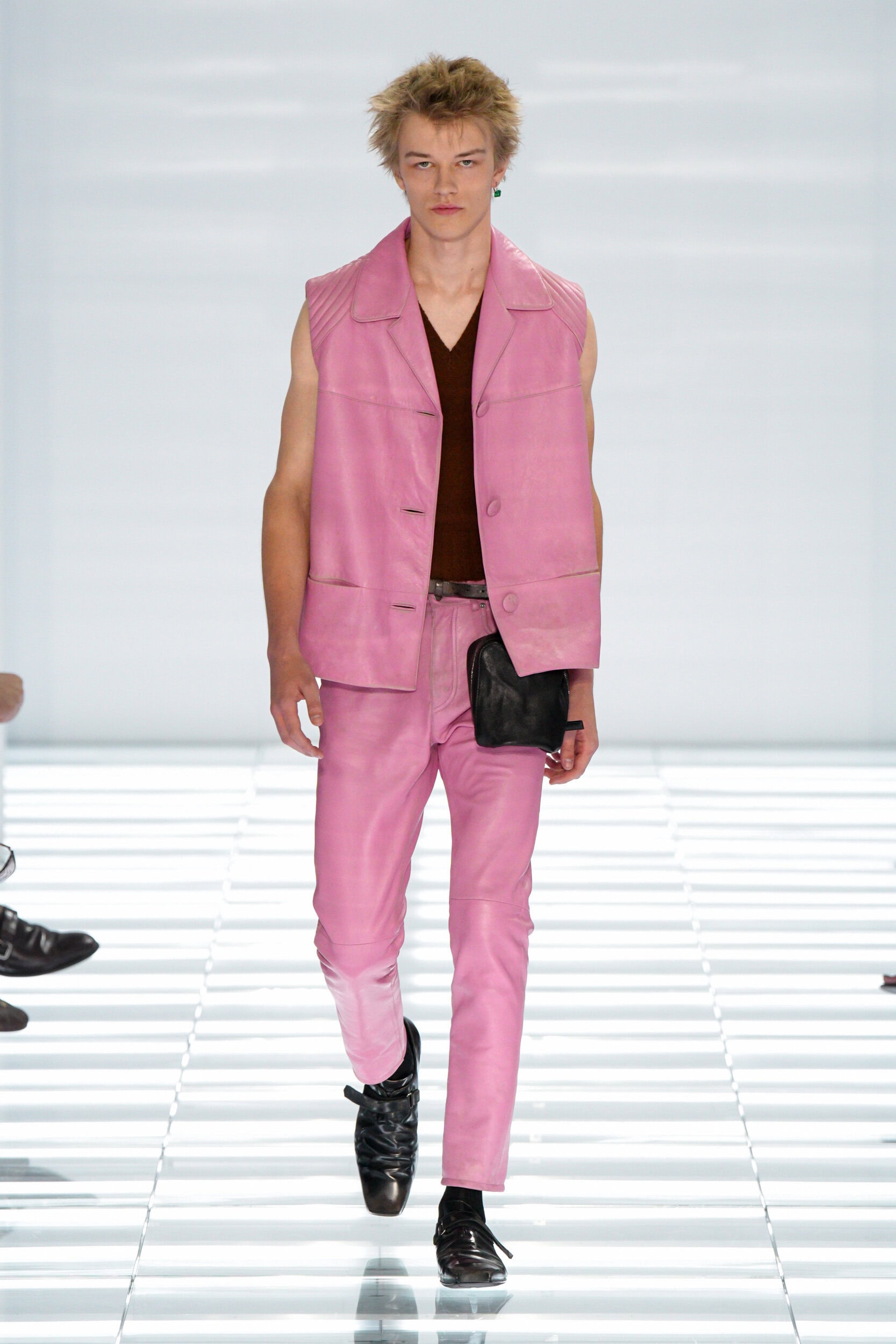
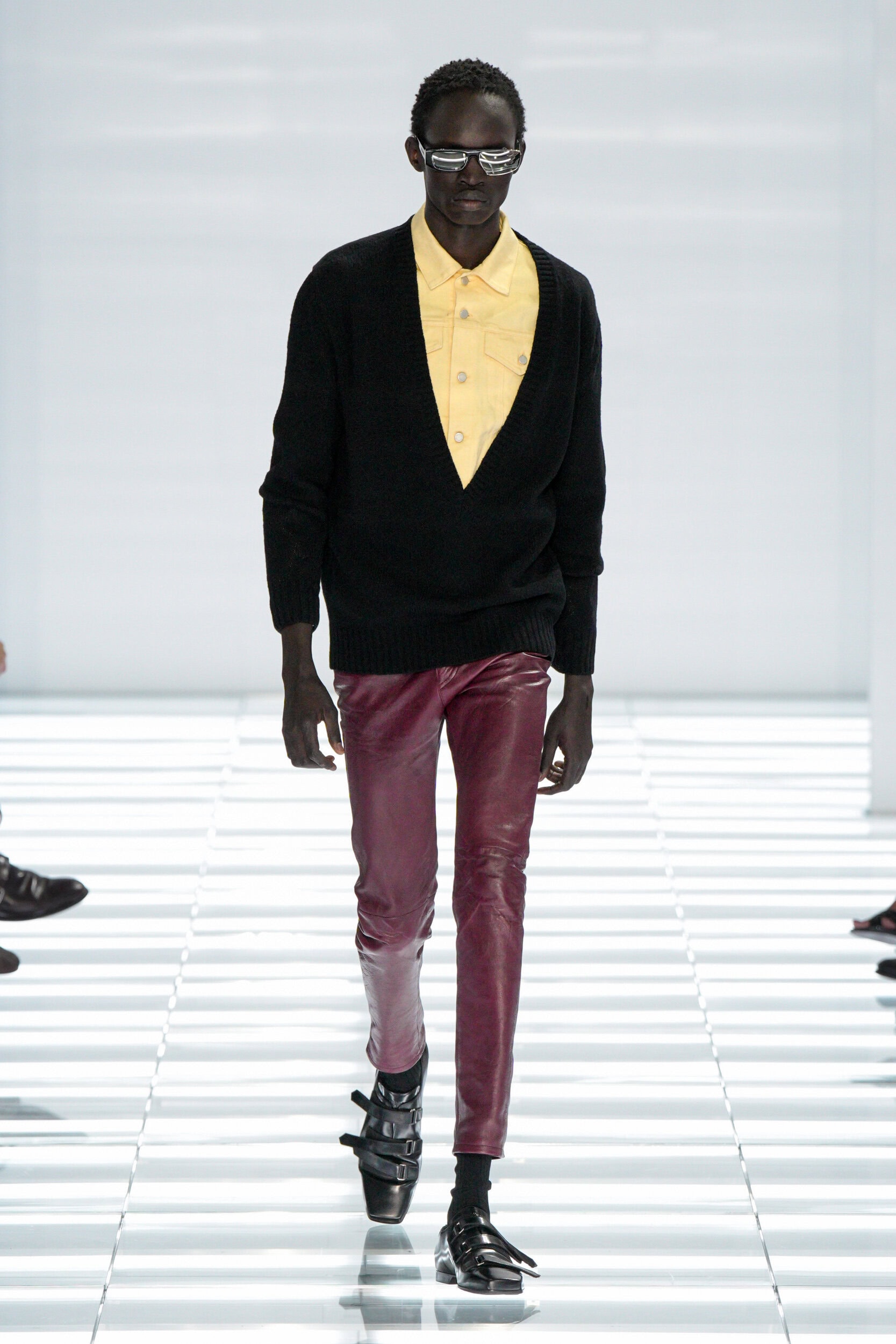
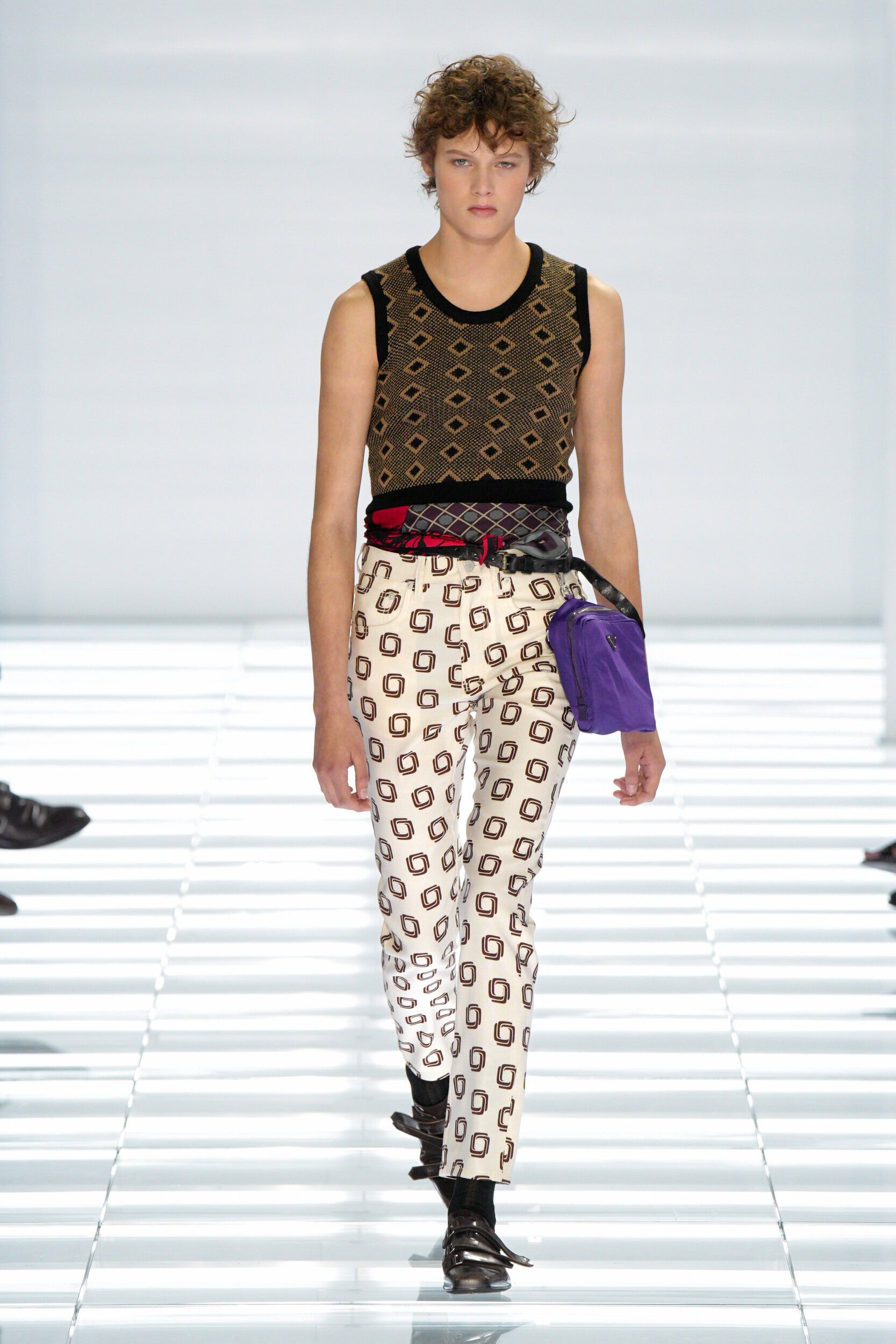
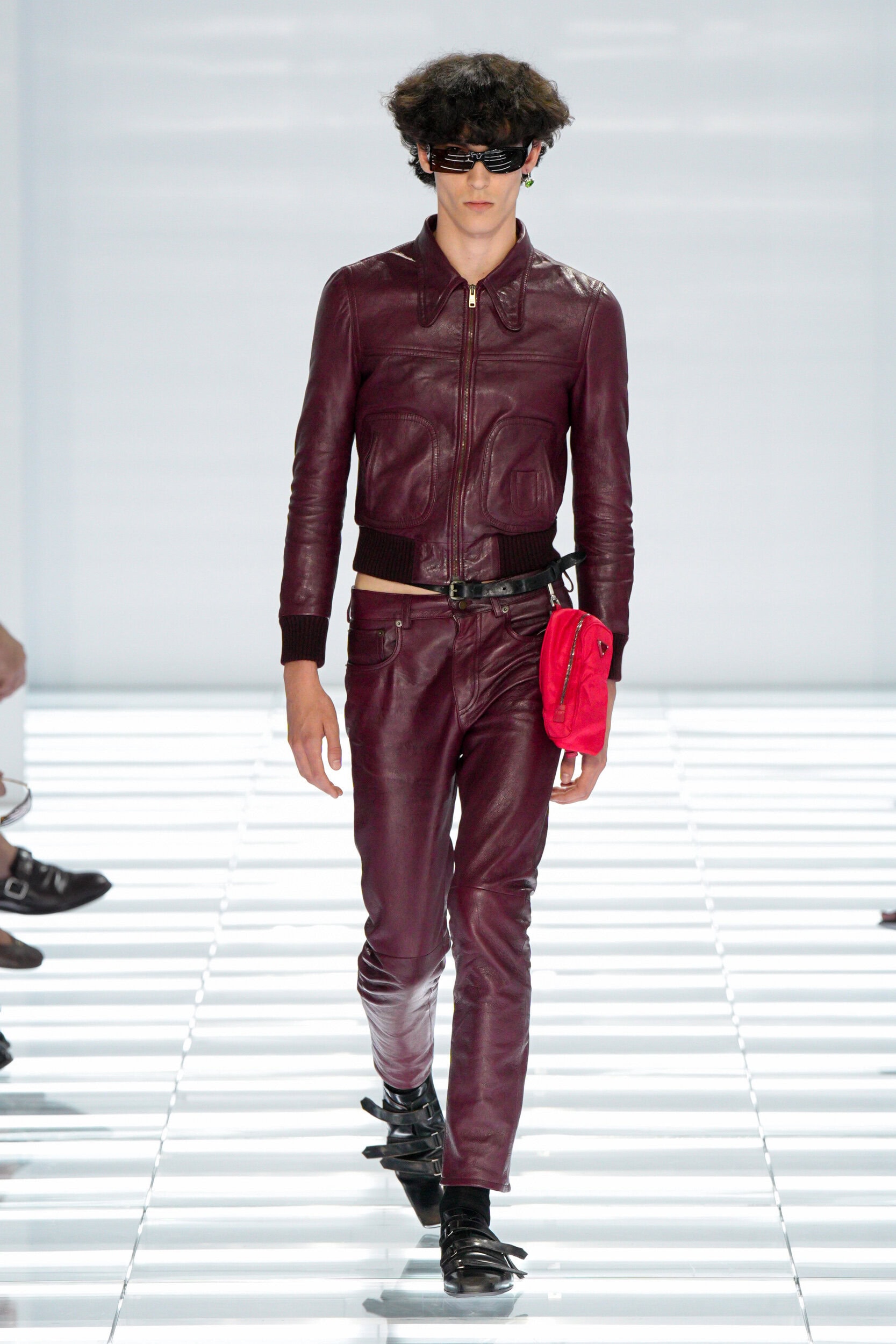
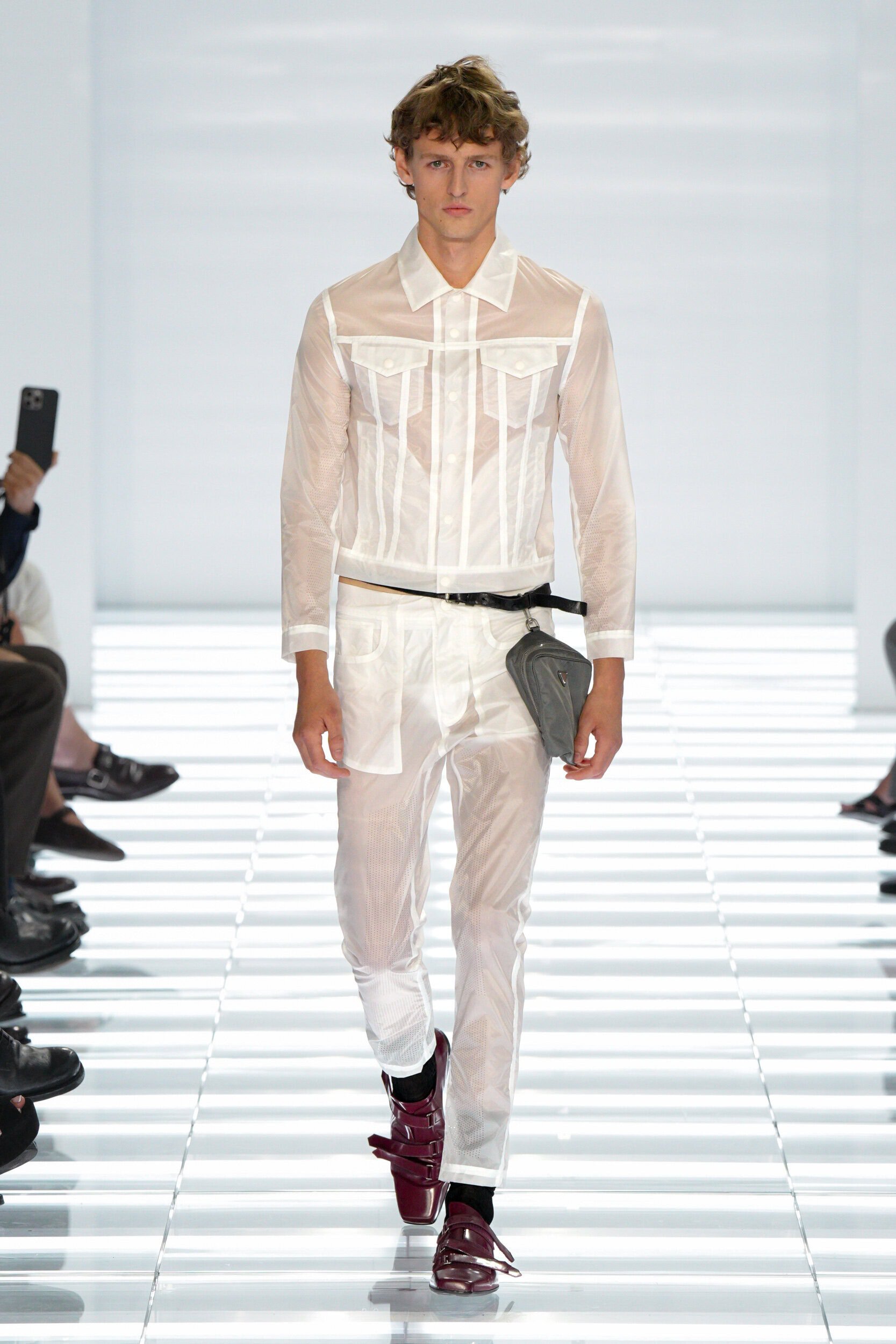
Classic menswear categories were stripped of unnecessary details and appeared almost 2D as they were flattened back to their foundations. This was where the duo encouraged their customers to start, to take archetypes they are inherently familiar with and create “ceaseless possibility and reinterpretation.” The concept in and of itself is an interesting one and gives each look an agency. What the co-designers are proposing is, they are giving us the tools, but it is up to us to take the next step and make these looks our own. In acknowledgement of how luxury fashion is bought, and contrary to how it is now styled for glossy editorials, head-to-toe looks are not always the preferred method of application. That denim jacket will be styled under a trench coat and paired with baggy jeans, while the pink leather vest combined with a chunky sweater and jorts. The reality of this fact was on the mind of Simons when designing the collection “A jeans pant, a jeans jacket, a T-shirt are re-materialized, re-scaled, or their use is reversed. Also, the way you wear them, or how you see certain items being used, compared to how it’s usually seen in fashion. To give an example, the jeans jacket becomes a shirt and the white jeans and jeans jacket together become a new suit when made in tailoring fabrics.”
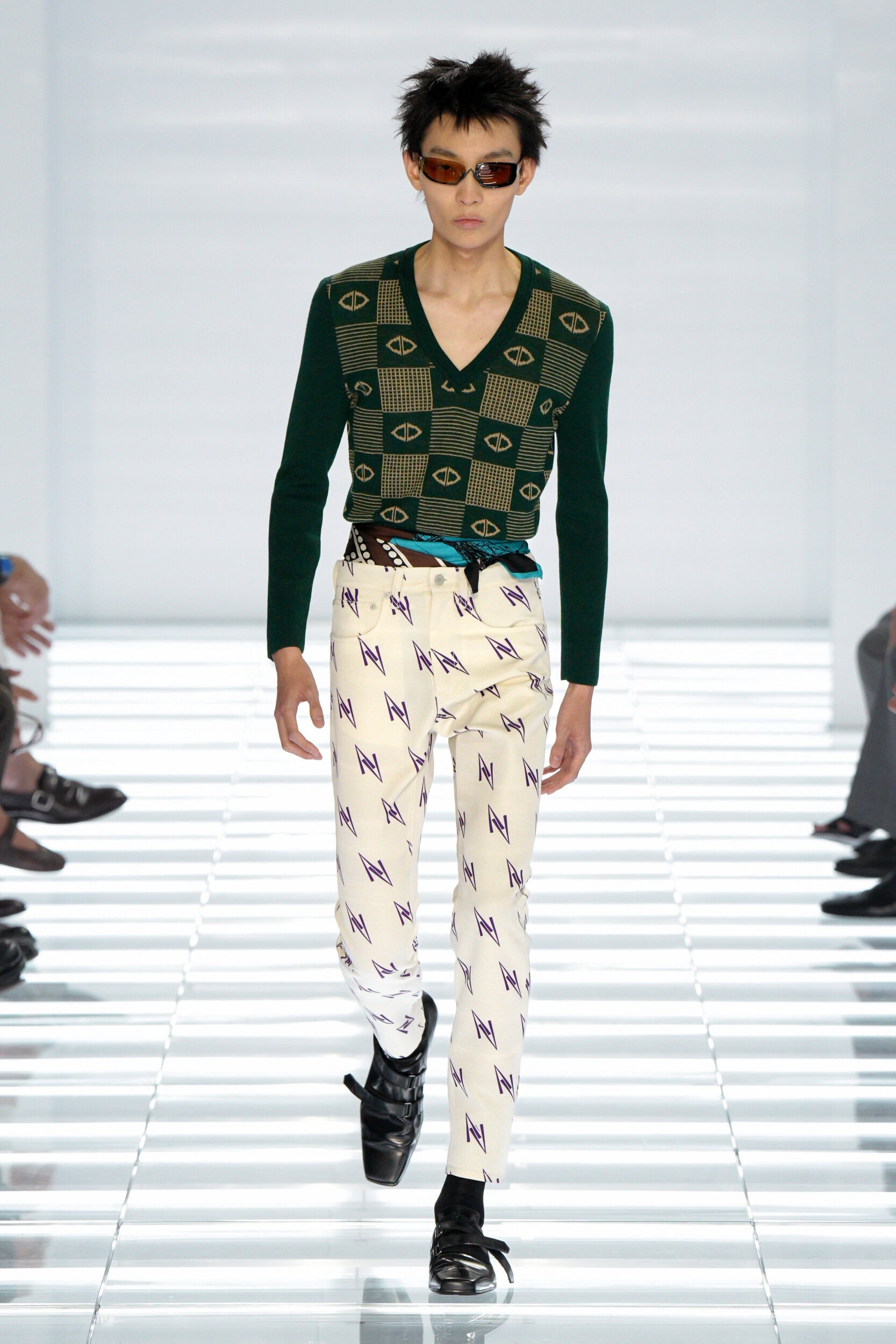
This was not about returning to the days of minimalism, a time that the brand dominated in the 1990s, this was a collection that wanted to refresh the idea of what simplicity can look like, while simultaneously concealing something more meaningful, as the duo said, “Everything looks simple, but it is not.” This also referred to the fact that the technical fabrics used couldn’t heat the wearer, the mixing of leathers, and the industrial print techniques as a point of interest. This balance is key, especially at a time when the perception of luxury products value is constantly in question, both online and off – the customer needs a reason to buy. Having presented the idea of multi-layering for their women’s show last season, where several elements would have to come together to define the final look, Prada noted that for the men’s show, showcasing how the idea could also work in the opposite realm – with ‘universal’ items – also appealed saying “when we started this collection we came from a season where we really pushed the idea of many ideas, many silhouettes, many different things… and this time the only thing we said when we started talking was let’s change it, let’s make it completely different, let’s make it simple…and we came up with the idea that it was the universal object.”
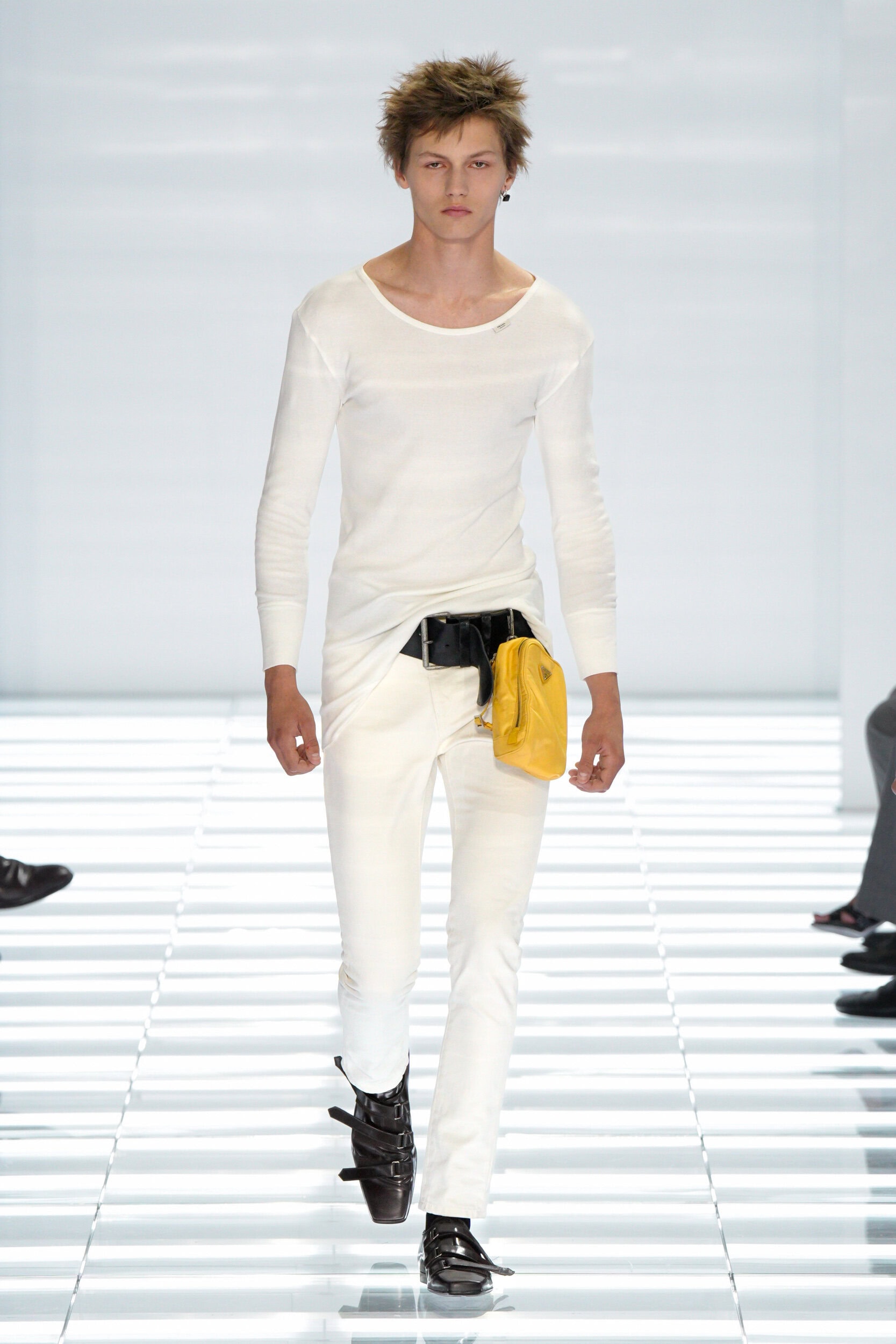
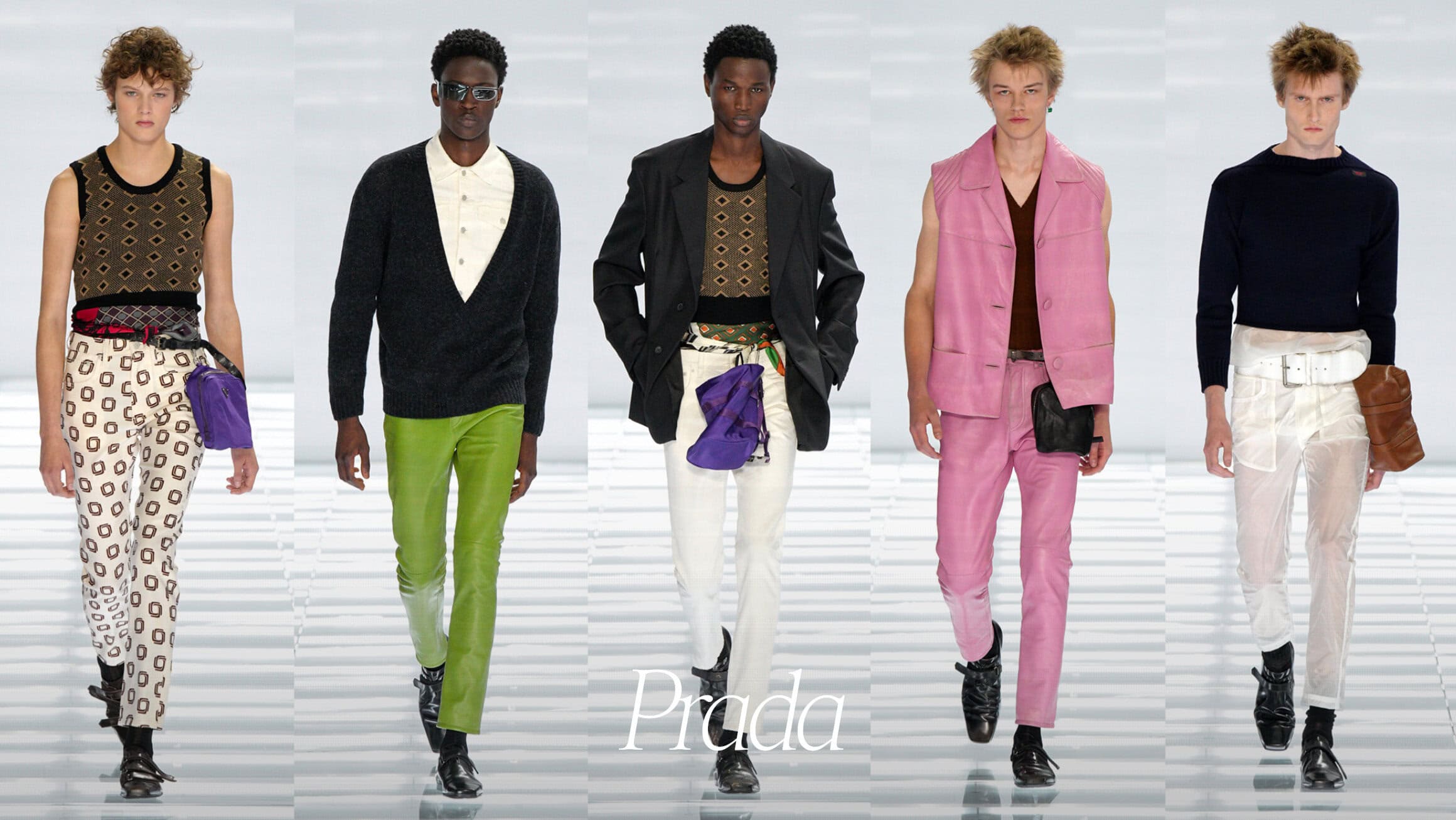
Jeans, of the stovepipe variety, became that universal object, or forever garment that Simons noted “start with garments that are not connected to a moment in time, garments that last forever and people will always want them.” With every model wearing one iteration or another of the straight-cut 1960s silhouette – denim, leather, organza, printed – could this be the start of a seasonal show concept? One where the team zoom in on one aspect of the modern wardrobe, distil it down to its purest form and give us that one item duplicated across different fabrics and finishes? It could be an exciting prospect, especially with the possibility of offering customers the option of customisation via colour, trim, finish and add-on accessories, such as those skinny scarves or nylon utility bags hooked onto belt loops, as the notes said this is an opportunity to create ‘ceaseless possibilities’ to build a custom wardrobe.
As uniform as it appeared, today’s collection actively encouraged individualism, as Simons spoke to “people can be individual with common garments, if you rethink how to wear them, how to combine them, we like the audience to suggest themselves, new ways to combine history.” Today’s notes also reiterated that these garments were to act as a framework, giving the wearer the freedom to rework each look and make it their own. This was a collection for “individual thinkers and like-minded groups” as Simons said, employing trickle-up economics and attempting to break the cycle of the average man on the street being “dictated to by high fashion brands and their high fashion events.”
THE WRAP UP
In the pre-show interview Mrs Prada said “The core of fashion is what you think is right to wear in that moment, and I think that in this sense, this is a very fashionable show, because it’s really what you think is trendy at the moment.”
Prada, the brand, has come to represent an alternative way to look at fashion. Always insistent that the viewer question their own beauty ideals and make room for the ugly, the individual or the unexpected. So, when Prada talks of wearing what is right – to meet the moment – she is also speaking to wearing what is wrong, as she has proved time and again “what you think we are doing wrong, we are selling well.” Prada is often ahead of the curve, so maybe it is not about a return to maximalism (following a period of so-called ‘Quiet Luxury’), maybe it is a march back to minimalism that will come to define this season. Challenging brands to distil down to their fundamental codes and assess whether what’s left reflects fashion in this very moment, when consumers are asking more from the brands they buy into – or is it simply useless design without meaning? When the season closes this question is sure to be answered.