
The Apparel Group Reported Its Strongest Quarter In Three Years As Margin Expansion, Americas Growth, And Early Vans Recovery Supported Its Turnaround Strategy
VF Corp. returned to annual growth in fiscal 2026, signaling further progress in the company’s multiyear turnaround strategy as momentum at The North Face and Timberland helped offset continued pressure at Vans and supported expanding margins across the business.
The company reported fourth-quarter revenue growth of 1 percent year-over-year for the period ended March 28, while revenue excluding Dickies — which VF sold during the third quarter — rose 8 percent, or 3 percent in constant currency, ahead of guidance. It marked the company’s strongest quarterly revenue performance in three years on a constant-currency basis excluding Dickies.

“For the first time in three years, we returned to a full year of growth and expect to keep growing in FY’27,” said Bracken Darrell, President and Chief Executive Officer of VF Corp. “We also significantly expanded margins and reduced our leverage ratio by a full turn versus last year.”
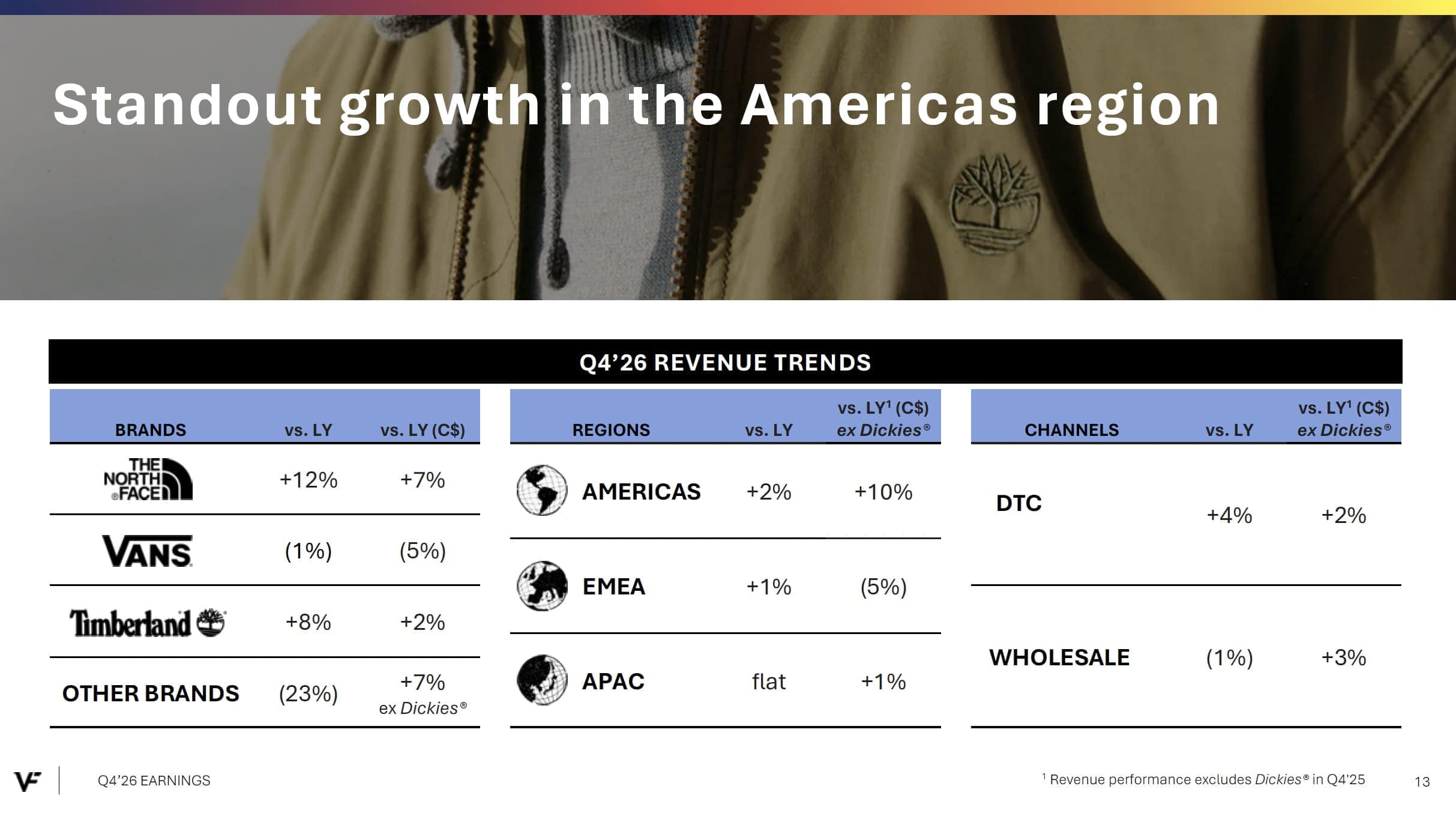
Darrell pointed to accelerating momentum across the portfolio, particularly in the Americas, where fourth-quarter revenue rose 2 percent overall and increased 10 percent in constant currency excluding Dickies — the region’s strongest growth since the first quarter of fiscal 2023.
The North Face remained VF’s strongest-performing brand during the quarter, with revenue rising 12 percent year-over-year, or 7 percent in constant currency. In the Americas, the outdoor label grew 17 percent, reinforcing its position as the company’s primary growth engine.
Timberland also posted solid gains, with quarterly revenue increasing 8 percent year-over-year, while Vans showed early signs of stabilization. Although Vans revenue declined 1 percent overall during the quarter, the brand returned to growth in Americas direct-to-consumer for the first time in more than four years.
Darrell described the Vans performance as evidence that the company’s reset strategy is beginning to gain traction.
“We remain on track to achieve our medium-term targets, an exit run rate of 10 percent operating margin in FY’28 and a leverage ratio of 2.5x or lower by FY’28,” he said.
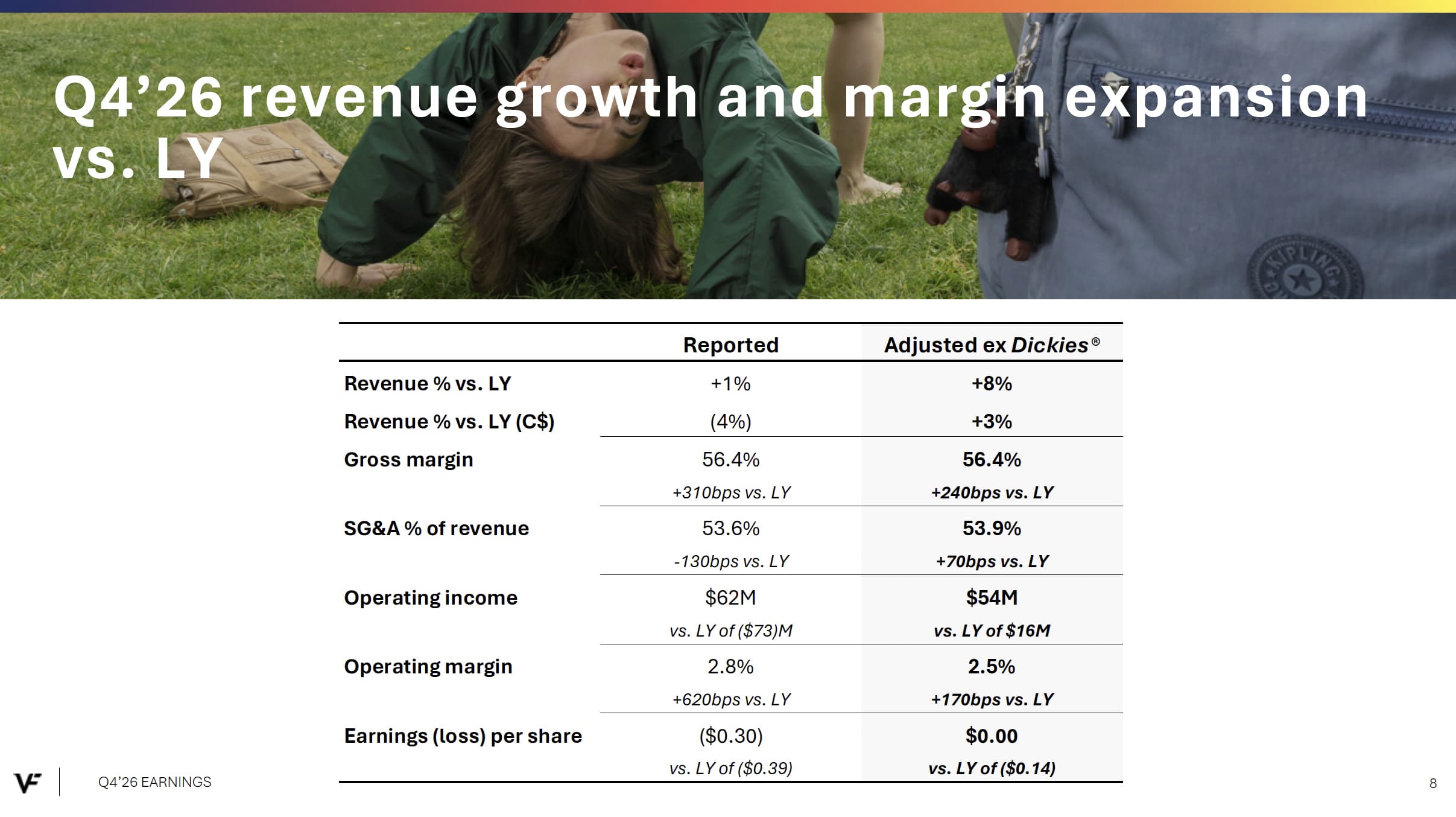
VF also delivered significant profitability improvements during the year. Fourth-quarter operating income reached $62 million, compared with a loss in the prior-year period, while adjusted operating income excluding Dickies totaled $54 million, ahead of company guidance.
For the full fiscal year, operating income reached $577 million, with operating margin expanding 280 basis points to 6 percent. Adjusted operating margin excluding Dickies rose to 7 percent.
Gross margin for the year increased 130 basis points to 54.8 percent, while free cash flow improved by more than $90 million to $405 million.
The company also continued reducing debt and strengthening its balance sheet. VF ended fiscal 2026 with a leverage ratio of 3.1x, down from 4.1x a year earlier and 5.1x at the end of fiscal 2024.
Looking ahead, VF reinstated annual guidance for fiscal 2027, forecasting revenue growth of 1 to 2 percent in constant currency, adjusted operating margin of approximately 8 percent, and further leverage reduction to between 2.6x and 2.9x.
The results suggest VF’s restructuring and operational reset under Darrell are beginning to stabilize the company after several years of declining sales, elevated debt, and brand underperformance. While Vans remains in recovery mode, continued strength at The North Face and improving trends across the Americas are helping reposition the group toward more sustainable growth.