
The Italian House Continued To Focus On Core Categories, Distribution Quality, And Operational Discipline As North America Emerged As A Key Growth Driver
Ferragamo said its three-pillar strategy continued to guide the business in the first quarter of 2026, as the Italian luxury house focused on strengthening direct-to-consumer performance, accelerating momentum in the Americas, and reinforcing its positioning around core product categories.
Speaking during a conference call following the release of first-quarter results, executive board member Ernesto Greco pointed to what he described as three strategic priorities: “value building,” centered on brand identity and product innovation; “elevating route to market,” focused on high-potential regions and channels including the Americas and direct-to-consumer; and “operational efficiency,” tied to governance, cost control, and financial discipline.
“The group will continue to prioritize top-line and distribution quality, while maintaining a strong focus on operational discipline and financial sustainability,” said Greco, who added that April and early May trends were continuing in line with the first quarter.
For the three months ended March 31, revenues declined 5.5 percent to €209 million from €221 million a year earlier. At constant exchange rates, sales were down 1.2 percent.
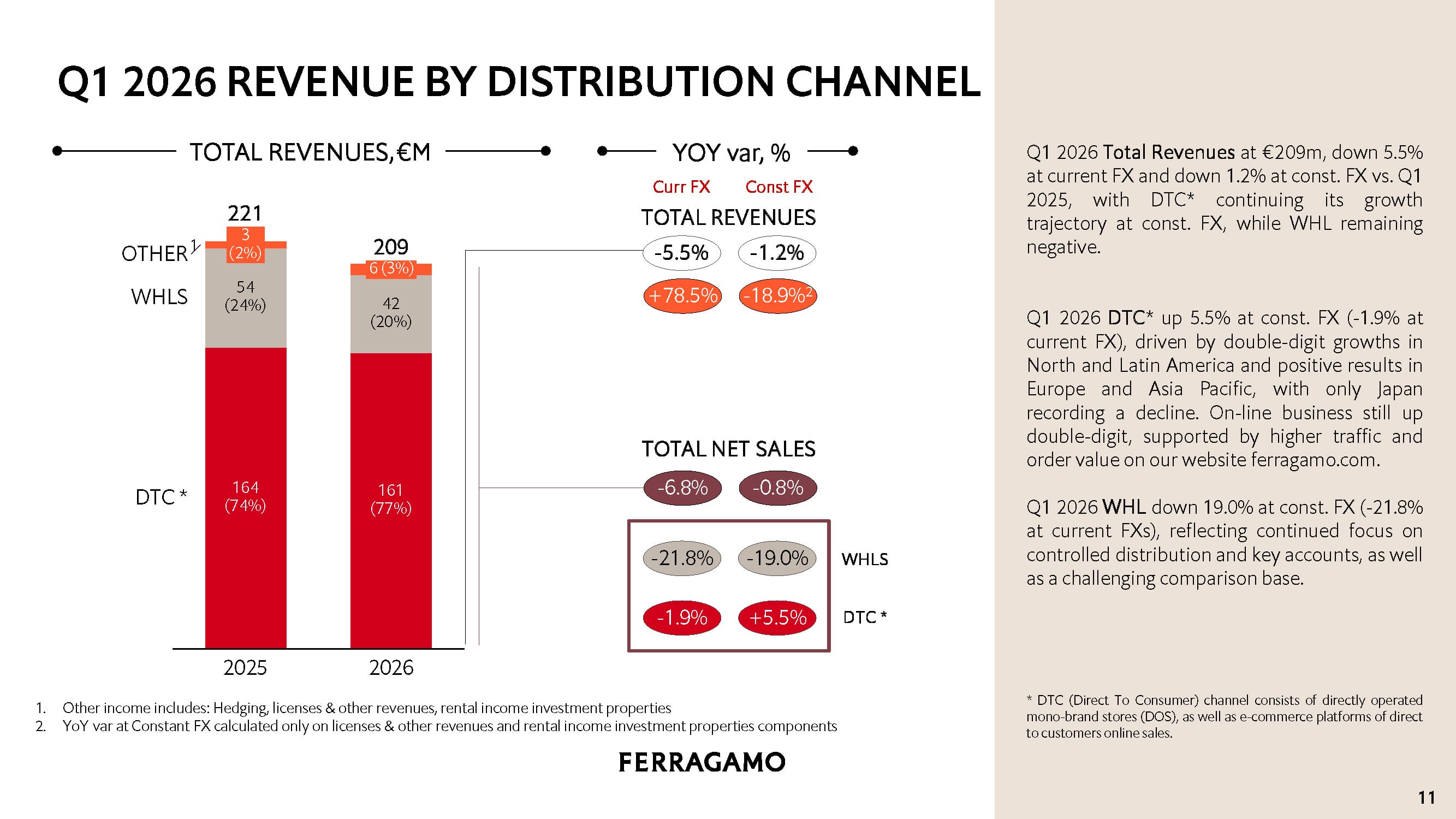
While wholesale continued to weigh on results, Ferragamo said the direct-to-consumer channel maintained positive momentum at constant currency, building on trends established in the fourth quarter of last year. DTC sales declined 1.9 percent to €161 million at reported rates, but increased 5.5 percent at constant currency, driven by double-digit growth in North and Latin America and positive performances in Europe and Asia-Pacific.
Greco emphasized that the company’s strategic focus remains centered on shoes and leather goods, noting that the Hug bag continues to be Ferragamo’s bestselling product. He also highlighted the continued performance of e-commerce, which delivered double-digit growth for the second consecutive year, supported by increased traffic and higher average order values.
“This is not only a commercial indicator and strategic tool but it also reassures us that we are going in the right direction, and we believe it will be reflected in brick-and-mortar,” said Greco.
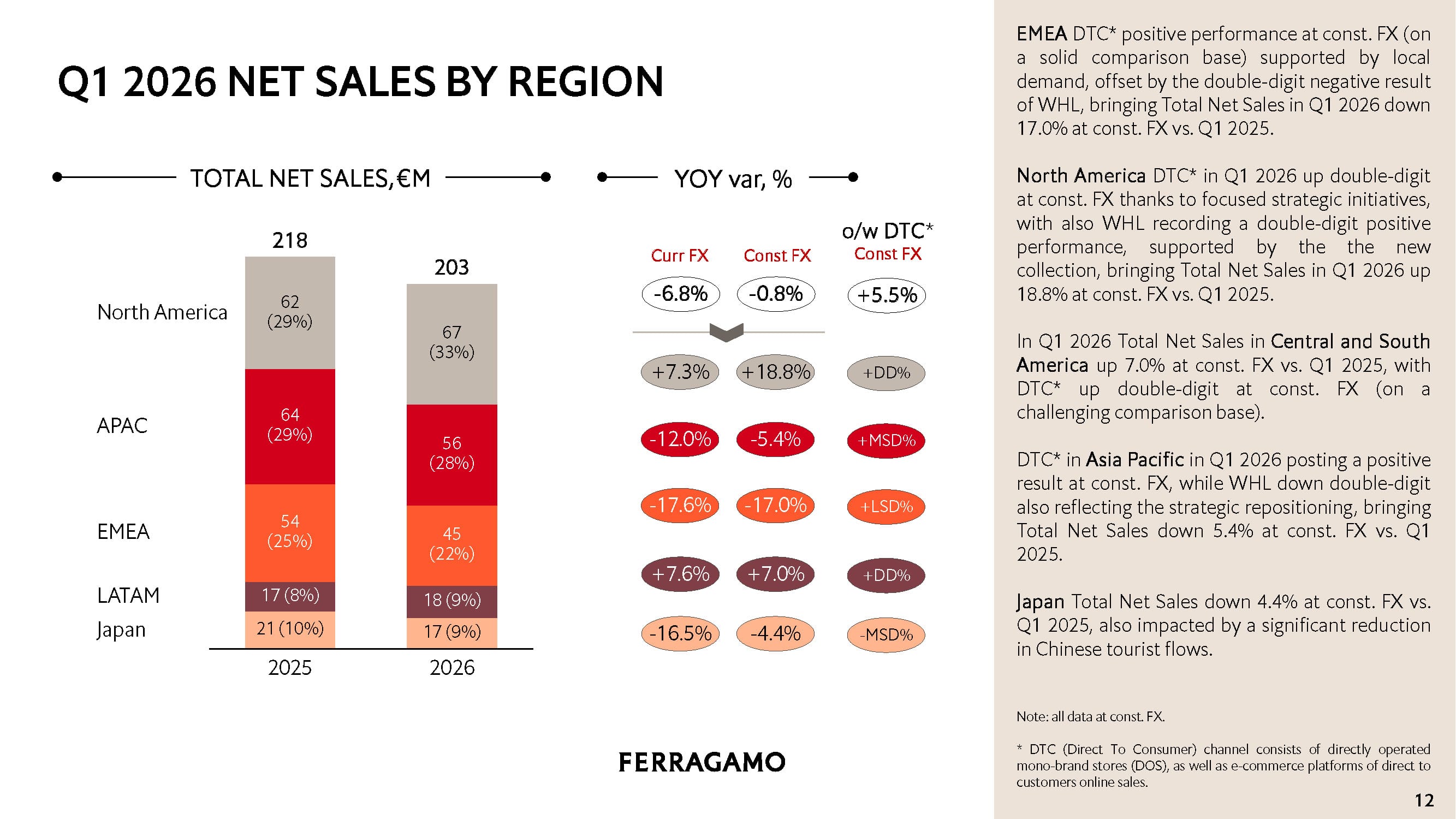
North America emerged as the company’s strongest region during the quarter. Sales rose 7.3 percent to €66.8 million, representing nearly one-third of total revenues. At constant exchange rates, revenues in the market climbed 18.8 percent, supported by double-digit growth across both wholesale and direct-to-consumer channels.
Ferragamo said it is continuing to prioritize the region through customer engagement initiatives, targeted product assortments, and retail investments, including renovations of its Fifth Avenue and Beverly Hills flagships as well as the opening of two temporary stores.
Central and South America also posted growth, with sales rising 7.6 percent to €17.8 million.
By contrast, Asia-Pacific remained under pressure. Revenues in the region fell 12 percent to €56.1 million, or down 5.4 percent at constant exchange rates, while Japan declined 16.5 percent at reported rates amid softer tourist flows from China. Greco acknowledged that China has yet to recover, though Korea and the Americas continued to perform well into April and May.
The wholesale channel declined 21.8 percent to €42 million during the quarter, reflecting Ferragamo’s continued efforts to streamline distribution and focus on what Greco described as “the highest quality stores,” particularly in China. The company has also ended transshipment activities initiated late last year as part of broader efforts to improve distribution discipline and brand positioning.
“We are more aggressive, [which will lead to] seeing good results in 2026,” Greco said of the wholesale clean-up strategy.
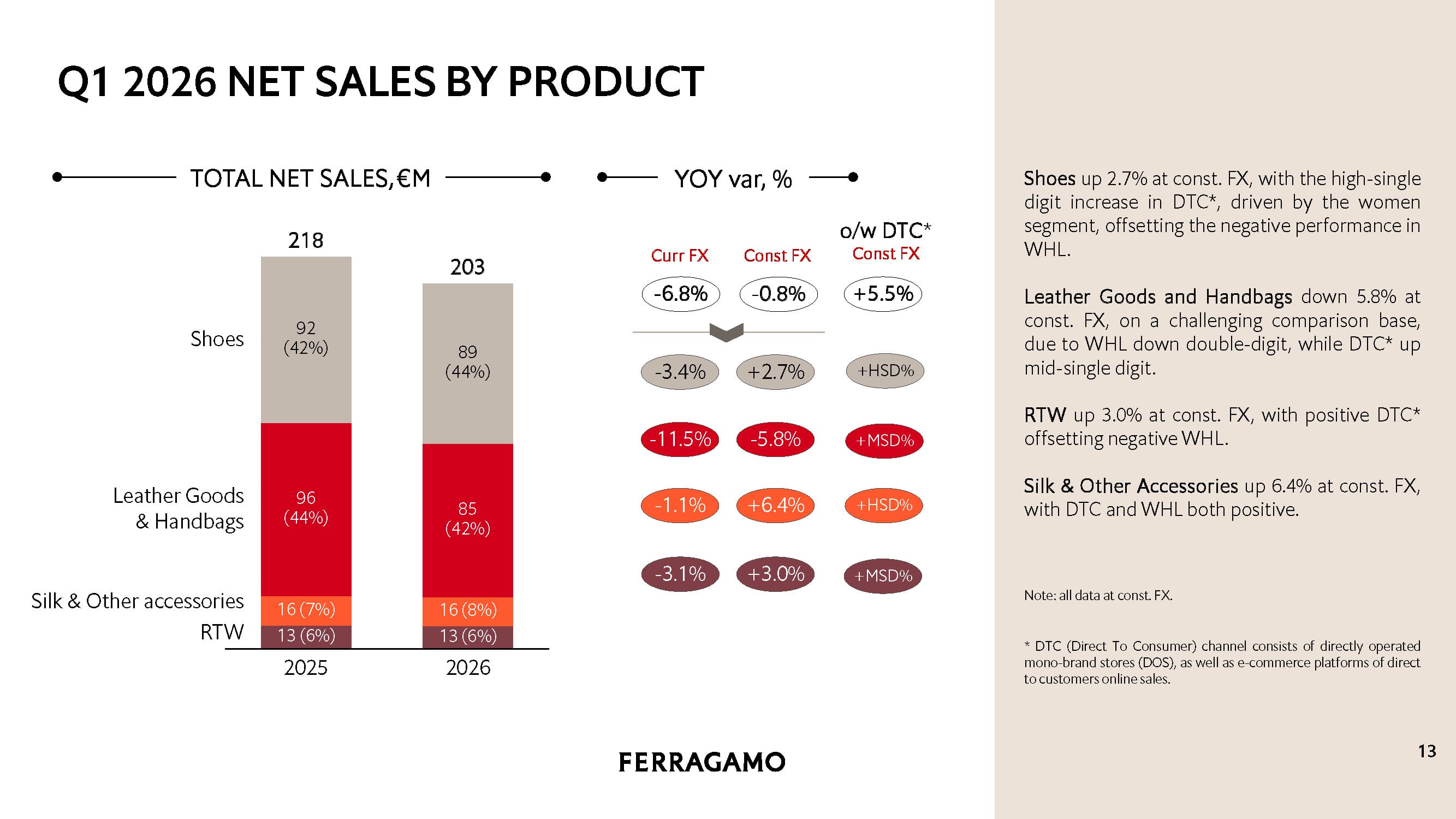
Across categories, footwear sales declined 3.4 percent to €89 million, while leather goods fell 11.5 percent to €85.1 million, though the decline narrowed to 5.8 percent at constant exchange rates. Apparel was down 3.1 percent at reported rates but rose 3 percent at constant currency, while silk increased 6.4 percent at constant exchange rates.
The quarter also reflected ongoing organizational and operational changes under the group’s transitional leadership structure. Greco referenced updates to product assortments, merchandising displays, and localized offerings, alongside broader management changes.
No mention was made during the earnings call regarding the appointment of a new chief executive officer.
The company remains under the direction of executive chairman Leonardo Ferragamo following the departure of former CEO Marco Gobbetti in March. Leadership responsibilities are currently shared with a transitional advisory committee including James Ferragamo, chief transformation and sustainability officer; Greco; and former CEO Michele Norsa, who now serves as special chairman adviser.
Last month, Ferragamo Finanziaria appointed former Estée Lauder Companies chief executive Fabrizio Freda as special strategic adviser. Freda has been tasked with supporting strategic decisions, including the selection of Ferragamo’s future CEO and the strengthening of the group’s broader operations and family-controlled businesses.