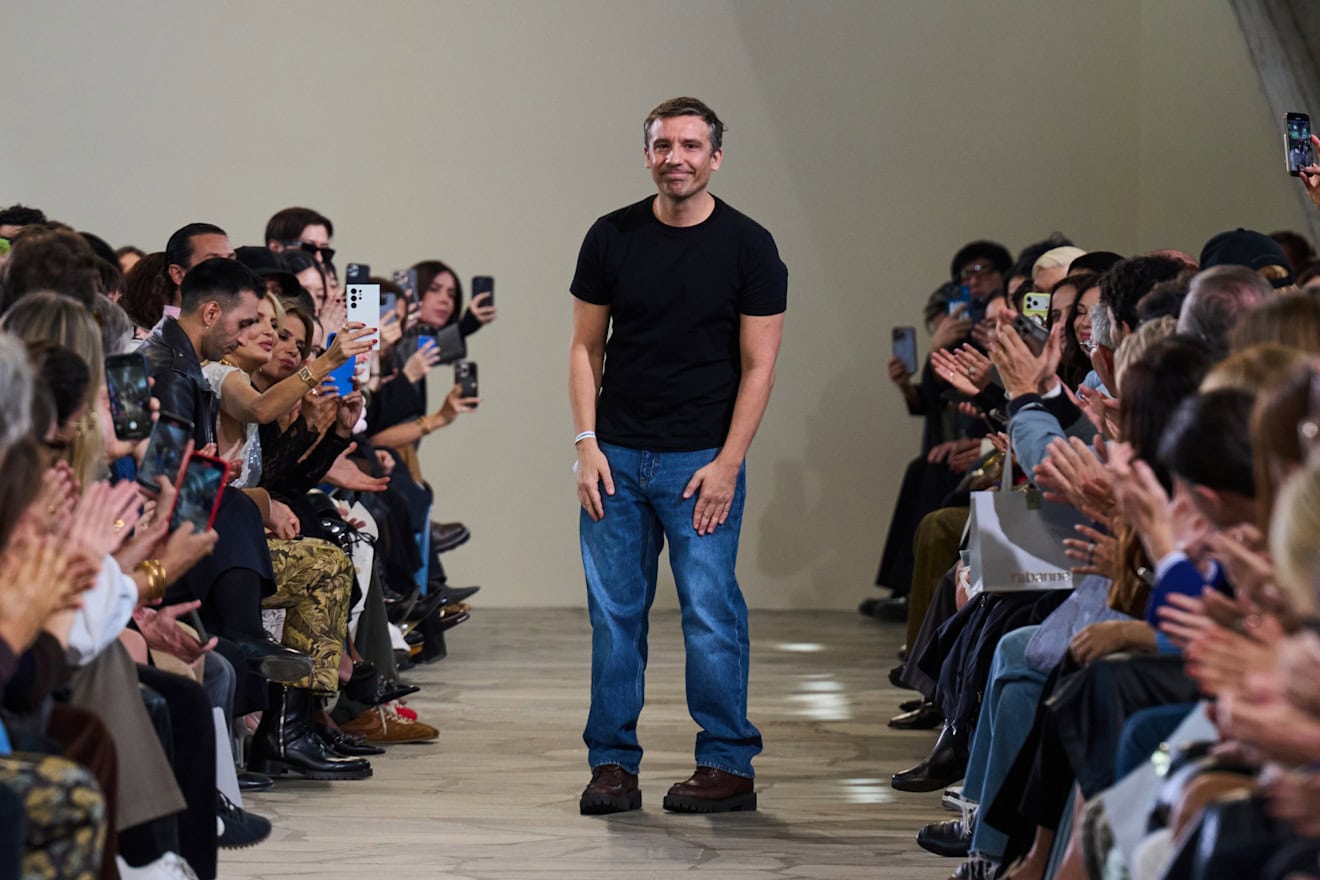
The designer leaves after a 13-year tenure that recast the Puig-owned house for a new generation
Key Takeaways
- The departure comes amid a broader cycle of creative turnover across European luxury houses.
- Julien Dossena is leaving Rabanne after 13 years as creative director.
- Rabanne said a successor will be announced in due time.
- His tenure helped translate the house’s Space Age codes into a contemporary fashion language.
Julien Dossena is leaving Rabanne after 13 years as creative director, closing one of the more sustained creative chapters in contemporary Paris fashion.
The Puig-owned house announced the departure on Wednesday and said a successor will be named in due time. The move comes as Rabanne continues to build on a period of renewed visibility, sharpened brand identity, and closer alignment between its fashion and fragrance businesses.
Dossena joined Paco Rabanne in 2013 and was promoted to creative director later that year, taking on a house with one of fashion’s most distinctive archives. Founded by Paco Rabanne in 1966, the brand was built around Space Age experimentation, including metal mesh, chain links, disc embellishment, and unconventional materials. Dossena’s work brought those codes into a more wearable contemporary vocabulary, balancing the house’s futuristic heritage with daywear, party dressing, and a culturally fluent sense of glamour.
During his tenure, Rabanne gained new relevance with a generation of celebrity clients and image-makers. Sabrina Carpenter, Dua Lipa, Miley Cyrus, and Beyoncé Knowles-Carter have all helped place the house’s metallic, high-shine language in the global pop-cultural conversation. The brand’s visual signatures — silver and gold surfaces, chain-mail constructions, and sculptural embellishment — became central across fashion, accessories, and beauty.
Dossena’s exit also follows a broader repositioning of the house under Puig. In 2023, the company shortened Paco Rabanne to Rabanne, a move designed to unify fashion and fragrance while supporting a wider push toward feminization and elevation. Fragrance remains a major engine for the brand, with global businesses built around scents including 1 Million, Invictus, Black XS, and Phantom.
For Puig, Rabanne occupies a valuable position within its portfolio: a house with strong fragrance equity, recognizable visual codes, and a fashion business capable of generating cultural heat beyond runway visibility. Dossena’s tenure helped stabilize and define that proposition after the brand’s ready-to-wear relaunch in 2011, following an earlier pause in fashion activity.
A graduate of La Cambre in Brussels, Dossena began his career at Balenciaga, where he worked in the studio under Nicolas Ghesquière from 2008 to 2012. He later joined Paco Rabanne under Lydia Maurer and briefly developed his own label, Atto, before focusing fully on Rabanne.
His final work for the house was an eveningwear capsule and resort collection shown to press earlier this month. His next move has yet to be announced.
The departure adds Rabanne to the growing list of European fashion houses navigating creative transition. With Dossena’s exit, Puig now faces the task of choosing a successor who can preserve the house’s highly recognizable codes while expanding its fashion authority at a time when brand clarity, cultural visibility, and commercial discipline are increasingly inseparable.