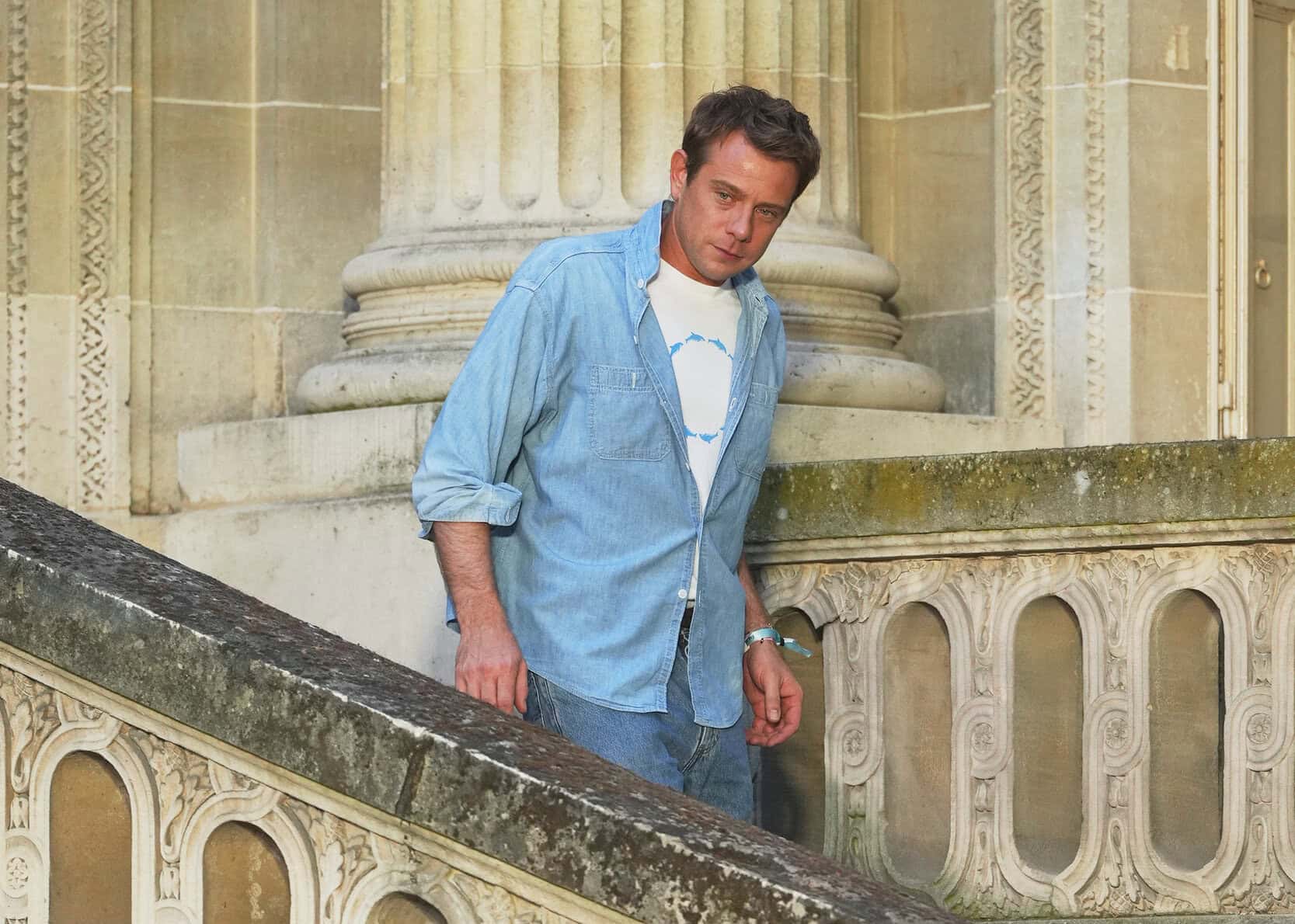
The British producer’s bespoke mix for the Paris runway wasn’t an ambient backdrop. It was the collection’s operating logic
Jonathan Anderson’s Spring/Summer 2027 menswear show for Dior opened in near-silence. The first model walked into the grand halls of the Musée Nissim de Camondo in Paris, found the speakers, and plugged in. What followed was seventeen minutes of high-BPM electronic music that didn’t merely accompany sixty-six looks; it explained them. The producer behind it was Fred Again, born Fred Gibson, and his involvement in the show ran considerably deeper than a playlist.
Anderson commissioned Fred Again to build a bespoke mix for the collection, drawing on contributions from KETTAMA and KTNA, Latin Mafia, Headie One, Young Thug, Mabe Fratti, Jamie T, and Jhené Aiko, with original vocals contributed by Christine and the Queens. The mix was sequenced to mirror the collection’s own movement: an opening of deconstructed suits in translucent silk chiffon gave way to sequined jeans, disco-ball boots, and embellished ripped denim as the beats escalated. At the 9:20 mark, an unreleased Fred Again production built around a Young Thug vocal and a sample of Jhené Aiko arrived at what Runway Magazine described as the apex of the remix, landing precisely as a continuous field of sequins created black and white polka dots on the runway. By 12:19, Headie One’s “Told” in instrumental form grounded the collection back into something more structural, as Japanese denim shirts patchworked with pulled and re-stitched threads gave way to silver thread embroidery transposing scrolls, leaves, and shells from a gentleman’s coat circa 1775 onto contemporary garments. A cello-driven passage built around an unreleased sample of Mabe Fratti’s “Todo Lo Que Querías Saber” offered a melodic pause before the final sequence. Anderson told the press backstage that Fred Again “came up with brand-new music for the show and remixed it and re-recorded it,” a process that mirrored his own approach to the archive with notable precision.
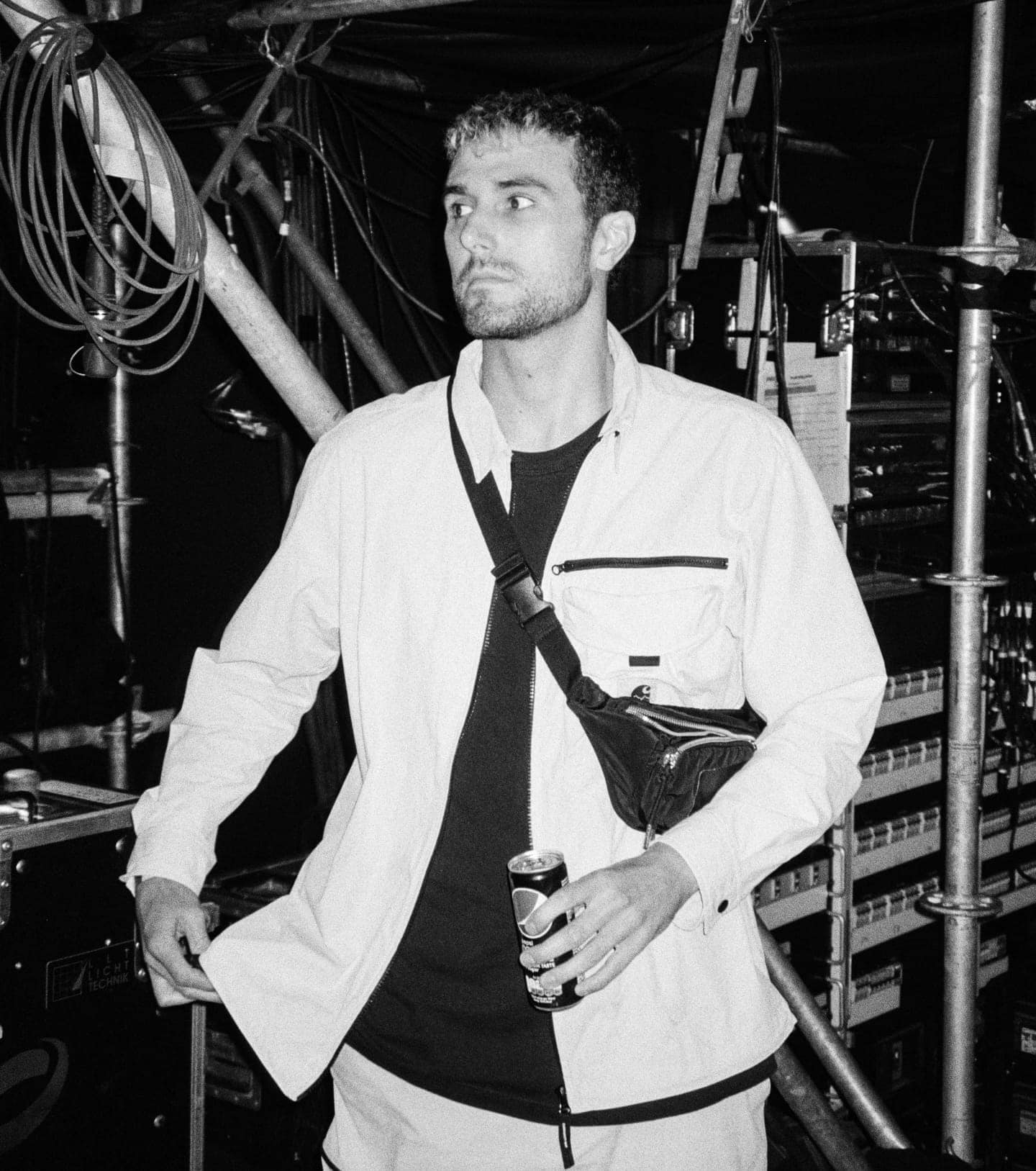
Fred Again’s rise to cultural prominence is inseparable from the methodology Anderson borrowed. Born in south London in 1994, Gibson spent the early part of his career as a behind-the-scenes producer of considerable commercial reach, accumulating credits with Ed Sheeran, Stormzy, Charli XCX, and FKA Twigs and becoming the youngest ever recipient of the Brit Awards’ Producer of the Year in 2020. His solo profile, however, remained limited until the release of the Actual Life trilogy: three mixtapes documenting the years 2020 to 2022 through a process of sampling voicemails, voice notes from friends, ambient pub recordings, and social media clips sourced from Instagram and TikTok. Gibson describes his approach as making art out of “the actual experience,” collecting fragments of other people’s moments and processing them, sometimes over months, through Logic Pro until spoken words become melodic hooks and background noise becomes rhythm. Brian Eno, who has served as Gibson’s mentor since his teenage years, described the result as something genuinely unfamiliar: music that operates in relation to a community rather than in commentary on it.
The Actual Life series became the defining sound of a generation that came of age during the pandemic, reaching audiences for whom the dancefloor and the voice note existed on the same continuum. Fred Again’s hold on Gen Z is rooted in a specific formal decision: by naming tracks after the people sampled, “Marea (we’ve lost dancing),” “Julia (Deep Diving),” “Danielle (smile on my face),” he turned production credits into emotional acknowledgement, making listeners feel not just heard but honored. His sets, which routinely sell out arenas and festival main stages, retain the intimacy of that gesture at scale, and his cross-genre fluency, moving between house, UK garage, drill, ambient, and electronica within a single performance, gives him a cultural reach that few electronic artists have sustained.
The parallels with Anderson are more than formal. Both artists operate as accumulators rather than originators, treating existing material as raw input to be displaced and rebuilt rather than referenced and replicated. Anderson described his own show notes as positioning the collection around making the “familiar transformed and the subtle, magnified,” language that maps directly onto Gibson’s stated approach to sampling: “I only use things that fundamentally jump out as something pure or honest.” Where Fred Again builds tracks by reworking voices found in the world, Anderson builds garments by reworking codes found in the archive. A silk shirt carried embroidery based on a trompe l’oeil scarf motif from the 1979 Dior haute couture. Footwear artisans replicated 19th-century embroidery by hand on a classic suede lace-up. The tuxedo, the show’s protagonist, was reimagined in organza-like fabric printed to appear like tailored wool, its formal identity preserved while its material logic was replaced entirely.
Anderson also noted rave culture as the social force underpinning both the collaboration and the collection’s energy. “Rave culture is starting back up again,” he told the press. “You see it in the suburbs. You see it outside the city. They’re mixing things. They’re playing.” Fred Again represents the current apex of that culture’s creative output: a producer who turned pandemic-era isolation into club music and club music into arena events, without sacrificing the intimacy that made either meaningful. Bringing him into the Musée Nissim de Camondo, a turn-of-the-century house built to mimic 18th-century architecture and currently closed for restoration, was itself a curatorial argument. Anderson described the pairing as “juxtaposing the historic and the contemporary and bringing Fred Again’s music into this typically quiet place.” The venue’s condition, mid-restoration and slightly undone, was the point.